

Soft Degrees of Freedom, Gibbons–Hawking Contribution and Entropy from. . .
379
F C (β, μ) = F I (β, μ) + F I I (β, 0) − F I I I (β, 0) − F I V (β, 0).
(40)
The zero mode will then only give the Gibbons–Hawking contribution
F
0
C (β, μ) = −
A
2d
μ
2 .
(41)
Non-zero modes, both those at k 3 = 0 and those of the additional scalar, will not
contribute to the μ dependent part. As usual, one separates the zero temperature
contribution from the thermal one,
F
C (β) = F
C (∞) + F
C (β).
(42)
In the limit of large plate area A and large L z , the former is the standard zero
temperature Casimir energy that may be computed from the zero point energies.
Between the plates, one finds
F
I (∞) =
¯
h
2
A
(2π) 2
d
2 k
⎡
⎣
k a k a + 2
∞
n=1
k a k a +
π 2 n 2
d
⎤
⎦ ,
(43)
while
F
I I (∞) − F
I I I (∞) − F
I V (∞) = −d
¯
h
2
A
(2π) 2
d
2 k
+∞
−∞
dk z
2π
k a k a + k 2
z
.
(44)
After a suitable cut-off regularization and with the help of the Euler–Maclaurin
formula, one then finds
F
C (∞) = −
Aπ 2 ¯
h
720d 3 .
(45)
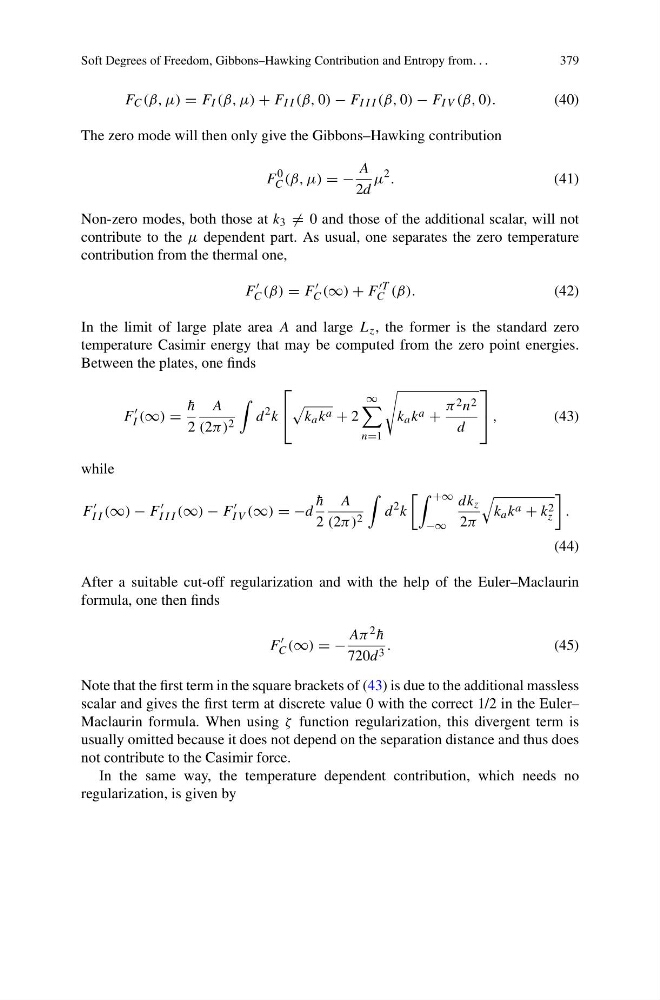
Note that the first term in the square brackets of (43) is due to the additional massless
scalar and gives the first term at discrete value 0 with the correct 1/2 in the Euler–
Maclaurin formula. When using ζ function regularization, this divergent term is
usually omitted because it does not depend on the separation distance and thus does
not contribute to the Casimir force.
In the same way, the temperature dependent contribution, which needs no
regularization, is given by
379
F C (β, μ) = F I (β, μ) + F I I (β, 0) − F I I I (β, 0) − F I V (β, 0).
(40)
The zero mode will then only give the Gibbons–Hawking contribution
F
0
C (β, μ) = −
A
2d
μ
2 .
(41)
Non-zero modes, both those at k 3 = 0 and those of the additional scalar, will not
contribute to the μ dependent part. As usual, one separates the zero temperature
contribution from the thermal one,
F
C (β) = F
C (∞) + F
C (β).
(42)
In the limit of large plate area A and large L z , the former is the standard zero
temperature Casimir energy that may be computed from the zero point energies.
Between the plates, one finds
F
I (∞) =
¯
h
2
A
(2π) 2
d
2 k
⎡
⎣
k a k a + 2
∞
n=1
k a k a +
π 2 n 2
d
⎤
⎦ ,
(43)
while
F
I I (∞) − F
I I I (∞) − F
I V (∞) = −d
¯
h
2
A
(2π) 2
d
2 k
+∞
−∞
dk z
2π
k a k a + k 2
z
.
(44)
After a suitable cut-off regularization and with the help of the Euler–Maclaurin
formula, one then finds
F
C (∞) = −
Aπ 2 ¯
h
720d 3 .
(45)
Note that the first term in the square brackets of (43) is due to the additional massless
scalar and gives the first term at discrete value 0 with the correct 1/2 in the Euler–
Maclaurin formula. When using ζ function regularization, this divergent term is
usually omitted because it does not depend on the separation distance and thus does
not contribute to the Casimir force.
In the same way, the temperature dependent contribution, which needs no
regularization, is given by