

Soft Degrees of Freedom, Gibbons–Hawking Contribution and Entropy from. . .
381
A 0 (x) =
1
(2π) 3/2
d 3 k
2ω(
k)
a 0 (
k, t)e
i
k·· x
+ c.c.
,
(52)
A i (x) =
1
(2π) 3/2
d 3 k
2ω(
k)
a m (
k, t)e
m
i (
k)e
i
k·· x
+ c.c.
,
(53)
where ω(
k) = |
k| = k, the polarization vectors are e 3
i = k i /ω(
k), and k i e a
i =
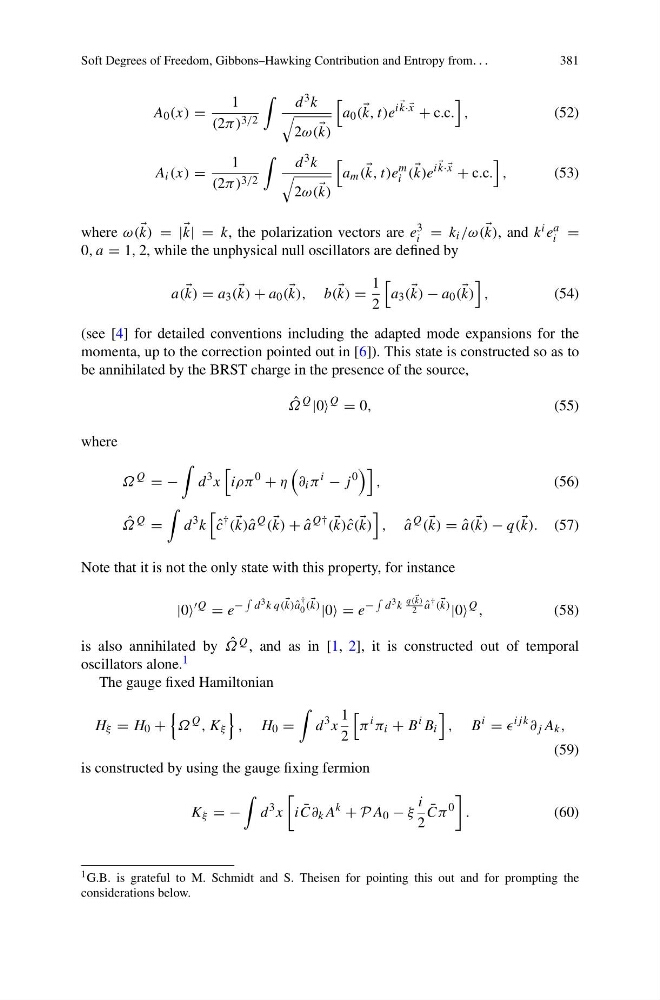
0, a = 1, 2, while the unphysical null oscillators are defined by
a(
k) = a 3 (
k) + a 0 (
k), b(
k) =
1
2
a 3 (
k) − a 0 (
k)
,
(54)
(see [4] for detailed conventions including the adapted mode expansions for the
momenta, up to the correction pointed out in [6]). This state is constructed so as to
be annihilated by the BRST charge in the presence of the source,
ˆ
Ω
Q
|0
Q
= 0,
(55)
where
Ω
Q
= −
d
3 x
iρπ
0
+ η
∂ i π
i
− j
0
,
(56)
ˆ
Ω
Q
=
d
3 k
ˆ
c
† (
k) ˆ
a
Q (
k) + ˆ
a
Q† (
k) ˆ
c(
k)
, ˆ
a
Q (
k) = ˆ
a(
k) − q(
k). (57)
Note that it is not the only state with this property, for instance
|0
= e
−
d 3 k q(
k) ˆ
a
†
0 (
k)
|0 = e
−
d 3 k
q(
k)
2 ˆ
a † (
k)
|0
Q ,
(58)
is also annihilated by ˆ
Ω Q , and as in [1, 2], it is constructed out of temporal
oscillators alone. 1
The gauge fixed Hamiltonian
H ξ = H 0 +
Ω
Q , K ξ
, H 0 =
d
3 x
1
2
π
i π i + B
i B i
, B
i
=
ij k ∂ j A k ,
(59)
is constructed by using the gauge fixing fermion
K ξ = −
d
3 x
i ¯
C∂ k A
k
+ PA 0 − ξ
i
2
¯
Cπ
0
.
(60)
1 G.B. is grateful to M. Schmidt and S. Theisen for pointing this out and for prompting the
considerations below.
381
A 0 (x) =
1
(2π) 3/2
d 3 k
2ω(
k)
a 0 (
k, t)e
i
k·· x
+ c.c.
,
(52)
A i (x) =
1
(2π) 3/2
d 3 k
2ω(
k)
a m (
k, t)e
m
i (
k)e
i
k·· x
+ c.c.
,
(53)
where ω(
k) = |
k| = k, the polarization vectors are e 3
i = k i /ω(
k), and k i e a
i =
0, a = 1, 2, while the unphysical null oscillators are defined by
a(
k) = a 3 (
k) + a 0 (
k), b(
k) =
1
2
a 3 (
k) − a 0 (
k)
,
(54)
(see [4] for detailed conventions including the adapted mode expansions for the
momenta, up to the correction pointed out in [6]). This state is constructed so as to
be annihilated by the BRST charge in the presence of the source,
ˆ
Ω
Q
|0
Q
= 0,
(55)
where
Ω
Q
= −
d
3 x
iρπ
0
+ η
∂ i π
i
− j
0
,
(56)
ˆ
Ω
Q
=
d
3 k
ˆ
c
† (
k) ˆ
a
Q (
k) + ˆ
a
Q† (
k) ˆ
c(
k)
, ˆ
a
Q (
k) = ˆ
a(
k) − q(
k). (57)
Note that it is not the only state with this property, for instance
|0
= e
−
d 3 k q(
k) ˆ
a
†
0 (
k)
|0 = e
−
d 3 k
q(
k)
2 ˆ
a † (
k)
|0
Q ,
(58)
is also annihilated by ˆ
Ω Q , and as in [1, 2], it is constructed out of temporal
oscillators alone. 1
The gauge fixed Hamiltonian
H ξ = H 0 +
Ω
Q , K ξ
, H 0 =
d
3 x
1
2
π
i π i + B
i B i
, B
i
=
ij k ∂ j A k ,
(59)
is constructed by using the gauge fixing fermion
K ξ = −
d
3 x
i ¯
C∂ k A
k
+ PA 0 − ξ
i
2
¯
Cπ
0
.
(60)
1 G.B. is grateful to M. Schmidt and S. Theisen for pointing this out and for prompting the
considerations below.