

Interplay of Coulomb Repulsion and Spin–Orbit Coupling in Superconducting. . .
363
a
b
c
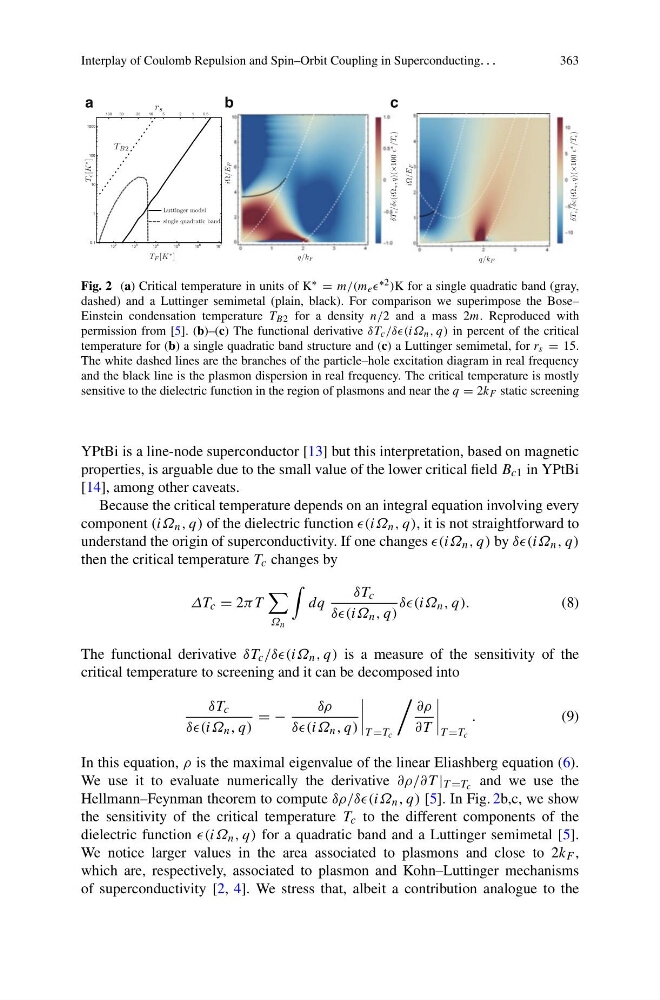
Fig. 2 (a) Critical temperature in units of K ∗ = m/(m e ∗2 )K for a single quadratic band (gray,
dashed) and a Luttinger semimetal (plain, black). For comparison we superimpose the Bose–
Einstein condensation temperature T B2 for a density n/2 and a mass 2m. Reproduced with
permission from [5]. (b)–(c) The functional derivative δT c /δδ(iΩ n , q) in percent of the critical
temperature for (b) a single quadratic band structure and (c) a Luttinger semimetal, for r s = 15.
The white dashed lines are the branches of the particle–hole excitation diagram in real frequency
and the black line is the plasmon dispersion in real frequency. The critical temperature is mostly
sensitive to the dielectric function in the region of plasmons and near the q = 2k F static screening
YPtBi is a line-node superconductor [13] but this interpretation, based on magnetic
properties, is arguable due to the small value of the lower critical field B c1 in YPtBi
[14], among other caveats.
Because the critical temperature depends on an integral equation involving every
component (iΩ n , q) of the dielectric function (iΩ n , q), it is not straightforward to
understand the origin of superconductivity. If one changes (iΩ n , q) by δδ(iΩ n , q)
then the critical temperature T c changes by
ΔT c = 2πT
Ω n
dq
δT c
δδ(iΩ n , q)
δδ(iΩ n , q).
(8)
The functional derivative δT c /δδ(iΩ n , q) is a measure of the sensitivity of the
critical temperature to screening and it can be decomposed into
δT c
δδ(iΩ n , q)
= −
δρ
δδ(iΩ n , q)
T =T c
∂ρ
∂T
T =T c
.
(9)
In this equation, ρ is the maximal eigenvalue of the linear Eliashberg equation (6).
We use it to evaluate numerically the derivative ∂ρ/∂T | T =T c and we use the
Hellmann–Feynman theorem to compute δρ/δδ(iΩ n , q) [5]. In Fig. 2b,c, we show
the sensitivity of the critical temperature T c to the different components of the
dielectric function (iΩ n , q) for a quadratic band and a Luttinger semimetal [5].
We notice larger values in the area associated to plasmons and close to 2k F ,
which are, respectively, associated to plasmon and Kohn–Luttinger mechanisms
of superconductivity [2, 4]. We stress that, albeit a contribution analogue to the
363
a
b
c
Fig. 2 (a) Critical temperature in units of K ∗ = m/(m e ∗2 )K for a single quadratic band (gray,
dashed) and a Luttinger semimetal (plain, black). For comparison we superimpose the Bose–
Einstein condensation temperature T B2 for a density n/2 and a mass 2m. Reproduced with
permission from [5]. (b)–(c) The functional derivative δT c /δδ(iΩ n , q) in percent of the critical
temperature for (b) a single quadratic band structure and (c) a Luttinger semimetal, for r s = 15.
The white dashed lines are the branches of the particle–hole excitation diagram in real frequency
and the black line is the plasmon dispersion in real frequency. The critical temperature is mostly
sensitive to the dielectric function in the region of plasmons and near the q = 2k F static screening
YPtBi is a line-node superconductor [13] but this interpretation, based on magnetic
properties, is arguable due to the small value of the lower critical field B c1 in YPtBi
[14], among other caveats.
Because the critical temperature depends on an integral equation involving every
component (iΩ n , q) of the dielectric function (iΩ n , q), it is not straightforward to
understand the origin of superconductivity. If one changes (iΩ n , q) by δδ(iΩ n , q)
then the critical temperature T c changes by
ΔT c = 2πT
Ω n
dq
δT c
δδ(iΩ n , q)
δδ(iΩ n , q).
(8)
The functional derivative δT c /δδ(iΩ n , q) is a measure of the sensitivity of the
critical temperature to screening and it can be decomposed into
δT c
δδ(iΩ n , q)
= −
δρ
δδ(iΩ n , q)
T =T c
∂ρ
∂T
T =T c
.
(9)
In this equation, ρ is the maximal eigenvalue of the linear Eliashberg equation (6).
We use it to evaluate numerically the derivative ∂ρ/∂T | T =T c and we use the
Hellmann–Feynman theorem to compute δρ/δδ(iΩ n , q) [5]. In Fig. 2b,c, we show
the sensitivity of the critical temperature T c to the different components of the
dielectric function (iΩ n , q) for a quadratic band and a Luttinger semimetal [5].
We notice larger values in the area associated to plasmons and close to 2k F ,
which are, respectively, associated to plasmon and Kohn–Luttinger mechanisms
of superconductivity [2, 4]. We stress that, albeit a contribution analogue to the