

364
S. Tchoumakov et al.
Kohn–Luttinger mechanism, the dynamical screening is central in the present
mechanism of superconductivity and we do not expect s−wave pairing for a static
interaction [4].
4 Pairing Beyond s−Wave from Spin–Orbit Coupling
In Luttinger semimetals, the quasiparticles are described with j = 3/2 multiplets
instead of spin-1/2 as in ordinary metals. The rotational symmetry of Eqs. (3–4)
allows to describe Cooper pairs by a gap function Δ J,LS (iω n , k) with a well-defined
total angular momentum J that combines the pseudo-spin S of the Cooper pair
and its orbital angular momentum L [15, 16]. At the critical temperature, these gap
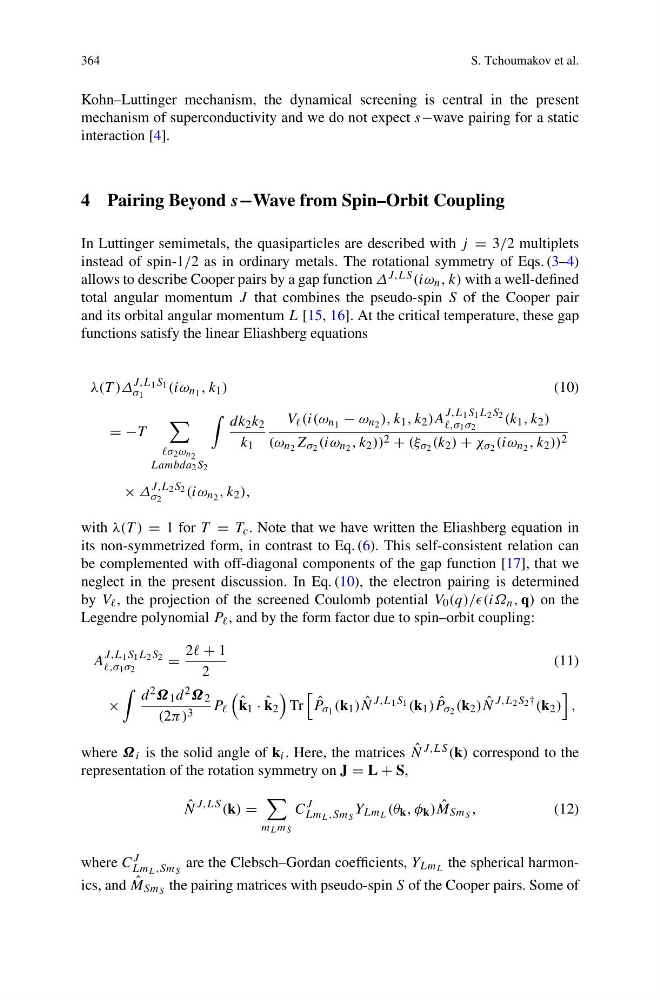
functions satisfy the linear Eliashberg equations
λ(T )Δ
J,L 1 S 1
σ 1
(iω n 1 , k 1 )
(10)
= −T
2 ω n 2
Lambda 2 S 2
dk 2 k 2
k 1
V (i(ω n 1 − ω n 2 ), k 1 , k 2 )A
J,L 1 S 1 L 2 S 2
1 σ 2
(k 1 , k 2 )
(ω n 2 Z σ 2 (iω n 2 , k 2 )) 2 + (ξ σ 2 (k 2 ) + χ σ 2 (iω n 2 , k 2 )) 2
× Δ
J,L 2 S 2
σ 2
(iω n 2 , k 2 ),
with λ(T ) = 1 for T = T c . Note that we have written the Eliashberg equation in
its non-symmetrized form, in contrast to Eq. (6). This self-consistent relation can
be complemented with off-diagonal components of the gap function [17], that we
neglect in the present discussion. In Eq. (10), the electron pairing is determined
by V , the projection of the screened Coulomb potential V 0 (q)//(iΩ n , q) on the
Legendre polynomial P , and by the form factor due to spin–orbit coupling:
A
J,L 1 S 1 L 2 S 2
1 σ 2
=
2 + 1
2
(11)
×
d 2 Ω 1 d 2 Ω 2
(2π) 3 P
ˆ
k 1 · ˆ
k 2
Tr
ˆ
P σ 1 (k 1 ) ˆ
N
J,L 1 S 1 (k 1 ) ˆ
P σ 2 (k 2 ) ˆ
N
J,L 2 S 2 † (k 2 )
,
where Ω i is the solid angle of k i . Here, the matrices ˆ
N J,LS (k) correspond to the
representation of the rotation symmetry on J = L + S,
ˆ
N
J,LS (k) =
m L m S
C
J
Lm L ,Sm S
Y Lm L (θ k , φ k ) ˆ
M Sm S ,
(12)
where C J
Lm L ,Sm S
are the Clebsch–Gordan coefficients, Y Lm L the spherical harmonics, and ˆ
M Sm S the pairing matrices with pseudo-spin S of the Cooper pairs. Some of
S. Tchoumakov et al.
Kohn–Luttinger mechanism, the dynamical screening is central in the present
mechanism of superconductivity and we do not expect s−wave pairing for a static
interaction [4].
4 Pairing Beyond s−Wave from Spin–Orbit Coupling
In Luttinger semimetals, the quasiparticles are described with j = 3/2 multiplets
instead of spin-1/2 as in ordinary metals. The rotational symmetry of Eqs. (3–4)
allows to describe Cooper pairs by a gap function Δ J,LS (iω n , k) with a well-defined
total angular momentum J that combines the pseudo-spin S of the Cooper pair
and its orbital angular momentum L [15, 16]. At the critical temperature, these gap
functions satisfy the linear Eliashberg equations
λ(T )Δ
J,L 1 S 1
σ 1
(iω n 1 , k 1 )
(10)
= −T
2 ω n 2
Lambda 2 S 2
dk 2 k 2
k 1
V (i(ω n 1 − ω n 2 ), k 1 , k 2 )A
J,L 1 S 1 L 2 S 2
1 σ 2
(k 1 , k 2 )
(ω n 2 Z σ 2 (iω n 2 , k 2 )) 2 + (ξ σ 2 (k 2 ) + χ σ 2 (iω n 2 , k 2 )) 2
× Δ
J,L 2 S 2
σ 2
(iω n 2 , k 2 ),
with λ(T ) = 1 for T = T c . Note that we have written the Eliashberg equation in
its non-symmetrized form, in contrast to Eq. (6). This self-consistent relation can
be complemented with off-diagonal components of the gap function [17], that we
neglect in the present discussion. In Eq. (10), the electron pairing is determined
by V , the projection of the screened Coulomb potential V 0 (q)//(iΩ n , q) on the
Legendre polynomial P , and by the form factor due to spin–orbit coupling:
A
J,L 1 S 1 L 2 S 2
1 σ 2
=
2 + 1
2
(11)
×
d 2 Ω 1 d 2 Ω 2
(2π) 3 P
ˆ
k 1 · ˆ
k 2
Tr
ˆ
P σ 1 (k 1 ) ˆ
N
J,L 1 S 1 (k 1 ) ˆ
P σ 2 (k 2 ) ˆ
N
J,L 2 S 2 † (k 2 )
,
where Ω i is the solid angle of k i . Here, the matrices ˆ
N J,LS (k) correspond to the
representation of the rotation symmetry on J = L + S,
ˆ
N
J,LS (k) =
m L m S
C
J
Lm L ,Sm S
Y Lm L (θ k , φ k ) ˆ
M Sm S ,
(12)
where C J
Lm L ,Sm S
are the Clebsch–Gordan coefficients, Y Lm L the spherical harmonics, and ˆ
M Sm S the pairing matrices with pseudo-spin S of the Cooper pairs. Some of