

362
S. Tchoumakov et al.
3 Superconductivity in Luttinger Semimetals
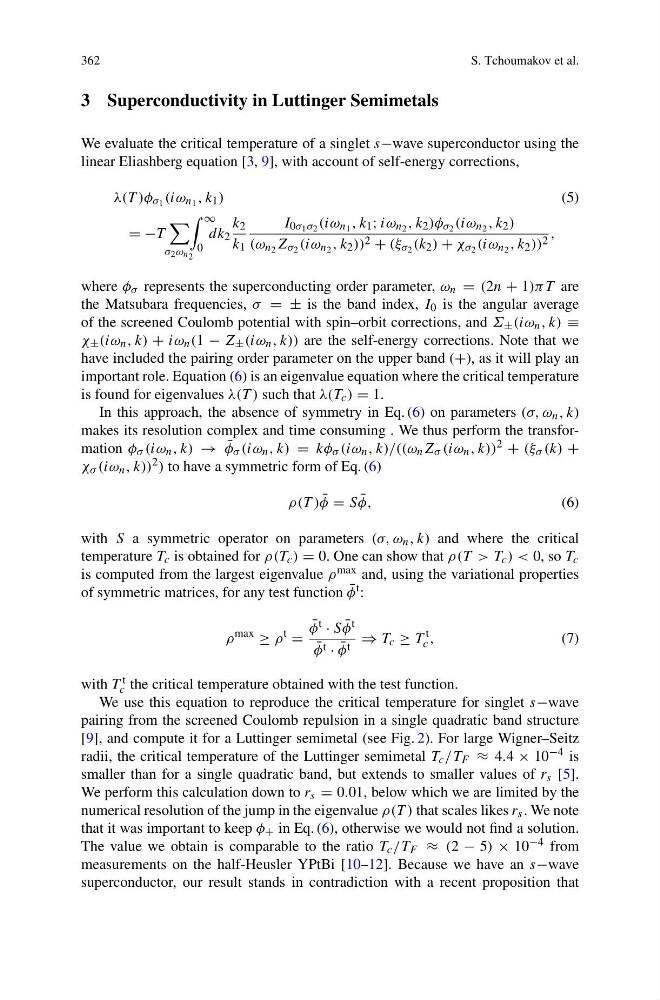
We evaluate the critical temperature of a singlet s−wave superconductor using the
linear Eliashberg equation [3, 9], with account of self-energy corrections,
λ(T )φ σ 1 (iω n 1 , k 1 )
(5)
= −T
σ 2 ω n 2
∞
0
dk 2
k 2
k 1
I 0σ 1 σ 2 (iω n 1 , k 1 ; iω n 2 , k 2 )φ σ 2 (iω n 2 , k 2 )
(ω n 2 Z σ 2 (iω n 2 , k 2 )) 2 + (ξ σ 2 (k 2 ) + χ σ 2 (iω n 2 , k 2 )) 2 ,
where φ σ represents the superconducting order parameter, ω n = (2n + 1)π T are
the Matsubara frequencies, σ = ± is the band index, I 0 is the angular average
of the screened Coulomb potential with spin–orbit corrections, and Σ ± (iω n , k) ≡
χ ± (iω n , k) + iω n (1 − Z ± (iω n , k)) are the self-energy corrections. Note that we
have included the pairing order parameter on the upper band (+), as it will play an
important role. Equation (6) is an eigenvalue equation where the critical temperature
is found for eigenvalues λ(T ) such that λ(T c ) = 1.
In this approach, the absence of symmetry in Eq. (6) on parameters (σ, ω n , k)
makes its resolution complex and time consuming . We thus perform the transformation φ σ (iω n , k) → ¯
φ σ (iω n , k) = kφ σ (iω n , k)/((ω n Z σ (iω n , k)) 2 + (ξ σ (k) +
χ σ (iω n , k)) 2 ) to have a symmetric form of Eq. (6)
ρ(T ) ¯
φ = S ¯
φ,
(6)
with S a symmetric operator on parameters (σ, ω n , k) and where the critical
temperature T c is obtained for ρ(T c ) = 0. One can show that ρ(T > T c ) < 0, so T c
is computed from the largest eigenvalue ρ max and, using the variational properties
of symmetric matrices, for any test function ¯
φ t :
ρ
max
≥ ρ
t
=
¯
φ t · S ¯
φ t
¯
φ t · ¯
φ t ⇒ T c ≥ T
t
c ,
(7)
with T t
c the critical temperature obtained with the test function.
We use this equation to reproduce the critical temperature for singlet s−wave
pairing from the screened Coulomb repulsion in a single quadratic band structure
[9], and compute it for a Luttinger semimetal (see Fig. 2). For large Wigner–Seitz
radii, the critical temperature of the Luttinger semimetal T c /T F ≈ 4.4 × 10 −4 is
smaller than for a single quadratic band, but extends to smaller values of r s [5].
We perform this calculation down to r s = 0.01, below which we are limited by the
numerical resolution of the jump in the eigenvalue ρ(T ) that scales likes r s . We note
that it was important to keep φ + in Eq. (6), otherwise we would not find a solution.
The value we obtain is comparable to the ratio T c /T F ≈ (2 − 5) × 10 −4 from
measurements on the half-Heusler YPtBi [10–12]. Because we have an s−wave
superconductor, our result stands in contradiction with a recent proposition that
S. Tchoumakov et al.
3 Superconductivity in Luttinger Semimetals
We evaluate the critical temperature of a singlet s−wave superconductor using the
linear Eliashberg equation [3, 9], with account of self-energy corrections,
λ(T )φ σ 1 (iω n 1 , k 1 )
(5)
= −T
σ 2 ω n 2
∞
0
dk 2
k 2
k 1
I 0σ 1 σ 2 (iω n 1 , k 1 ; iω n 2 , k 2 )φ σ 2 (iω n 2 , k 2 )
(ω n 2 Z σ 2 (iω n 2 , k 2 )) 2 + (ξ σ 2 (k 2 ) + χ σ 2 (iω n 2 , k 2 )) 2 ,
where φ σ represents the superconducting order parameter, ω n = (2n + 1)π T are
the Matsubara frequencies, σ = ± is the band index, I 0 is the angular average
of the screened Coulomb potential with spin–orbit corrections, and Σ ± (iω n , k) ≡
χ ± (iω n , k) + iω n (1 − Z ± (iω n , k)) are the self-energy corrections. Note that we
have included the pairing order parameter on the upper band (+), as it will play an
important role. Equation (6) is an eigenvalue equation where the critical temperature
is found for eigenvalues λ(T ) such that λ(T c ) = 1.
In this approach, the absence of symmetry in Eq. (6) on parameters (σ, ω n , k)
makes its resolution complex and time consuming . We thus perform the transformation φ σ (iω n , k) → ¯
φ σ (iω n , k) = kφ σ (iω n , k)/((ω n Z σ (iω n , k)) 2 + (ξ σ (k) +
χ σ (iω n , k)) 2 ) to have a symmetric form of Eq. (6)
ρ(T ) ¯
φ = S ¯
φ,
(6)
with S a symmetric operator on parameters (σ, ω n , k) and where the critical
temperature T c is obtained for ρ(T c ) = 0. One can show that ρ(T > T c ) < 0, so T c
is computed from the largest eigenvalue ρ max and, using the variational properties
of symmetric matrices, for any test function ¯
φ t :
ρ
max
≥ ρ
t
=
¯
φ t · S ¯
φ t
¯
φ t · ¯
φ t ⇒ T c ≥ T
t
c ,
(7)
with T t
c the critical temperature obtained with the test function.
We use this equation to reproduce the critical temperature for singlet s−wave
pairing from the screened Coulomb repulsion in a single quadratic band structure
[9], and compute it for a Luttinger semimetal (see Fig. 2). For large Wigner–Seitz
radii, the critical temperature of the Luttinger semimetal T c /T F ≈ 4.4 × 10 −4 is
smaller than for a single quadratic band, but extends to smaller values of r s [5].
We perform this calculation down to r s = 0.01, below which we are limited by the
numerical resolution of the jump in the eigenvalue ρ(T ) that scales likes r s . We note
that it was important to keep φ + in Eq. (6), otherwise we would not find a solution.
The value we obtain is comparable to the ratio T c /T F ≈ (2 − 5) × 10 −4 from
measurements on the half-Heusler YPtBi [10–12]. Because we have an s−wave
superconductor, our result stands in contradiction with a recent proposition that