

Interplay of Coulomb Repulsion and Spin–Orbit Coupling in Superconducting. . .
361
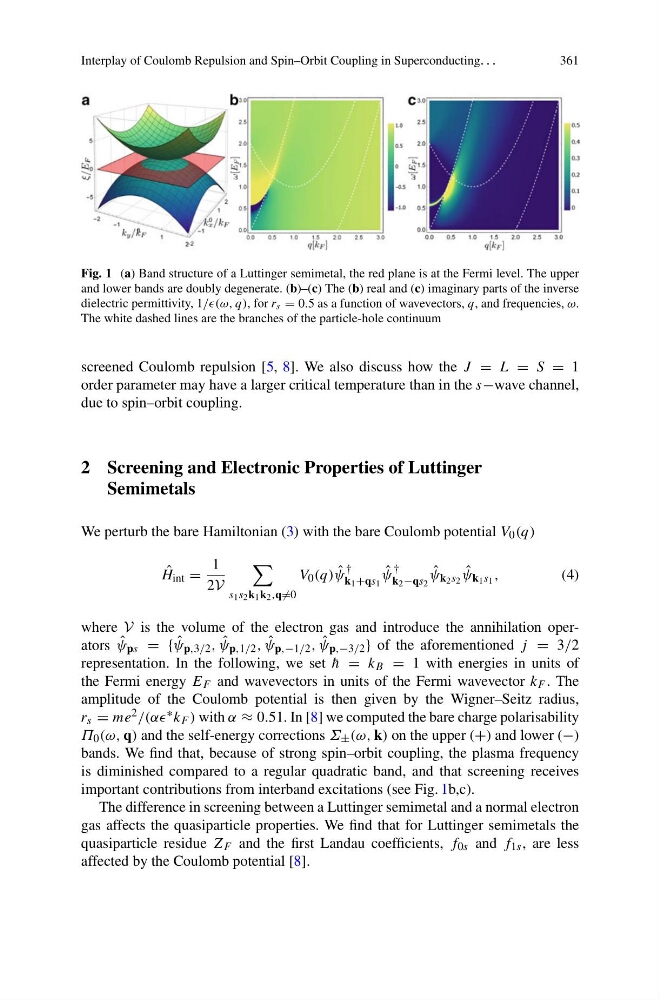
Fig. 1 (a) Band structure of a Luttinger semimetal, the red plane is at the Fermi level. The upper
and lower bands are doubly degenerate. (b)–(c) The (b) real and (c) imaginary parts of the inverse
dielectric permittivity, 1//(ω, q), for r s = 0.5 as a function of wavevectors, q, and frequencies, ω.
The white dashed lines are the branches of the particle-hole continuum
screened Coulomb repulsion [5, 8]. We also discuss how the J = L = S = 1
order parameter may have a larger critical temperature than in the s−wave channel,
due to spin–orbit coupling.
2 Screening and Electronic Properties of Luttinger
Semimetals
We perturb the bare Hamiltonian (3) with the bare Coulomb potential V 0 (q)
ˆ
H int =
1
2V
s 1 s 2 k 1 k 2 ,q =0
V 0 (q) ˆ
ψ
†
k 1 +qs 1
ˆ
ψ
†
k 2 −qs 2
ˆ
ψ k 2 s 2 ˆ
ψ k 1 s 1 ,
(4)
where V is the volume of the electron gas and introduce the annihilation operators ˆ
ψ ps = { ˆ
ψ p,3/2 , ˆ
ψ p,1/2 , ˆ
ψ p,−1/2 , ˆ
ψ p,−3/2 } of the aforementioned j = 3/2
representation. In the following, we set ¯
h = k B = 1 with energies in units of
the Fermi energy E F and wavevectors in units of the Fermi wavevector k F . The
amplitude of the Coulomb potential is then given by the Wigner–Seitz radius,
r s = me 2 /(αα ∗ k F ) with α ≈ 0.51. In [8] we computed the bare charge polarisability
Π 0 (ω, q) and the self-energy corrections Σ ± (ω, k) on the upper (+) and lower (−)
bands. We find that, because of strong spin–orbit coupling, the plasma frequency
is diminished compared to a regular quadratic band, and that screening receives
important contributions from interband excitations (see Fig. 1b,c).
The difference in screening between a Luttinger semimetal and a normal electron
gas affects the quasiparticle properties. We find that for Luttinger semimetals the
quasiparticle residue Z F and the first Landau coefficients, f 0s and f 1s , are less
affected by the Coulomb potential [8].
361
Fig. 1 (a) Band structure of a Luttinger semimetal, the red plane is at the Fermi level. The upper
and lower bands are doubly degenerate. (b)–(c) The (b) real and (c) imaginary parts of the inverse
dielectric permittivity, 1//(ω, q), for r s = 0.5 as a function of wavevectors, q, and frequencies, ω.
The white dashed lines are the branches of the particle-hole continuum
screened Coulomb repulsion [5, 8]. We also discuss how the J = L = S = 1
order parameter may have a larger critical temperature than in the s−wave channel,
due to spin–orbit coupling.
2 Screening and Electronic Properties of Luttinger
Semimetals
We perturb the bare Hamiltonian (3) with the bare Coulomb potential V 0 (q)
ˆ
H int =
1
2V
s 1 s 2 k 1 k 2 ,q =0
V 0 (q) ˆ
ψ
†
k 1 +qs 1
ˆ
ψ
†
k 2 −qs 2
ˆ
ψ k 2 s 2 ˆ
ψ k 1 s 1 ,
(4)
where V is the volume of the electron gas and introduce the annihilation operators ˆ
ψ ps = { ˆ
ψ p,3/2 , ˆ
ψ p,1/2 , ˆ
ψ p,−1/2 , ˆ
ψ p,−3/2 } of the aforementioned j = 3/2
representation. In the following, we set ¯
h = k B = 1 with energies in units of
the Fermi energy E F and wavevectors in units of the Fermi wavevector k F . The
amplitude of the Coulomb potential is then given by the Wigner–Seitz radius,
r s = me 2 /(αα ∗ k F ) with α ≈ 0.51. In [8] we computed the bare charge polarisability
Π 0 (ω, q) and the self-energy corrections Σ ± (ω, k) on the upper (+) and lower (−)
bands. We find that, because of strong spin–orbit coupling, the plasma frequency
is diminished compared to a regular quadratic band, and that screening receives
important contributions from interband excitations (see Fig. 1b,c).
The difference in screening between a Luttinger semimetal and a normal electron
gas affects the quasiparticle properties. We find that for Luttinger semimetals the
quasiparticle residue Z F and the first Landau coefficients, f 0s and f 1s , are less
affected by the Coulomb potential [8].