

360
S. Tchoumakov et al.
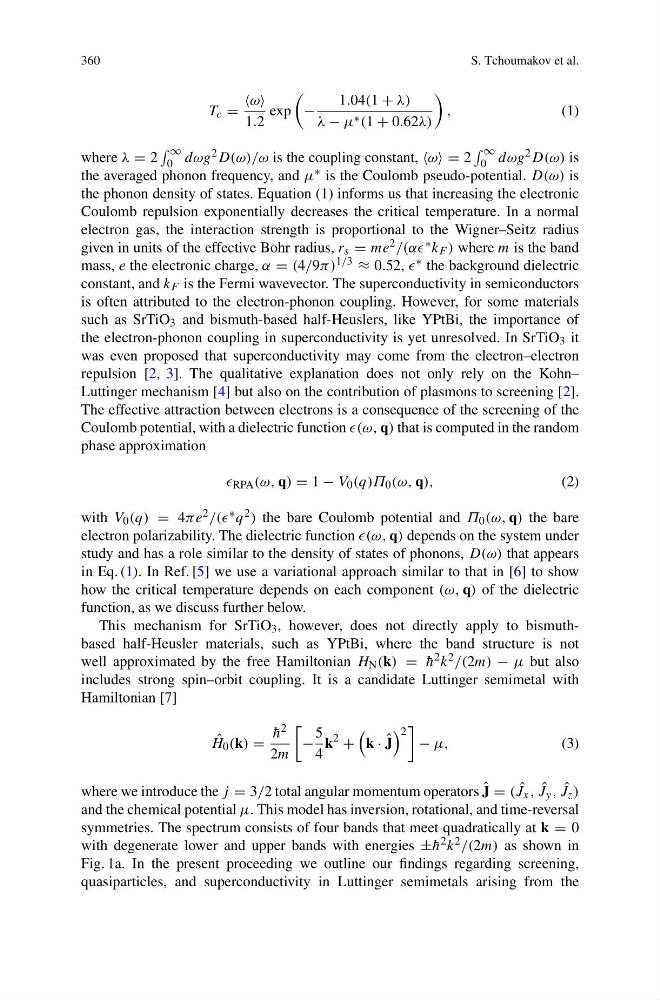
T c =
1.2
exp
−
1.04(1 + λ)
λ − μ ∗ (1 + 0.62λ)
,
(1)
where λ = 2
∞
0 dωg 2 D(ω)/ω is the coupling constant, = 2
∞
0 dωg 2 D(ω) is
the averaged phonon frequency, and μ ∗ is the Coulomb pseudo-potential. D(ω) is
the phonon density of states. Equation (1) informs us that increasing the electronic
Coulomb repulsion exponentially decreases the critical temperature. In a normal
electron gas, the interaction strength is proportional to the Wigner–Seitz radius
given in units of the effective Bohr radius, r s = me 2 /(αα ∗ k F ) where m is the band
mass, e the electronic charge, α = (4/9π) 1/3 ≈ 0.52, ∗ the background dielectric
constant, and k F is the Fermi wavevector. The superconductivity in semiconductors
is often attributed to the electron-phonon coupling. However, for some materials
such as SrTiO 3 and bismuth-based half-Heuslers, like YPtBi, the importance of
the electron-phonon coupling in superconductivity is yet unresolved. In SrTiO 3 it
was even proposed that superconductivity may come from the electron–electron
repulsion [2, 3]. The qualitative explanation does not only rely on the Kohn–
Luttinger mechanism [4] but also on the contribution of plasmons to screening [2].
The effective attraction between electrons is a consequence of the screening of the
Coulomb potential, with a dielectric function (ω, q) that is computed in the random
phase approximation
RPA (ω, q) = 1 − V 0 (q)Π 0 (ω, q),
(2)
with V 0 (q) = 4πe 2 /(( ∗ q 2 ) the bare Coulomb potential and Π 0 (ω, q) the bare
electron polarizability. The dielectric function (ω, q) depends on the system under
study and has a role similar to the density of states of phonons, D(ω) that appears
in Eq. (1). In Ref. [5] we use a variational approach similar to that in [6] to show
how the critical temperature depends on each component (ω, q) of the dielectric
function, as we discuss further below.
This mechanism for SrTiO 3 , however, does not directly apply to bismuthbased half-Heusler materials, such as YPtBi, where the band structure is not
well approximated by the free Hamiltonian H N (k) = ¯
h 2 k 2 /(2m) − μ but also
includes strong spin–orbit coupling. It is a candidate Luttinger semimetal with
Hamiltonian [7]
ˆ
H 0 (k) =
¯
h 2
2m
−
5
4
k
2
+
k · ˆ
J
2
− μ,
(3)
where we introduce the j = 3/2 total angular momentum operators ˆ
J = ( ˆ
J x , ˆ
J y , ˆ
J z )
and the chemical potential μ. This model has inversion, rotational, and time-reversal
symmetries. The spectrum consists of four bands that meet quadratically at k = 0
with degenerate lower and upper bands with energies ± ¯
h 2 k 2 /(2m) as shown in
Fig. 1a. In the present proceeding we outline our findings regarding screening,
quasiparticles, and superconductivity in Luttinger semimetals arising from the
S. Tchoumakov et al.
T c =
1.2
exp
−
1.04(1 + λ)
λ − μ ∗ (1 + 0.62λ)
,
(1)
where λ = 2
∞
0 dωg 2 D(ω)/ω is the coupling constant, = 2
∞
0 dωg 2 D(ω) is
the averaged phonon frequency, and μ ∗ is the Coulomb pseudo-potential. D(ω) is
the phonon density of states. Equation (1) informs us that increasing the electronic
Coulomb repulsion exponentially decreases the critical temperature. In a normal
electron gas, the interaction strength is proportional to the Wigner–Seitz radius
given in units of the effective Bohr radius, r s = me 2 /(αα ∗ k F ) where m is the band
mass, e the electronic charge, α = (4/9π) 1/3 ≈ 0.52, ∗ the background dielectric
constant, and k F is the Fermi wavevector. The superconductivity in semiconductors
is often attributed to the electron-phonon coupling. However, for some materials
such as SrTiO 3 and bismuth-based half-Heuslers, like YPtBi, the importance of
the electron-phonon coupling in superconductivity is yet unresolved. In SrTiO 3 it
was even proposed that superconductivity may come from the electron–electron
repulsion [2, 3]. The qualitative explanation does not only rely on the Kohn–
Luttinger mechanism [4] but also on the contribution of plasmons to screening [2].
The effective attraction between electrons is a consequence of the screening of the
Coulomb potential, with a dielectric function (ω, q) that is computed in the random
phase approximation
RPA (ω, q) = 1 − V 0 (q)Π 0 (ω, q),
(2)
with V 0 (q) = 4πe 2 /(( ∗ q 2 ) the bare Coulomb potential and Π 0 (ω, q) the bare
electron polarizability. The dielectric function (ω, q) depends on the system under
study and has a role similar to the density of states of phonons, D(ω) that appears
in Eq. (1). In Ref. [5] we use a variational approach similar to that in [6] to show
how the critical temperature depends on each component (ω, q) of the dielectric
function, as we discuss further below.
This mechanism for SrTiO 3 , however, does not directly apply to bismuthbased half-Heusler materials, such as YPtBi, where the band structure is not
well approximated by the free Hamiltonian H N (k) = ¯
h 2 k 2 /(2m) − μ but also
includes strong spin–orbit coupling. It is a candidate Luttinger semimetal with
Hamiltonian [7]
ˆ
H 0 (k) =
¯
h 2
2m
−
5
4
k
2
+
k · ˆ
J
2
− μ,
(3)
where we introduce the j = 3/2 total angular momentum operators ˆ
J = ( ˆ
J x , ˆ
J y , ˆ
J z )
and the chemical potential μ. This model has inversion, rotational, and time-reversal
symmetries. The spectrum consists of four bands that meet quadratically at k = 0
with degenerate lower and upper bands with energies ± ¯
h 2 k 2 /(2m) as shown in
Fig. 1a. In the present proceeding we outline our findings regarding screening,
quasiparticles, and superconductivity in Luttinger semimetals arising from the