

Emergent Geometry from Entanglement Structure
349
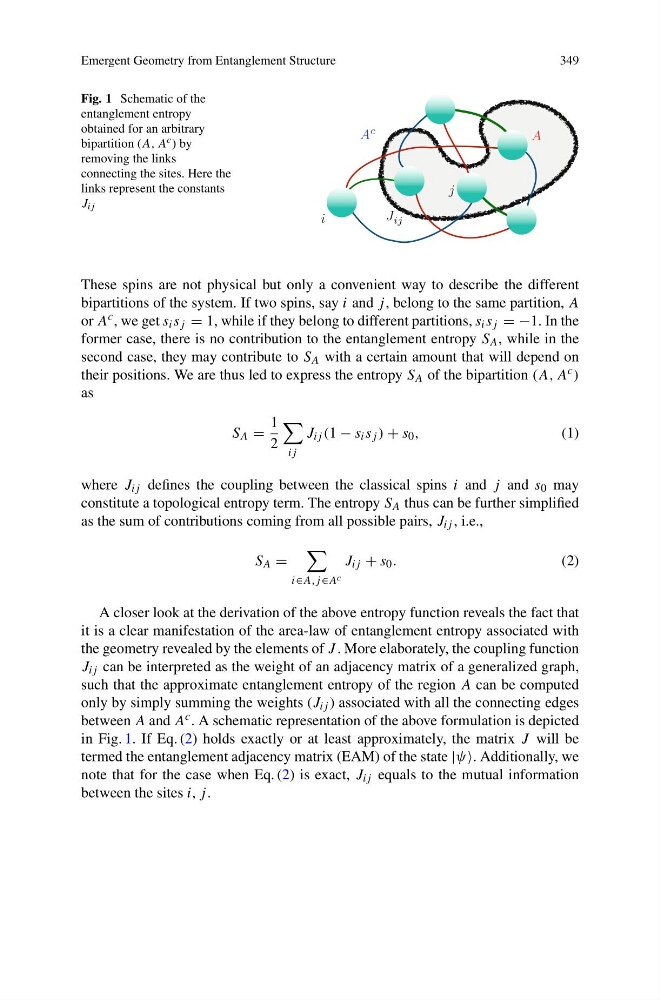
Fig. 1 Schematic of the
entanglement entropy
obtained for an arbitrary
bipartition (A, A c ) by
removing the links
connecting the sites. Here the
links represent the constants
J ij
A
c
A
J ij
i
j
These spins are not physical but only a convenient way to describe the different
bipartitions of the system. If two spins, say i and j , belong to the same partition, A
or A c , we get s i s j = 1, while if they belong to different partitions, s i s j = −1. In the
former case, there is no contribution to the entanglement entropy S A , while in the
second case, they may contribute to S A with a certain amount that will depend on
their positions. We are thus led to express the entropy S A of the bipartition (A, A c )
as
S A =
1
2
ij
J ij (1 − s i s j ) + s 0 ,
(1)
where J ij defines the coupling between the classical spins i and j and s 0 may
constitute a topological entropy term. The entropy S A thus can be further simplified
as the sum of contributions coming from all possible pairs, J ij , i.e.,
S A =
i∈A,j ∈A c
J ij + s 0 .
(2)
A closer look at the derivation of the above entropy function reveals the fact that
it is a clear manifestation of the area-law of entanglement entropy associated with
the geometry revealed by the elements of J . More elaborately, the coupling function
J ij can be interpreted as the weight of an adjacency matrix of a generalized graph,
such that the approximate entanglement entropy of the region A can be computed
only by simply summing the weights (J ij ) associated with all the connecting edges
between A and A c . A schematic representation of the above formulation is depicted
in Fig. 1. If Eq. (2) holds exactly or at least approximately, the matrix J will be
termed the entanglement adjacency matrix (EAM) of the state |ψ. Additionally, we
note that for the case when Eq. (2) is exact, J ij equals to the mutual information
between the sites i, j .
349
Fig. 1 Schematic of the
entanglement entropy
obtained for an arbitrary
bipartition (A, A c ) by
removing the links
connecting the sites. Here the
links represent the constants
J ij
A
c
A
J ij
i
j
These spins are not physical but only a convenient way to describe the different
bipartitions of the system. If two spins, say i and j , belong to the same partition, A
or A c , we get s i s j = 1, while if they belong to different partitions, s i s j = −1. In the
former case, there is no contribution to the entanglement entropy S A , while in the
second case, they may contribute to S A with a certain amount that will depend on
their positions. We are thus led to express the entropy S A of the bipartition (A, A c )
as
S A =
1
2
ij
J ij (1 − s i s j ) + s 0 ,
(1)
where J ij defines the coupling between the classical spins i and j and s 0 may
constitute a topological entropy term. The entropy S A thus can be further simplified
as the sum of contributions coming from all possible pairs, J ij , i.e.,
S A =
i∈A,j ∈A c
J ij + s 0 .
(2)
A closer look at the derivation of the above entropy function reveals the fact that
it is a clear manifestation of the area-law of entanglement entropy associated with
the geometry revealed by the elements of J . More elaborately, the coupling function
J ij can be interpreted as the weight of an adjacency matrix of a generalized graph,
such that the approximate entanglement entropy of the region A can be computed
only by simply summing the weights (J ij ) associated with all the connecting edges
between A and A c . A schematic representation of the above formulation is depicted
in Fig. 1. If Eq. (2) holds exactly or at least approximately, the matrix J will be
termed the entanglement adjacency matrix (EAM) of the state |ψ. Additionally, we
note that for the case when Eq. (2) is exact, J ij equals to the mutual information
between the sites i, j .