

348
S. S. Roy et al.
7] and geometry which emerges from the distribution of quantum entanglement
across all possible bipartitions of a pure quantum many-body state. Towards this
aim, we first define the notion of geometry by means of a generalized adjacency
matrix such that the approximate entanglement entropy of any given bipartition
can be obtained as a linear sum of the weights of the links connecting it with its
surroundings. We show that the representation is exact when there is a perfect arealaw. In other cases, it still provides an efficient approximation with minimal error.
Interestingly, we also report some other important states, e.g., the rainbow state
[8–15], where though a strong violation of area-law is observed for the geometry
defined by the local structure of the Hamiltonian, an area-law feature can indeed be
recovered for a geometry which is completely different than that suggested by the
Hamiltonian.
As an application of the formalism, we provide a route to compute the entanglement contour function for quantum many-body systems, which is radically different
than that previously introduced in Ref. [16]. A quantitative comparison of the
contour functions obtained using these two different approaches is made for the
ground state of a non-interacting model. Additionally, we also study the behavior of
contour function obtained for an interacting model, which surpasses the limitation
of the previous approach [16–22].
Finally, we extend our analysis to conformal invariant physical systems [23–26].
As an important finding, we show that the conformal field theory (CFT) descriptions
help us to interpret the elements of the generalized adjacency matrix as the two-point
correlator of an entanglement current operator. This field theory realization provides
a framework to consider entanglement as a flow among different parts of the system
[27], similar to the flow of energy that is characterized by the stress tensor.
In the following sections, after briefly introducing the formalism, we elaborate
on our main findings.
2 Emergent Geometry
We start with an N -party pure quantum state |ψ, and characterize its entanglement
properties by computing the von Neumann entropies S A = −Tr A (ρ A log ρ A ) for
all possible bipartitions of the state, namely (A, A c ), where ρ A = Tr A c |ψ and
Tr A(A c ) denotes partial trace on the subsystem A(A c ). We then aim to investigate
whether the set of entropies obtained in this way respond to an area-law for some
geometry. As a first step, we assign a classical spin configuration {s i } N to each such
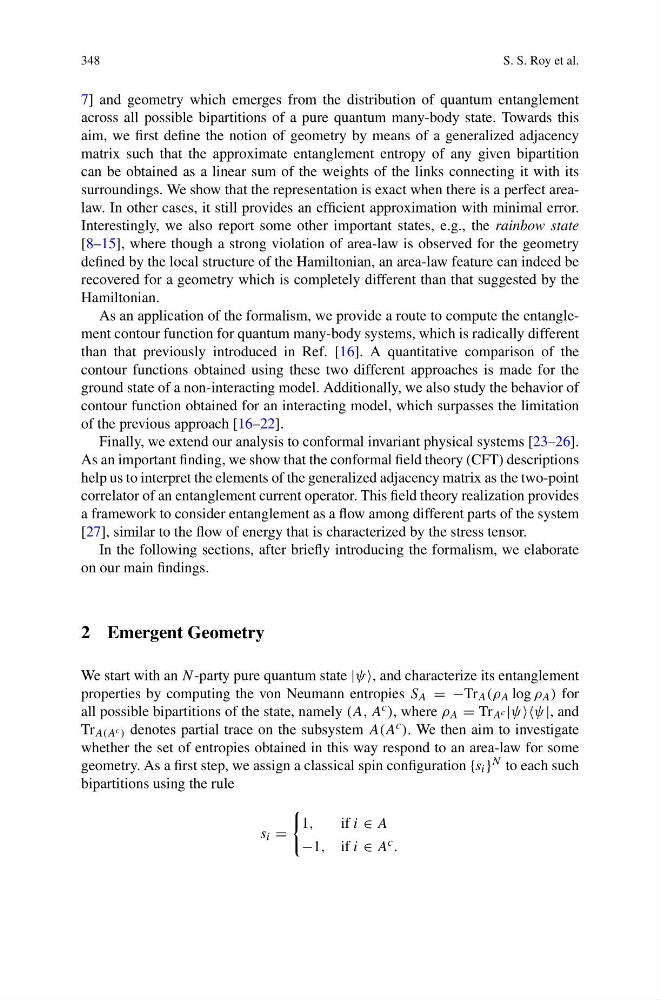
bipartitions using the rule
s i =
1,
if i ∈ A
−1, if i ∈ A c .
S. S. Roy et al.
7] and geometry which emerges from the distribution of quantum entanglement
across all possible bipartitions of a pure quantum many-body state. Towards this
aim, we first define the notion of geometry by means of a generalized adjacency
matrix such that the approximate entanglement entropy of any given bipartition
can be obtained as a linear sum of the weights of the links connecting it with its
surroundings. We show that the representation is exact when there is a perfect arealaw. In other cases, it still provides an efficient approximation with minimal error.
Interestingly, we also report some other important states, e.g., the rainbow state
[8–15], where though a strong violation of area-law is observed for the geometry
defined by the local structure of the Hamiltonian, an area-law feature can indeed be
recovered for a geometry which is completely different than that suggested by the
Hamiltonian.
As an application of the formalism, we provide a route to compute the entanglement contour function for quantum many-body systems, which is radically different
than that previously introduced in Ref. [16]. A quantitative comparison of the
contour functions obtained using these two different approaches is made for the
ground state of a non-interacting model. Additionally, we also study the behavior of
contour function obtained for an interacting model, which surpasses the limitation
of the previous approach [16–22].
Finally, we extend our analysis to conformal invariant physical systems [23–26].
As an important finding, we show that the conformal field theory (CFT) descriptions
help us to interpret the elements of the generalized adjacency matrix as the two-point
correlator of an entanglement current operator. This field theory realization provides
a framework to consider entanglement as a flow among different parts of the system
[27], similar to the flow of energy that is characterized by the stress tensor.
In the following sections, after briefly introducing the formalism, we elaborate
on our main findings.
2 Emergent Geometry
We start with an N -party pure quantum state |ψ, and characterize its entanglement
properties by computing the von Neumann entropies S A = −Tr A (ρ A log ρ A ) for
all possible bipartitions of the state, namely (A, A c ), where ρ A = Tr A c |ψ and
Tr A(A c ) denotes partial trace on the subsystem A(A c ). We then aim to investigate
whether the set of entropies obtained in this way respond to an area-law for some
geometry. As a first step, we assign a classical spin configuration {s i } N to each such
bipartitions using the rule
s i =
1,
if i ∈ A
−1, if i ∈ A c .