

Monopole Operators and Their Symmetries in QED 3 -Gross–Neveu Models
333
3 Hierarchy Among Monopole Operators
So far, we have only computed the minimal scaling dimension of monopole
operators in QED 3 -cHGN. Monopole operators with larger scaling dimensions
are expected at this QCP since the degeneracy of monopoles in QED 3 should be
lifted [18] by the cHGN interaction which breaks the flavor symmetry
SU(2N) → SU(2) × SU(N) .
(14)
We first review how monopole operators are organized in QED 3 with flavor
symmetry SU(2N). We focus on the simplest case with the minimal magnetic
charge q = 1/2 where monopole operators are automatically Lorentz scalars [3].
A monopole operator can then be written as half of the 2N zero modes creation
operators c
†
I i
multiplying a bare monopole operator M
†
Bare which creates all
negative energy modes in a 2π magnetic flux background
M
†
I 1 ...I N
= c
†
I 1
. . . c
†
I N
M
†
Bare , I i ∈ {1, 2, . . . , 2N } .
(15)
Antisymmetry between these fermionic operators yields a rank-N antisymmetric
tensor in flavor space. The first step in understanding the hierarchy of monopole
operators at the QCP is to obtain the reduction of this SU(2N) irreducible
representation (irrep) in terms of irreps of the subgroup SU(2) × SU(N). This is
a specific case of the reduction SU(MN) → SU(M) × SU(N), where M and N are
integers, whose branching rules are well studied [21].
For N = 2, there are two valleys v = L, R and monopoles form the rank2 antisymmetric irrep of SU(4), denoted by its dimension 6. We note that for the
specific examples discussed in this section, the irreps are uniquely determined by
their dimension. Monopole operators are then expressed as
c
† A
c
†
M
†
Bare ,
(16)
where A acts on vectors in flavor space c † =
c
†
↑,L , c
†
↑,R , c
†
↓,L , c
†
↓,R
. At the QCP,
monopole operators in the irrep 6 of SU(4) of QED 3 reorganize as irreps (m, n)
with dimension m × n of the remaining subgroup SU(2) Spin × SU(2) Nodal [21]
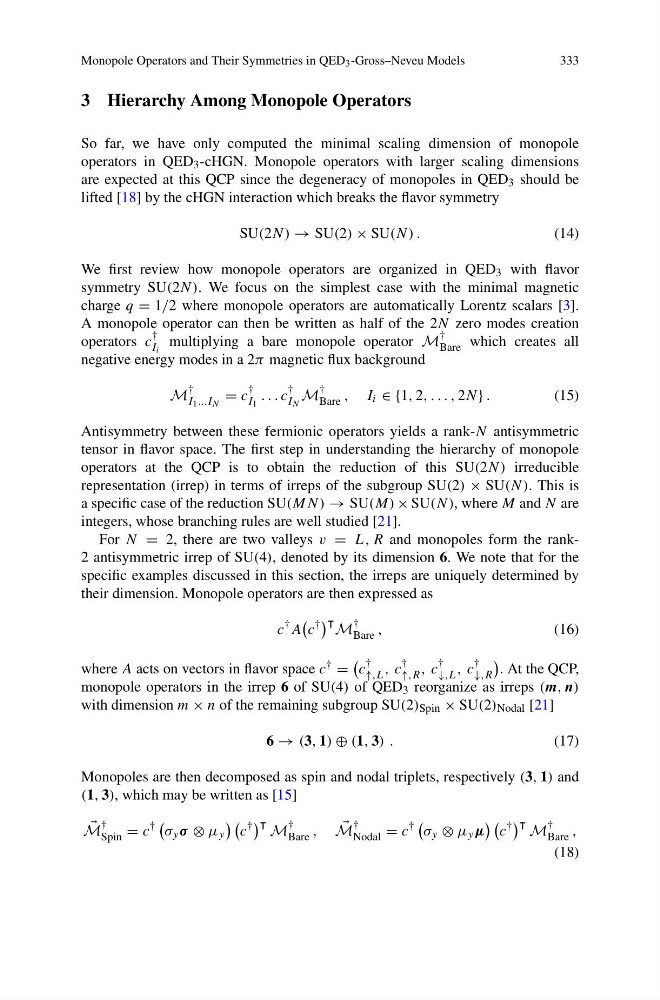
6 → (3, 1) ⊕ (1, 3) .
(17)
Monopoles are then decomposed as spin and nodal triplets, respectively (3, 1) and
(1, 3), which may be written as [15]
M
†
Spin = c
†
σ y σ ⊗ μ y
c
†
M
†
Bare ,
M
†
Nodal = c
†
σ y ⊗ μ y μ
c
†
M
†
Bare ,
(18)
333
3 Hierarchy Among Monopole Operators
So far, we have only computed the minimal scaling dimension of monopole
operators in QED 3 -cHGN. Monopole operators with larger scaling dimensions
are expected at this QCP since the degeneracy of monopoles in QED 3 should be
lifted [18] by the cHGN interaction which breaks the flavor symmetry
SU(2N) → SU(2) × SU(N) .
(14)
We first review how monopole operators are organized in QED 3 with flavor
symmetry SU(2N). We focus on the simplest case with the minimal magnetic
charge q = 1/2 where monopole operators are automatically Lorentz scalars [3].
A monopole operator can then be written as half of the 2N zero modes creation
operators c
†
I i
multiplying a bare monopole operator M
†
Bare which creates all
negative energy modes in a 2π magnetic flux background
M
†
I 1 ...I N
= c
†
I 1
. . . c
†
I N
M
†
Bare , I i ∈ {1, 2, . . . , 2N } .
(15)
Antisymmetry between these fermionic operators yields a rank-N antisymmetric
tensor in flavor space. The first step in understanding the hierarchy of monopole
operators at the QCP is to obtain the reduction of this SU(2N) irreducible
representation (irrep) in terms of irreps of the subgroup SU(2) × SU(N). This is
a specific case of the reduction SU(MN) → SU(M) × SU(N), where M and N are
integers, whose branching rules are well studied [21].
For N = 2, there are two valleys v = L, R and monopoles form the rank2 antisymmetric irrep of SU(4), denoted by its dimension 6. We note that for the
specific examples discussed in this section, the irreps are uniquely determined by
their dimension. Monopole operators are then expressed as
c
† A
c
†
M
†
Bare ,
(16)
where A acts on vectors in flavor space c † =
c
†
↑,L , c
†
↑,R , c
†
↓,L , c
†
↓,R
. At the QCP,
monopole operators in the irrep 6 of SU(4) of QED 3 reorganize as irreps (m, n)
with dimension m × n of the remaining subgroup SU(2) Spin × SU(2) Nodal [21]
6 → (3, 1) ⊕ (1, 3) .
(17)
Monopoles are then decomposed as spin and nodal triplets, respectively (3, 1) and
(1, 3), which may be written as [15]
M
†
Spin = c
†
σ y σ ⊗ μ y
c
†
M
†
Bare ,
M
†
Nodal = c
†
σ y ⊗ μ y μ
c
†
M
†
Bare ,
(18)