

332
É. Dupuis et al.
E
QED 3
QED 3 -cHGN
0
2
4
6
8
10
0
5
10
15
b
a
q
Δ
q / (2N)
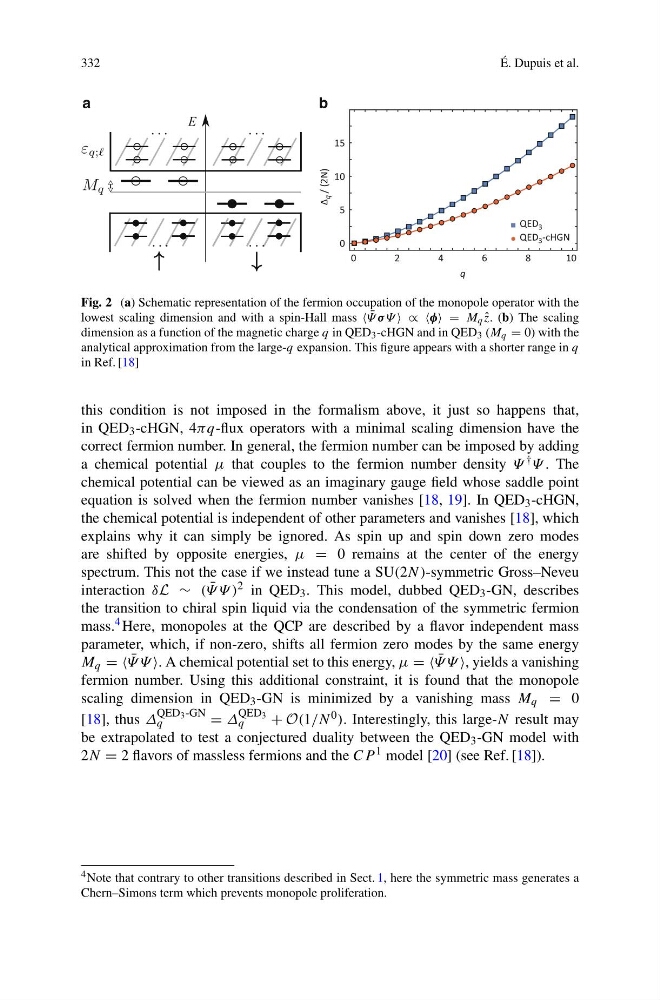
Fig. 2 (a) Schematic representation of the fermion occupation of the monopole operator with the
lowest scaling dimension and with a spin-Hall mass ¯
Ψ σ Ψ ∝ ∝φ = M q ˆ
z. (b) The scaling
dimension as a function of the magnetic charge q in QED 3 -cHGN and in QED 3 (M q = 0) with the
analytical approximation from the large-q expansion. This figure appears with a shorter range in q
in Ref. [18]
this condition is not imposed in the formalism above, it just so happens that,
in QED 3 -cHGN, 4πq-flux operators with a minimal scaling dimension have the
correct fermion number. In general, the fermion number can be imposed by adding
a chemical potential μ that couples to the fermion number density Ψ † Ψ . The
chemical potential can be viewed as an imaginary gauge field whose saddle point
equation is solved when the fermion number vanishes [18, 19]. In QED 3 -cHGN,
the chemical potential is independent of other parameters and vanishes [18], which
explains why it can simply be ignored. As spin up and spin down zero modes
are shifted by opposite energies, μ = 0 remains at the center of the energy
spectrum. This not the case if we instead tune a SU(2N)-symmetric Gross–Neveu
interaction δL ∼ ( ¯
Ψ Ψ ) 2 in QED 3 . This model, dubbed QED 3 -GN, describes
the transition to chiral spin liquid via the condensation of the symmetric fermion
mass. 4 Here, monopoles at the QCP are described by a flavor independent mass
parameter, which, if non-zero, shifts all fermion zero modes by the same energy
M q = = ¯
Ψ Ψ . A chemical potential set to this energy, μ = = ¯
Ψ Ψ , yields a vanishing
fermion number. Using this additional constraint, it is found that the monopole
scaling dimension in QED 3 -GN is minimized by a vanishing mass M q = 0
[18], thus Δ
QED 3 -GN
q
= Δ
QED 3
q
+ O(1/N 0 ). Interestingly, this large-N result may
be extrapolated to test a conjectured duality between the QED 3 -GN model with
2N = 2 flavors of massless fermions and the CP 1 model [20] (see Ref. [18]).
4 Note that contrary to other transitions described in Sect. 1, here the symmetric mass generates a
Chern–Simons term which prevents monopole proliferation.
É. Dupuis et al.
E
QED 3
QED 3 -cHGN
0
2
4
6
8
10
0
5
10
15
b
a
q
Δ
q / (2N)
Fig. 2 (a) Schematic representation of the fermion occupation of the monopole operator with the
lowest scaling dimension and with a spin-Hall mass ¯
Ψ σ Ψ ∝ ∝φ = M q ˆ
z. (b) The scaling
dimension as a function of the magnetic charge q in QED 3 -cHGN and in QED 3 (M q = 0) with the
analytical approximation from the large-q expansion. This figure appears with a shorter range in q
in Ref. [18]
this condition is not imposed in the formalism above, it just so happens that,
in QED 3 -cHGN, 4πq-flux operators with a minimal scaling dimension have the
correct fermion number. In general, the fermion number can be imposed by adding
a chemical potential μ that couples to the fermion number density Ψ † Ψ . The
chemical potential can be viewed as an imaginary gauge field whose saddle point
equation is solved when the fermion number vanishes [18, 19]. In QED 3 -cHGN,
the chemical potential is independent of other parameters and vanishes [18], which
explains why it can simply be ignored. As spin up and spin down zero modes
are shifted by opposite energies, μ = 0 remains at the center of the energy
spectrum. This not the case if we instead tune a SU(2N)-symmetric Gross–Neveu
interaction δL ∼ ( ¯
Ψ Ψ ) 2 in QED 3 . This model, dubbed QED 3 -GN, describes
the transition to chiral spin liquid via the condensation of the symmetric fermion
mass. 4 Here, monopoles at the QCP are described by a flavor independent mass
parameter, which, if non-zero, shifts all fermion zero modes by the same energy
M q = = ¯
Ψ Ψ . A chemical potential set to this energy, μ = = ¯
Ψ Ψ , yields a vanishing
fermion number. Using this additional constraint, it is found that the monopole
scaling dimension in QED 3 -GN is minimized by a vanishing mass M q = 0
[18], thus Δ
QED 3 -GN
q
= Δ
QED 3
q
+ O(1/N 0 ). Interestingly, this large-N result may
be extrapolated to test a conjectured duality between the QED 3 -GN model with
2N = 2 flavors of massless fermions and the CP 1 model [20] (see Ref. [18]).
4 Note that contrary to other transitions described in Sect. 1, here the symmetric mass generates a
Chern–Simons term which prevents monopole proliferation.