

Monopole Operators and Their Symmetries in QED 3 -Gross–Neveu Models
331
hole space. The operator in the determinant of Eq. (9) then yields the following
spectrum [18]:
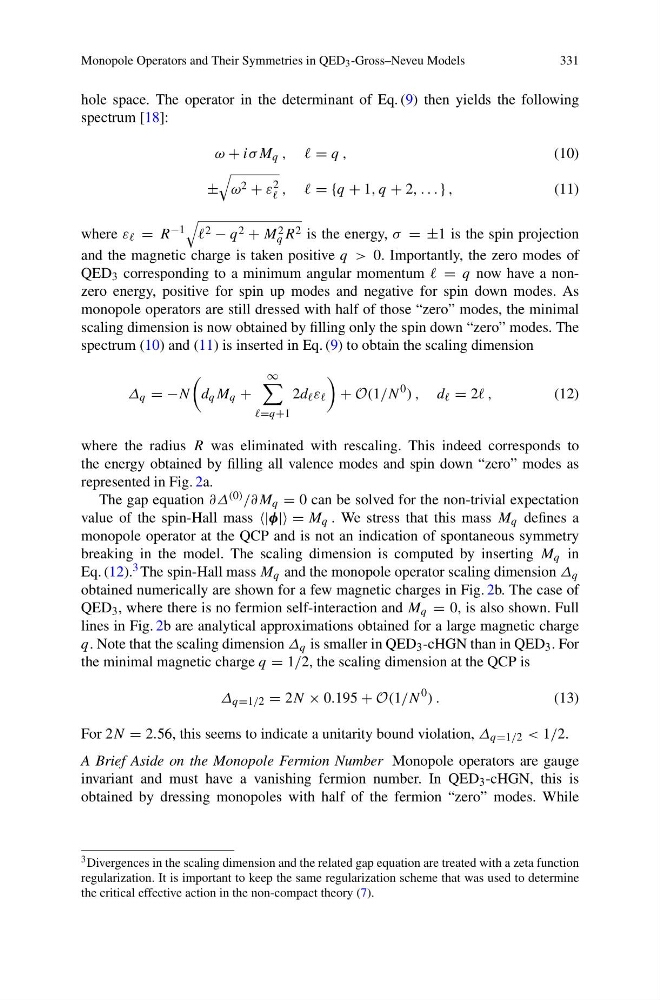
ω + iσ M q , , = q ,
(10)
±
ω 2 + ε 2
, , = {q + 1, q + 2, . . . } ,
(11)
where ε = R −1
2 − q 2 + M 2
q R 2 is the energy, σ = ±1 is the spin projection
and the magnetic charge is taken positive q > 0. Importantly, the zero modes of
QED 3 corresponding to a minimum angular momentum = q now have a nonzero energy, positive for spin up modes and negative for spin down modes. As
monopole operators are still dressed with half of those “zero” modes, the minimal
scaling dimension is now obtained by filling only the spin down “zero” modes. The
spectrum (10) and (11) is inserted in Eq. (9) to obtain the scaling dimension
Δ q = −N
d q M q +
∞
2d ε
+ O(1/N
0 ) , d = 2 ,
(12)
where the radius R was eliminated with rescaling. This indeed corresponds to
the energy obtained by filling all valence modes and spin down “zero” modes as
represented in Fig. 2a.
The gap equation ∂Δ (0) /∂M q = 0 can be solved for the non-trivial expectation
value of the spin-Hall mass = M q . We stress that this mass M q defines a
monopole operator at the QCP and is not an indication of spontaneous symmetry
breaking in the model. The scaling dimension is computed by inserting M q in
Eq. (12). 3 The spin-Hall mass M q and the monopole operator scaling dimension Δ q
obtained numerically are shown for a few magnetic charges in Fig. 2b. The case of
QED 3 , where there is no fermion self-interaction and M q = 0, is also shown. Full
lines in Fig. 2b are analytical approximations obtained for a large magnetic charge
q. Note that the scaling dimension Δ q is smaller in QED 3 -cHGN than in QED 3 . For
the minimal magnetic charge q = 1/2, the scaling dimension at the QCP is
Δ q=1/2 = 2N × 0.195 + O(1/N
0 ) .
(13)
For 2N = 2.56, this seems to indicate a unitarity bound violation, Δ q=1/2 < 1/2.
A Brief Aside on the Monopole Fermion Number Monopole operators are gauge
invariant and must have a vanishing fermion number. In QED 3 -cHGN, this is
obtained by dressing monopoles with half of the fermion “zero” modes. While
3 Divergences in the scaling dimension and the related gap equation are treated with a zeta function
regularization. It is important to keep the same regularization scheme that was used to determine
the critical effective action in the non-compact theory (7).
331
hole space. The operator in the determinant of Eq. (9) then yields the following
spectrum [18]:
ω + iσ M q , , = q ,
(10)
±
ω 2 + ε 2
, , = {q + 1, q + 2, . . . } ,
(11)
where ε = R −1
2 − q 2 + M 2
q R 2 is the energy, σ = ±1 is the spin projection
and the magnetic charge is taken positive q > 0. Importantly, the zero modes of
QED 3 corresponding to a minimum angular momentum = q now have a nonzero energy, positive for spin up modes and negative for spin down modes. As
monopole operators are still dressed with half of those “zero” modes, the minimal
scaling dimension is now obtained by filling only the spin down “zero” modes. The
spectrum (10) and (11) is inserted in Eq. (9) to obtain the scaling dimension
Δ q = −N
d q M q +
∞
2d ε
+ O(1/N
0 ) , d = 2 ,
(12)
where the radius R was eliminated with rescaling. This indeed corresponds to
the energy obtained by filling all valence modes and spin down “zero” modes as
represented in Fig. 2a.
The gap equation ∂Δ (0) /∂M q = 0 can be solved for the non-trivial expectation
value of the spin-Hall mass = M q . We stress that this mass M q defines a
monopole operator at the QCP and is not an indication of spontaneous symmetry
breaking in the model. The scaling dimension is computed by inserting M q in
Eq. (12). 3 The spin-Hall mass M q and the monopole operator scaling dimension Δ q
obtained numerically are shown for a few magnetic charges in Fig. 2b. The case of
QED 3 , where there is no fermion self-interaction and M q = 0, is also shown. Full
lines in Fig. 2b are analytical approximations obtained for a large magnetic charge
q. Note that the scaling dimension Δ q is smaller in QED 3 -cHGN than in QED 3 . For
the minimal magnetic charge q = 1/2, the scaling dimension at the QCP is
Δ q=1/2 = 2N × 0.195 + O(1/N
0 ) .
(13)
For 2N = 2.56, this seems to indicate a unitarity bound violation, Δ q=1/2 < 1/2.
A Brief Aside on the Monopole Fermion Number Monopole operators are gauge
invariant and must have a vanishing fermion number. In QED 3 -cHGN, this is
obtained by dressing monopoles with half of the fermion “zero” modes. While
3 Divergences in the scaling dimension and the related gap equation are treated with a zeta function
regularization. It is important to keep the same regularization scheme that was used to determine
the critical effective action in the non-compact theory (7).