

330
É. Dupuis et al.
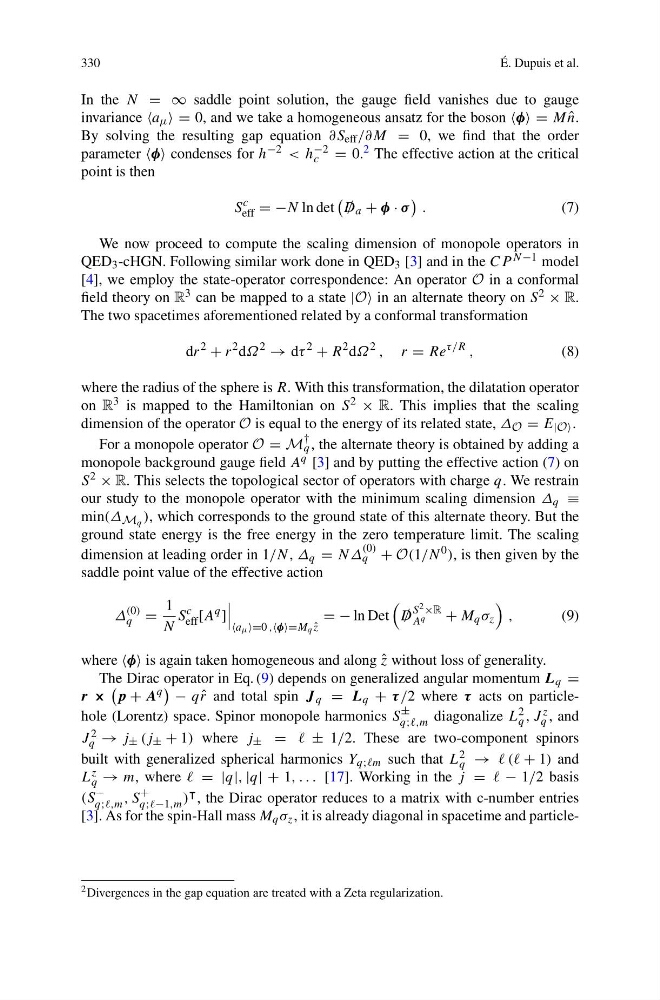
In the N = ∞ saddle point solution, the gauge field vanishes due to gauge
invariance μ = 0, and we take a homogeneous ansatz for the boson = M ˆ
n.
By solving the resulting gap equation ∂S eff /∂M = 0, we find that the order
parameter condenses for h −2 < h −2
c = 0. 2 The effective action at the critical
point is then
S
c
eff = −N ln det
/
D a + φ · σ
.
(7)
We now proceed to compute the scaling dimension of monopole operators in
QED 3 -cHGN. Following similar work done in QED 3 [3] and in the CP N −1 model
[4], we employ the state-operator correspondence: An operator O in a conformal
field theory on R 3 can be mapped to a state |O in an alternate theory on S 2 × R.
The two spacetimes aforementioned related by a conformal transformation
dr
2
+ r
2 dΩ
2
→ dτ
2
+ R
2 dΩ
2 , r = Re
τ/R ,
(8)
where the radius of the sphere is R. With this transformation, the dilatation operator
on R 3 is mapped to the Hamiltonian on S 2 × R. This implies that the scaling
dimension of the operator O is equal to the energy of its related state, Δ O = E |O .
For a monopole operator O = M
†
q , the alternate theory is obtained by adding a
monopole background gauge field A q [3] and by putting the effective action (7) on
S 2 × R. This selects the topological sector of operators with charge q. We restrain
our study to the monopole operator with the minimum scaling dimension Δ q ≡
min(Δ M q ), which corresponds to the ground state of this alternate theory. But the
ground state energy is the free energy in the zero temperature limit. The scaling
dimension at leading order in 1/N, Δ q = NΔ
(0)
q + O(1/N 0 ), is then given by the
saddle point value of the effective action
Δ
(0)
q =
1
N
S
c
eff [A
q
]
μ , q ˆ
z
= − ln Det
/
D
S 2 ×R
A q
+ M q σ z
,
(9)
where is again taken homogeneous and along ˆ
z without loss of generality.
The Dirac operator in Eq. (9) depends on generalized angular momentum L q =
r ×
p + A
q
− q ˆ
r and total spin J q = L q + τ /2 where τ acts on particlehole (Lorentz) space. Spinor monopole harmonics S
±
q; diagonalize L 2
q , J z
q , and
J 2
q → j ± (j ± + 1) where j ± = ± 1/2. These are two-component spinors
built with generalized spherical harmonics Y q;m such that L 2
q → ( + 1) and
L z
q → m, where = |q|, |q| + 1, . . . [17]. Working in the j = − 1/2 basis
(S
−
q;,m , S
+
q; ) , the Dirac operator reduces to a matrix with c-number entries
[3]. As for the spin-Hall mass M q σ z , it is already diagonal in spacetime and particle2 Divergences in the gap equation are treated with a Zeta regularization.
É. Dupuis et al.
In the N = ∞ saddle point solution, the gauge field vanishes due to gauge
invariance μ = 0, and we take a homogeneous ansatz for the boson = M ˆ
n.
By solving the resulting gap equation ∂S eff /∂M = 0, we find that the order
parameter condenses for h −2 < h −2
c = 0. 2 The effective action at the critical
point is then
S
c
eff = −N ln det
/
D a + φ · σ
.
(7)
We now proceed to compute the scaling dimension of monopole operators in
QED 3 -cHGN. Following similar work done in QED 3 [3] and in the CP N −1 model
[4], we employ the state-operator correspondence: An operator O in a conformal
field theory on R 3 can be mapped to a state |O in an alternate theory on S 2 × R.
The two spacetimes aforementioned related by a conformal transformation
dr
2
+ r
2 dΩ
2
→ dτ
2
+ R
2 dΩ
2 , r = Re
τ/R ,
(8)
where the radius of the sphere is R. With this transformation, the dilatation operator
on R 3 is mapped to the Hamiltonian on S 2 × R. This implies that the scaling
dimension of the operator O is equal to the energy of its related state, Δ O = E |O .
For a monopole operator O = M
†
q , the alternate theory is obtained by adding a
monopole background gauge field A q [3] and by putting the effective action (7) on
S 2 × R. This selects the topological sector of operators with charge q. We restrain
our study to the monopole operator with the minimum scaling dimension Δ q ≡
min(Δ M q ), which corresponds to the ground state of this alternate theory. But the
ground state energy is the free energy in the zero temperature limit. The scaling
dimension at leading order in 1/N, Δ q = NΔ
(0)
q + O(1/N 0 ), is then given by the
saddle point value of the effective action
Δ
(0)
q =
1
N
S
c
eff [A
q
]
μ , q ˆ
z
= − ln Det
/
D
S 2 ×R
A q
+ M q σ z
,
(9)
where is again taken homogeneous and along ˆ
z without loss of generality.
The Dirac operator in Eq. (9) depends on generalized angular momentum L q =
r ×
p + A
q
− q ˆ
r and total spin J q = L q + τ /2 where τ acts on particlehole (Lorentz) space. Spinor monopole harmonics S
±
q; diagonalize L 2
q , J z
q , and
J 2
q → j ± (j ± + 1) where j ± = ± 1/2. These are two-component spinors
built with generalized spherical harmonics Y q;m such that L 2
q → ( + 1) and
L z
q → m, where = |q|, |q| + 1, . . . [17]. Working in the j = − 1/2 basis
(S
−
q;,m , S
+
q; ) , the Dirac operator reduces to a matrix with c-number entries
[3]. As for the spin-Hall mass M q σ z , it is already diagonal in spacetime and particle2 Divergences in the gap equation are treated with a Zeta regularization.