

Monopole Operators and Their Symmetries in QED 3 -Gross–Neveu Models
329
AFM
DSL
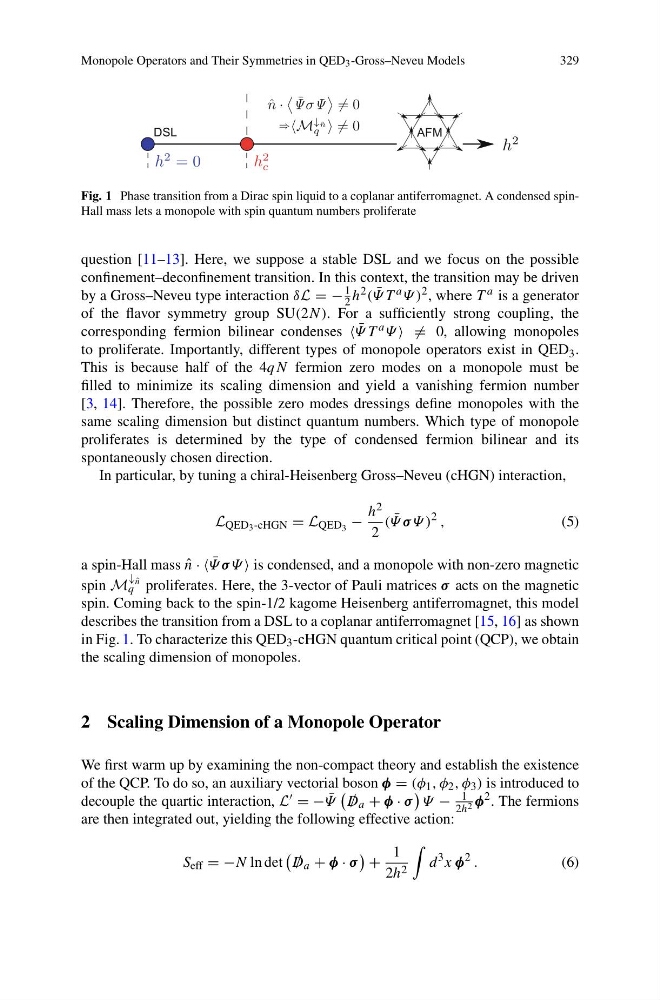
Fig. 1 Phase transition from a Dirac spin liquid to a coplanar antiferromagnet. A condensed spinHall mass lets a monopole with spin quantum numbers proliferate
question [11–13]. Here, we suppose a stable DSL and we focus on the possible
confinement–deconfinement transition. In this context, the transition may be driven
by a Gross–Neveu type interaction δL = −
1
2 h 2 ( ¯
Ψ T a Ψ ) 2 , where T a is a generator
of the flavor symmetry group SU(2N). For a sufficiently strong coupling, the
corresponding fermion bilinear condenses ¯
Ψ T a Ψ = 0, allowing monopoles
to proliferate. Importantly, different types of monopole operators exist in QED 3 .
This is because half of the 4qN fermion zero modes on a monopole must be
filled to minimize its scaling dimension and yield a vanishing fermion number
[3, 14]. Therefore, the possible zero modes dressings define monopoles with the
same scaling dimension but distinct quantum numbers. Which type of monopole
proliferates is determined by the type of condensed fermion bilinear and its
spontaneously chosen direction.
In particular, by tuning a chiral-Heisenberg Gross–Neveu (cHGN) interaction,
L QED 3 -cHGN = L QED 3 −
h 2
2
( ¯
Ψ σ Ψ )
2 ,
(5)
a spin-Hall mass ˆ
n · · ¯
Ψ σ Ψ is condensed, and a monopole with non-zero magnetic
spin M
↓ ˆ
n
q proliferates. Here, the 3-vector of Pauli matrices σ acts on the magnetic
spin. Coming back to the spin-1/2 kagome Heisenberg antiferromagnet, this model
describes the transition from a DSL to a coplanar antiferromagnet [15, 16] as shown
in Fig. 1. To characterize this QED 3 -cHGN quantum critical point (QCP), we obtain
the scaling dimension of monopoles.
2 Scaling Dimension of a Monopole Operator
We first warm up by examining the non-compact theory and establish the existence
of the QCP. To do so, an auxiliary vectorial boson φ = (φ 1 , φ 2 , φ 3 ) is introduced to
decouple the quartic interaction, L = − ¯
Ψ
/
D a + φ · σ
Ψ −
1
2h 2 φ
2 . The fermions
are then integrated out, yielding the following effective action:
S eff = −N ln det
/
D a + φ · σ
+
1
2h 2
d
3 x φ
2 .
(6)
329
AFM
DSL
Fig. 1 Phase transition from a Dirac spin liquid to a coplanar antiferromagnet. A condensed spinHall mass lets a monopole with spin quantum numbers proliferate
question [11–13]. Here, we suppose a stable DSL and we focus on the possible
confinement–deconfinement transition. In this context, the transition may be driven
by a Gross–Neveu type interaction δL = −
1
2 h 2 ( ¯
Ψ T a Ψ ) 2 , where T a is a generator
of the flavor symmetry group SU(2N). For a sufficiently strong coupling, the
corresponding fermion bilinear condenses ¯
Ψ T a Ψ = 0, allowing monopoles
to proliferate. Importantly, different types of monopole operators exist in QED 3 .
This is because half of the 4qN fermion zero modes on a monopole must be
filled to minimize its scaling dimension and yield a vanishing fermion number
[3, 14]. Therefore, the possible zero modes dressings define monopoles with the
same scaling dimension but distinct quantum numbers. Which type of monopole
proliferates is determined by the type of condensed fermion bilinear and its
spontaneously chosen direction.
In particular, by tuning a chiral-Heisenberg Gross–Neveu (cHGN) interaction,
L QED 3 -cHGN = L QED 3 −
h 2
2
( ¯
Ψ σ Ψ )
2 ,
(5)
a spin-Hall mass ˆ
n · · ¯
Ψ σ Ψ is condensed, and a monopole with non-zero magnetic
spin M
↓ ˆ
n
q proliferates. Here, the 3-vector of Pauli matrices σ acts on the magnetic
spin. Coming back to the spin-1/2 kagome Heisenberg antiferromagnet, this model
describes the transition from a DSL to a coplanar antiferromagnet [15, 16] as shown
in Fig. 1. To characterize this QED 3 -cHGN quantum critical point (QCP), we obtain
the scaling dimension of monopoles.
2 Scaling Dimension of a Monopole Operator
We first warm up by examining the non-compact theory and establish the existence
of the QCP. To do so, an auxiliary vectorial boson φ = (φ 1 , φ 2 , φ 3 ) is introduced to
decouple the quartic interaction, L = − ¯
Ψ
/
D a + φ · σ
Ψ −
1
2h 2 φ
2 . The fermions
are then integrated out, yielding the following effective action:
S eff = −N ln det
/
D a + φ · σ
+
1
2h 2
d
3 x φ
2 .
(6)