

328
É. Dupuis et al.
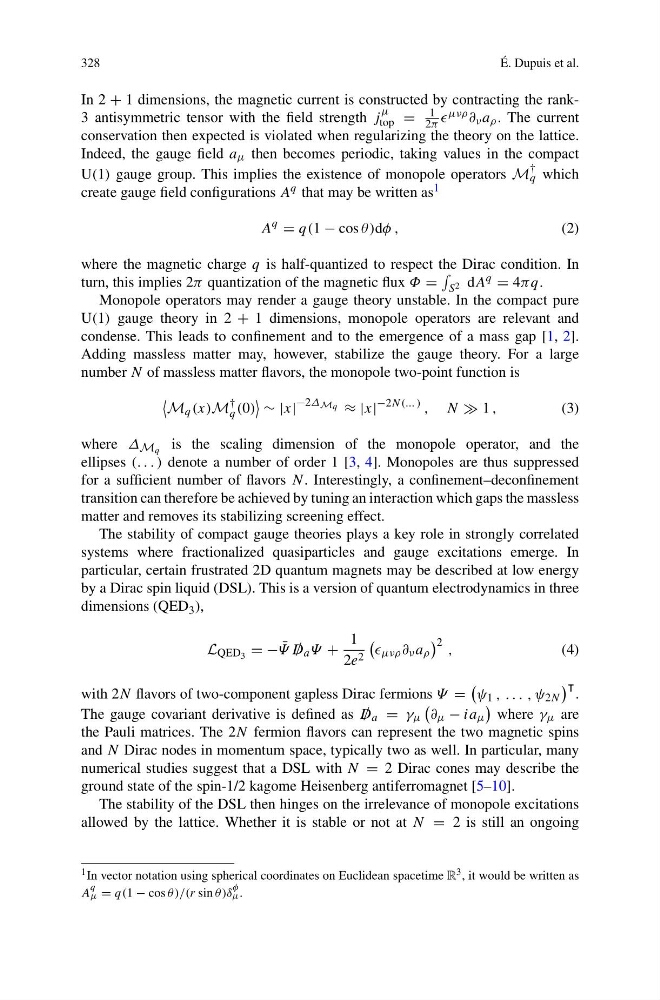
In 2 + 1 dimensions, the magnetic current is constructed by contracting the rank3 antisymmetric tensor with the field strength j
μ
top =
1
2π μνρ ∂ ν a ρ . The current
conservation then expected is violated when regularizing the theory on the lattice.
Indeed, the gauge field a μ then becomes periodic, taking values in the compact
U(1) gauge group. This implies the existence of monopole operators M
†
q which
create gauge field configurations A q that may be written as 1
A
q
= q(1 − cos θ)dφ ,
(2)
where the magnetic charge q is half-quantized to respect the Dirac condition. In
turn, this implies 2π quantization of the magnetic flux Φ =
S 2 dA q = 4πq.
Monopole operators may render a gauge theory unstable. In the compact pure
U(1) gauge theory in 2 + 1 dimensions, monopole operators are relevant and
condense. This leads to confinement and to the emergence of a mass gap [1, 2].
Adding massless matter may, however, stabilize the gauge theory. For a large
number N of massless matter flavors, the monopole two-point function is
M q (x)M
†
q (0)
∼ |x|
−2Δ Mq ≈ |x|
−2N (... ) , N 1 ,
(3)
where Δ M q is the scaling dimension of the monopole operator, and the
ellipses (. . . ) denote a number of order 1 [3, 4]. Monopoles are thus suppressed
for a sufficient number of flavors N. Interestingly, a confinement–deconfinement
transition can therefore be achieved by tuning an interaction which gaps the massless
matter and removes its stabilizing screening effect.
The stability of compact gauge theories plays a key role in strongly correlated
systems where fractionalized quasiparticles and gauge excitations emerge. In
particular, certain frustrated 2D quantum magnets may be described at low energy
by a Dirac spin liquid (DSL). This is a version of quantum electrodynamics in three
dimensions (QED 3 ),
L QED 3 = − ¯
Ψ /
D a Ψ +
1
2e 2
μνρ ∂ ν a ρ
2 ,
(4)
with 2N flavors of two-component gapless Dirac fermions Ψ =
ψ 1 , . . . , ψ 2N
.
The gauge covariant derivative is defined as /
D a = γ μ
∂ μ − ia μ
where γ μ are
the Pauli matrices. The 2N fermion flavors can represent the two magnetic spins
and N Dirac nodes in momentum space, typically two as well. In particular, many
numerical studies suggest that a DSL with N = 2 Dirac cones may describe the
ground state of the spin-1/2 kagome Heisenberg antiferromagnet [5–10].
The stability of the DSL then hinges on the irrelevance of monopole excitations
allowed by the lattice. Whether it is stable or not at N = 2 is still an ongoing
1 In vector notation using spherical coordinates on Euclidean spacetime R 3 , it would be written as
A
q
μ = q(1 − cos θ)/(r sin θ)δ
φ
μ .
É. Dupuis et al.
In 2 + 1 dimensions, the magnetic current is constructed by contracting the rank3 antisymmetric tensor with the field strength j
μ
top =
1
2π μνρ ∂ ν a ρ . The current
conservation then expected is violated when regularizing the theory on the lattice.
Indeed, the gauge field a μ then becomes periodic, taking values in the compact
U(1) gauge group. This implies the existence of monopole operators M
†
q which
create gauge field configurations A q that may be written as 1
A
q
= q(1 − cos θ)dφ ,
(2)
where the magnetic charge q is half-quantized to respect the Dirac condition. In
turn, this implies 2π quantization of the magnetic flux Φ =
S 2 dA q = 4πq.
Monopole operators may render a gauge theory unstable. In the compact pure
U(1) gauge theory in 2 + 1 dimensions, monopole operators are relevant and
condense. This leads to confinement and to the emergence of a mass gap [1, 2].
Adding massless matter may, however, stabilize the gauge theory. For a large
number N of massless matter flavors, the monopole two-point function is
M q (x)M
†
q (0)
∼ |x|
−2Δ Mq ≈ |x|
−2N (... ) , N 1 ,
(3)
where Δ M q is the scaling dimension of the monopole operator, and the
ellipses (. . . ) denote a number of order 1 [3, 4]. Monopoles are thus suppressed
for a sufficient number of flavors N. Interestingly, a confinement–deconfinement
transition can therefore be achieved by tuning an interaction which gaps the massless
matter and removes its stabilizing screening effect.
The stability of compact gauge theories plays a key role in strongly correlated
systems where fractionalized quasiparticles and gauge excitations emerge. In
particular, certain frustrated 2D quantum magnets may be described at low energy
by a Dirac spin liquid (DSL). This is a version of quantum electrodynamics in three
dimensions (QED 3 ),
L QED 3 = − ¯
Ψ /
D a Ψ +
1
2e 2
μνρ ∂ ν a ρ
2 ,
(4)
with 2N flavors of two-component gapless Dirac fermions Ψ =
ψ 1 , . . . , ψ 2N
.
The gauge covariant derivative is defined as /
D a = γ μ
∂ μ − ia μ
where γ μ are
the Pauli matrices. The 2N fermion flavors can represent the two magnetic spins
and N Dirac nodes in momentum space, typically two as well. In particular, many
numerical studies suggest that a DSL with N = 2 Dirac cones may describe the
ground state of the spin-1/2 kagome Heisenberg antiferromagnet [5–10].
The stability of the DSL then hinges on the irrelevance of monopole excitations
allowed by the lattice. Whether it is stable or not at N = 2 is still an ongoing
1 In vector notation using spherical coordinates on Euclidean spacetime R 3 , it would be written as
A
q
μ = q(1 − cos θ)/(r sin θ)δ
φ
μ .