

334
É. Dupuis et al.
where μ are Pauli matrices acting on nodal subspace. The scaling dimension of
monopole operators in these spin and nodal triplets are expected to differ given
that no hidden symmetry connects the multiplets. Monopole operators with the
largest total spin (here, S = 1) have access to the largest polarization and as a
result can minimize the contribution from the spin-Hall mass. These operators have
the lowest scaling dimension and are the finite-N analogues of monopoles with
minimal scaling dimension Δ 1/2 studied in Sect. 2. In our large-N analysis, we
gave the example of a monopole filled only with spin down “zero” modes along
ˆ
z such that the corresponding spin-Hall mass ¯
Ψ σ z Ψ ∝ M q > 0 is minimized. As
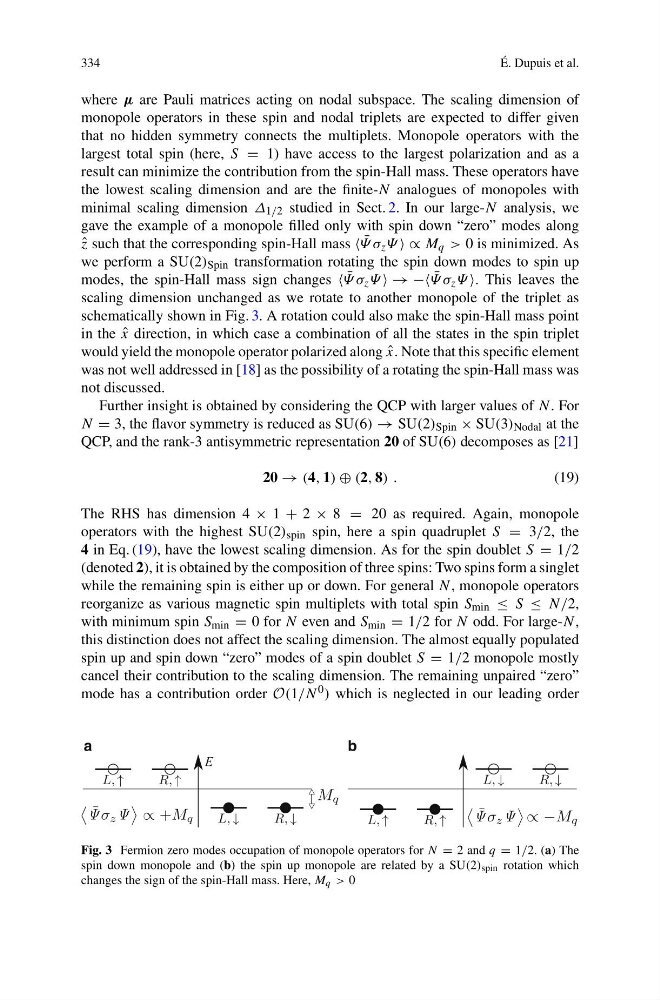
we perform a SU(2) Spin transformation rotating the spin down modes to spin up
modes, the spin-Hall mass sign changes ¯
Ψ σ z Ψ → −− ¯
Ψ σ z Ψ . This leaves the
scaling dimension unchanged as we rotate to another monopole of the triplet as
schematically shown in Fig. 3. A rotation could also make the spin-Hall mass point
in the ˆ
x direction, in which case a combination of all the states in the spin triplet
would yield the monopole operator polarized along ˆ
x. Note that this specific element
was not well addressed in [18] as the possibility of a rotating the spin-Hall mass was
not discussed.
Further insight is obtained by considering the QCP with larger values of N . For
N = 3, the flavor symmetry is reduced as SU(6) → SU(2) Spin × SU(3) Nodal at the
QCP, and the rank-3 antisymmetric representation 20 of SU(6) decomposes as [21]
20 → (4, 1) ⊕ (2, 8) .
(19)
The RHS has dimension 4 × 1 + 2 × 8 = 20 as required. Again, monopole
operators with the highest SU(2) spin spin, here a spin quadruplet S = 3/2, the
4 in Eq. (19), have the lowest scaling dimension. As for the spin doublet S = 1/2
(denoted 2), it is obtained by the composition of three spins: Two spins form a singlet
while the remaining spin is either up or down. For general N , monopole operators
reorganize as various magnetic spin multiplets with total spin S min ≤ S ≤ N/2,
with minimum spin S min = 0 for N even and S min = 1/2 for N odd. For large-N ,
this distinction does not affect the scaling dimension. The almost equally populated
spin up and spin down “zero” modes of a spin doublet S = 1/2 monopole mostly
cancel their contribution to the scaling dimension. The remaining unpaired “zero”
mode has a contribution order O(1/N 0 ) which is neglected in our leading order
E
b
a
Fig. 3 Fermion zero modes occupation of monopole operators for N = 2 and q = 1/2. (a) The
spin down monopole and (b) the spin up monopole are related by a SU(2) spin rotation which
changes the sign of the spin-Hall mass. Here, M q > 0
É. Dupuis et al.
where μ are Pauli matrices acting on nodal subspace. The scaling dimension of
monopole operators in these spin and nodal triplets are expected to differ given
that no hidden symmetry connects the multiplets. Monopole operators with the
largest total spin (here, S = 1) have access to the largest polarization and as a
result can minimize the contribution from the spin-Hall mass. These operators have
the lowest scaling dimension and are the finite-N analogues of monopoles with
minimal scaling dimension Δ 1/2 studied in Sect. 2. In our large-N analysis, we
gave the example of a monopole filled only with spin down “zero” modes along
ˆ
z such that the corresponding spin-Hall mass ¯
Ψ σ z Ψ ∝ M q > 0 is minimized. As
we perform a SU(2) Spin transformation rotating the spin down modes to spin up
modes, the spin-Hall mass sign changes ¯
Ψ σ z Ψ → −− ¯
Ψ σ z Ψ . This leaves the
scaling dimension unchanged as we rotate to another monopole of the triplet as
schematically shown in Fig. 3. A rotation could also make the spin-Hall mass point
in the ˆ
x direction, in which case a combination of all the states in the spin triplet
would yield the monopole operator polarized along ˆ
x. Note that this specific element
was not well addressed in [18] as the possibility of a rotating the spin-Hall mass was
not discussed.
Further insight is obtained by considering the QCP with larger values of N . For
N = 3, the flavor symmetry is reduced as SU(6) → SU(2) Spin × SU(3) Nodal at the
QCP, and the rank-3 antisymmetric representation 20 of SU(6) decomposes as [21]
20 → (4, 1) ⊕ (2, 8) .
(19)
The RHS has dimension 4 × 1 + 2 × 8 = 20 as required. Again, monopole
operators with the highest SU(2) spin spin, here a spin quadruplet S = 3/2, the
4 in Eq. (19), have the lowest scaling dimension. As for the spin doublet S = 1/2
(denoted 2), it is obtained by the composition of three spins: Two spins form a singlet
while the remaining spin is either up or down. For general N , monopole operators
reorganize as various magnetic spin multiplets with total spin S min ≤ S ≤ N/2,
with minimum spin S min = 0 for N even and S min = 1/2 for N odd. For large-N ,
this distinction does not affect the scaling dimension. The almost equally populated
spin up and spin down “zero” modes of a spin doublet S = 1/2 monopole mostly
cancel their contribution to the scaling dimension. The remaining unpaired “zero”
mode has a contribution order O(1/N 0 ) which is neglected in our leading order
E
b
a
Fig. 3 Fermion zero modes occupation of monopole operators for N = 2 and q = 1/2. (a) The
spin down monopole and (b) the spin up monopole are related by a SU(2) spin rotation which
changes the sign of the spin-Hall mass. Here, M q > 0