

Spin Chains of Haldane–Shastry Type: A Bird’s Eye View
17
where σ takes all values in {1, . . . , m + n} N . As we shall next discuss, this formula
is much better suited for deriving the asymptotic behavior of the partition function
in the thermodynamic limit N → ∞.
7 Thermodynamics
We shall only present here a brief overview of the application of the methods
outlined in the previous sections to the computation the free energy of a supersymmetric spin chain of Haldane–Shastry type in the thermodynamic limit, referring the
interested reader to Refs. [9, 12] for details.
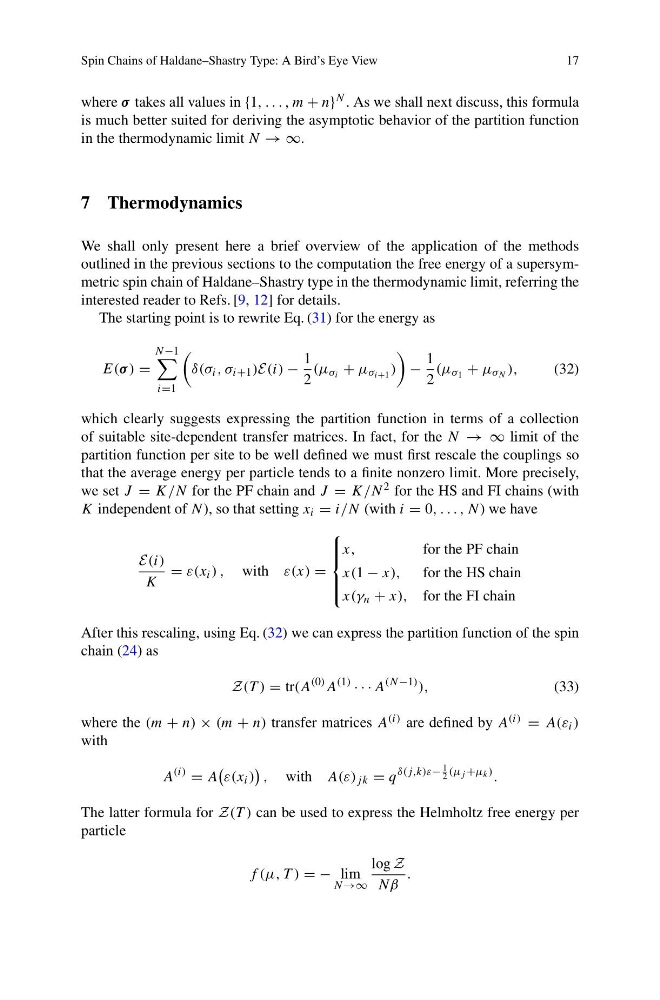
The starting point is to rewrite Eq. (31) for the energy as
E(σ ) =
N −1
i=1
δ(σ i , σ i+1 )E(i) −
1
2
(μ σ i + μ σ i+1 )
−
1
2
(μ σ 1 + μ σ N ),
(32)
which clearly suggests expressing the partition function in terms of a collection
of suitable site-dependent transfer matrices. In fact, for the N → ∞ limit of the
partition function per site to be well defined we must first rescale the couplings so
that the average energy per particle tends to a finite nonzero limit. More precisely,
we set J = K/N for the PF chain and J = K/N 2 for the HS and FI chains (with
K independent of N ), so that setting x i = i/N (with i = 0, . . . , N) we have
E(i)
K
= ε(x i ) , with ε(x) =
⎧
⎪ ⎪ ⎨
⎪ ⎪ ⎩
x,
for the PF chain
x(1 − x), for the HS chain
x(γ n + x), for the FI chain
After this rescaling, using Eq. (32) we can express the partition function of the spin
chain (24) as
Z(T ) = tr(A
(0) A
(1)
· · · A
(N −1) ),
(33)
where the (m + n) × (m + n) transfer matrices A (i) are defined by A (i) = A(ε i )
with
A
(i)
= A
ε(x i )
, with A(ε) jk = q
δ(j,k)ε−
1
2 (μ j +μ k ) .
The latter formula for Z(T ) can be used to express the Helmholtz free energy per
particle
f (μ, T ) = − lim
N →∞
log Z
Nβ
.
17
where σ takes all values in {1, . . . , m + n} N . As we shall next discuss, this formula
is much better suited for deriving the asymptotic behavior of the partition function
in the thermodynamic limit N → ∞.
7 Thermodynamics
We shall only present here a brief overview of the application of the methods
outlined in the previous sections to the computation the free energy of a supersymmetric spin chain of Haldane–Shastry type in the thermodynamic limit, referring the
interested reader to Refs. [9, 12] for details.
The starting point is to rewrite Eq. (31) for the energy as
E(σ ) =
N −1
i=1
δ(σ i , σ i+1 )E(i) −
1
2
(μ σ i + μ σ i+1 )
−
1
2
(μ σ 1 + μ σ N ),
(32)
which clearly suggests expressing the partition function in terms of a collection
of suitable site-dependent transfer matrices. In fact, for the N → ∞ limit of the
partition function per site to be well defined we must first rescale the couplings so
that the average energy per particle tends to a finite nonzero limit. More precisely,
we set J = K/N for the PF chain and J = K/N 2 for the HS and FI chains (with
K independent of N ), so that setting x i = i/N (with i = 0, . . . , N) we have
E(i)
K
= ε(x i ) , with ε(x) =
⎧
⎪ ⎪ ⎨
⎪ ⎪ ⎩
x,
for the PF chain
x(1 − x), for the HS chain
x(γ n + x), for the FI chain
After this rescaling, using Eq. (32) we can express the partition function of the spin
chain (24) as
Z(T ) = tr(A
(0) A
(1)
· · · A
(N −1) ),
(33)
where the (m + n) × (m + n) transfer matrices A (i) are defined by A (i) = A(ε i )
with
A
(i)
= A
ε(x i )
, with A(ε) jk = q
δ(j,k)ε−
1
2 (μ j +μ k ) .
The latter formula for Z(T ) can be used to express the Helmholtz free energy per
particle
f (μ, T ) = − lim
N →∞
log Z
Nβ
.