

16
F. Finkel et al.
6 Associated Vertex Models
The closed expression (28) for the partition function of the supersymmetric HS-type
chains (24) provides an efficient way of computing their energies and degeneracies,
but it is not appropriate for deriving the thermodynamics of these models. In this
section we shall relate the spin chains (24) to an inhomogeneous vertex model,
finding in this way an alternative expression for the partition function better suited
for studying its thermodynamic limit N → ∞.
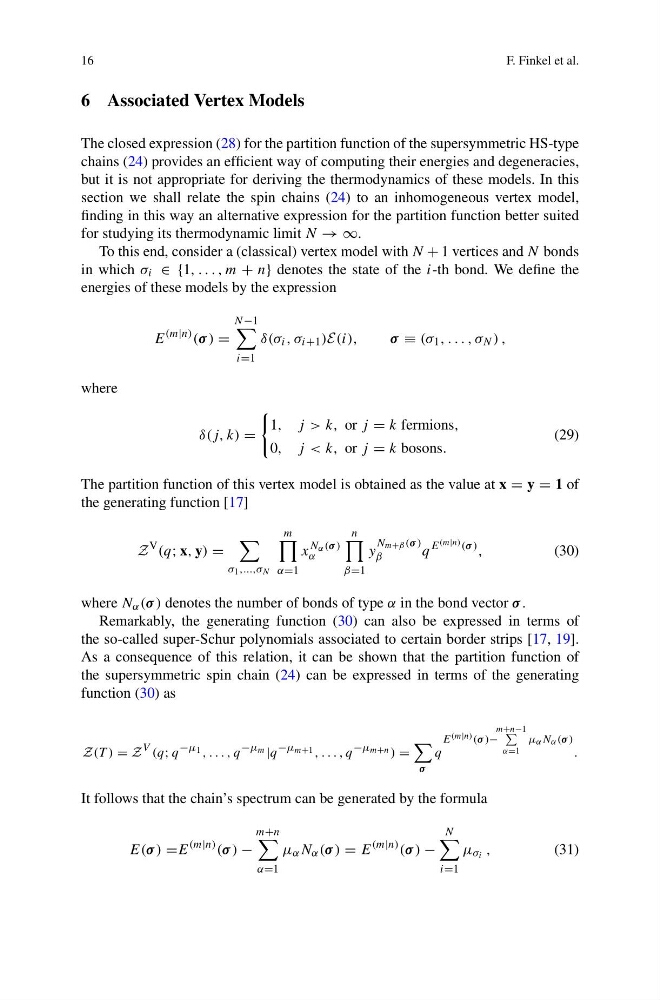
To this end, consider a (classical) vertex model with N + 1 vertices and N bonds
in which σ i ∈ {1, . . . , m + n} denotes the state of the i-th bond. We define the
energies of these models by the expression
E
(m|n) (σ ) =
N −1
i=1
δ(σ i , σ i+1 )E(i),
σ ≡ (σ 1 , . . . , σ N ) ,
where
δ(j, k) =
1, j > k, or j = k fermions,
0, j < k, or j = k bosons.
(29)
The partition function of this vertex model is obtained as the value at x = y = 1 of
the generating function [17]
Z
V (q; x, y) =
σ 1 ,...,σ N
m
α=1
x
N α (σ )
α
n
β=1
y
N m+β (σ )
β
q
E (m|n) (σ ) ,
(30)
where N α (σ ) denotes the number of bonds of type α in the bond vector σ .
Remarkably, the generating function (30) can also be expressed in terms of
the so-called super-Schur polynomials associated to certain border strips [17, 19].
As a consequence of this relation, it can be shown that the partition function of
the supersymmetric spin chain (24) can be expressed in terms of the generating
function (30) as
Z(T ) = Z V (q; q −μ 1 , . . . , q −μ m |q −μ m+1 , . . . , q −μ m+n ) =
σ
q
E (m|n) (σ )−
m+n−1
α=1
μ α N α (σ )
.
It follows that the chain’s spectrum can be generated by the formula
E(σ ) =E
(m|n) (σ ) −
m+n
α=1
μ α N α (σ ) = E
(m|n) (σ ) −
N
i=1
μ σ i ,
(31)
F. Finkel et al.
6 Associated Vertex Models
The closed expression (28) for the partition function of the supersymmetric HS-type
chains (24) provides an efficient way of computing their energies and degeneracies,
but it is not appropriate for deriving the thermodynamics of these models. In this
section we shall relate the spin chains (24) to an inhomogeneous vertex model,
finding in this way an alternative expression for the partition function better suited
for studying its thermodynamic limit N → ∞.
To this end, consider a (classical) vertex model with N + 1 vertices and N bonds
in which σ i ∈ {1, . . . , m + n} denotes the state of the i-th bond. We define the
energies of these models by the expression
E
(m|n) (σ ) =
N −1
i=1
δ(σ i , σ i+1 )E(i),
σ ≡ (σ 1 , . . . , σ N ) ,
where
δ(j, k) =
1, j > k, or j = k fermions,
0, j < k, or j = k bosons.
(29)
The partition function of this vertex model is obtained as the value at x = y = 1 of
the generating function [17]
Z
V (q; x, y) =
σ 1 ,...,σ N
m
α=1
x
N α (σ )
α
n
β=1
y
N m+β (σ )
β
q
E (m|n) (σ ) ,
(30)
where N α (σ ) denotes the number of bonds of type α in the bond vector σ .
Remarkably, the generating function (30) can also be expressed in terms of
the so-called super-Schur polynomials associated to certain border strips [17, 19].
As a consequence of this relation, it can be shown that the partition function of
the supersymmetric spin chain (24) can be expressed in terms of the generating
function (30) as
Z(T ) = Z V (q; q −μ 1 , . . . , q −μ m |q −μ m+1 , . . . , q −μ m+n ) =
σ
q
E (m|n) (σ )−
m+n−1
α=1
μ α N α (σ )
.
It follows that the chain’s spectrum can be generated by the formula
E(σ ) =E
(m|n) (σ ) −
m+n
α=1
μ α N α (σ ) = E
(m|n) (σ ) −
N
i=1
μ σ i ,
(31)