

Spin Chains of Haldane–Shastry Type: A Bird’s Eye View
15
the operators H , H sc , and H 0 are related to the spin chain Hamiltonian (24) by the
expressions
H = H sc +
2a
J
H
(m|n)
ξ i →x i
.
Reasoning as in the previous sections, we deduce that the partition function of the
spin chain (24) can be computed from the freezing trick formula
Z(T ) = lim
a→∞
Z(2aT /J )
Z sc (2aT /J )
,
where Z and Z sc , respectively, denote the partition functions of H and H sc . In
fact, the partition function of the scalar model H sc has already been computed in
Sect. 2.2 (cf. Eq. (3)). As to the dynamical spin model, its partition function can be
obtained along the same lines as in the purely fermionic or bosonic cases, although
the computations are more involved due to the presence of the chemical potential
term. The final result is
Z
2aT
J
= q
J E 0 /(2a)
k∈P N
Σ(k) q
J
r−1
i=1
K i
r
i=1
1
1 − q J K i
,
(27)
(cf. [12]), where
Σ(k) =
r
i=1
σ (k i ), σ (k i ) =
k i
j =0
h k i −j
q −μ 1 , . . . , q −μ m
e j
q −μ m+1 , . . . , q −μ m+n
,
μ m+n = 0, and h and e, respectively, denote the complete homogeneous and
elementary symmetric polynomials (see, e.g., [19] for their precise definitions and
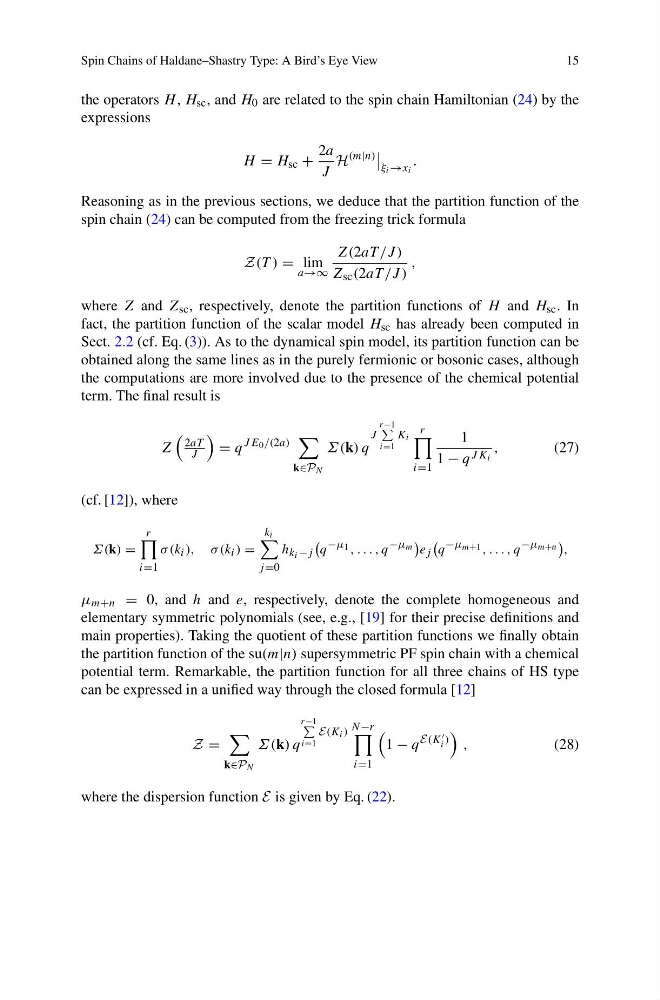
main properties). Taking the quotient of these partition functions we finally obtain
the partition function of the su(m|n) supersymmetric PF spin chain with a chemical
potential term. Remarkable, the partition function for all three chains of HS type
can be expressed in a unified way through the closed formula [12]
Z =
k∈P N
Σ(k) q
r−1
i=1
E(K i ) N −r
i=1
1 − q
E(K
i )
,
(28)
where the dispersion function E is given by Eq. (22).
15
the operators H , H sc , and H 0 are related to the spin chain Hamiltonian (24) by the
expressions
H = H sc +
2a
J
H
(m|n)
ξ i →x i
.
Reasoning as in the previous sections, we deduce that the partition function of the
spin chain (24) can be computed from the freezing trick formula
Z(T ) = lim
a→∞
Z(2aT /J )
Z sc (2aT /J )
,
where Z and Z sc , respectively, denote the partition functions of H and H sc . In
fact, the partition function of the scalar model H sc has already been computed in
Sect. 2.2 (cf. Eq. (3)). As to the dynamical spin model, its partition function can be
obtained along the same lines as in the purely fermionic or bosonic cases, although
the computations are more involved due to the presence of the chemical potential
term. The final result is
Z
2aT
J
= q
J E 0 /(2a)
k∈P N
Σ(k) q
J
r−1
i=1
K i
r
i=1
1
1 − q J K i
,
(27)
(cf. [12]), where
Σ(k) =
r
i=1
σ (k i ), σ (k i ) =
k i
j =0
h k i −j
q −μ 1 , . . . , q −μ m
e j
q −μ m+1 , . . . , q −μ m+n
,
μ m+n = 0, and h and e, respectively, denote the complete homogeneous and
elementary symmetric polynomials (see, e.g., [19] for their precise definitions and
main properties). Taking the quotient of these partition functions we finally obtain
the partition function of the su(m|n) supersymmetric PF spin chain with a chemical
potential term. Remarkable, the partition function for all three chains of HS type
can be expressed in a unified way through the closed formula [12]
Z =
k∈P N
Σ(k) q
r−1
i=1
E(K i ) N −r
i=1
1 − q
E(K
i )
,
(28)
where the dispersion function E is given by Eq. (22).