

14
F. Finkel et al.
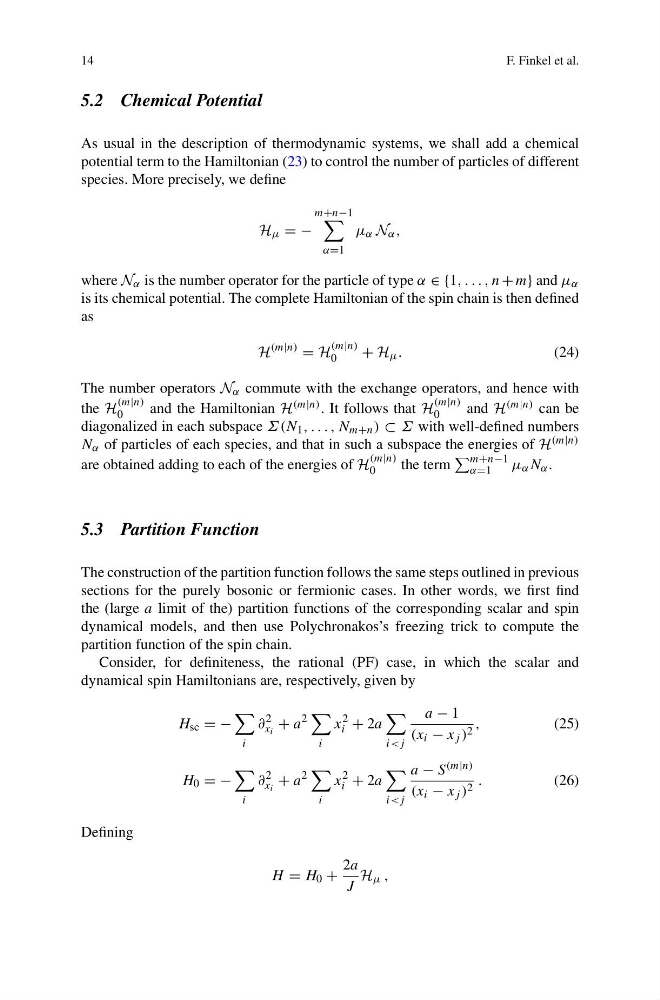
5.2 Chemical Potential
As usual in the description of thermodynamic systems, we shall add a chemical
potential term to the Hamiltonian (23) to control the number of particles of different
species. More precisely, we define
H μ = −
m+n−1
α=1
μ α N α ,
where N α is the number operator for the particle of type α ∈ {1, . . . , n + m} and μ α
is its chemical potential. The complete Hamiltonian of the spin chain is then defined
as
H
(m|n)
= H
(m|n)
0
+ H μ .
(24)
The number operators N α commute with the exchange operators, and hence with
the H
(m|n)
0
and the Hamiltonian H (m|n) . It follows that H
(m|n)
0
and H (m|n) can be
diagonalized in each subspace Σ(N 1 , . . . , N m+n ) ⊂ Σ with well-defined numbers
N α of particles of each species, and that in such a subspace the energies of H (m|n)
are obtained adding to each of the energies of H
(m|n)
0
the term
m+n−1
α=1
μ α N α .
5.3 Partition Function
The construction of the partition function follows the same steps outlined in previous
sections for the purely bosonic or fermionic cases. In other words, we first find
the (large a limit of the) partition functions of the corresponding scalar and spin
dynamical models, and then use Polychronakos’s freezing trick to compute the
partition function of the spin chain.
Consider, for definiteness, the rational (PF) case, in which the scalar and
dynamical spin Hamiltonians are, respectively, given by
H sc = −
i
∂
2
x i
+ a
2
i
x
2
i + 2a
i
(x i − x j ) 2 ,
(25)
H 0 = −
i
∂
2
x i
+ a
2
i
x
2
i + 2a
i
(x i − x j ) 2 .
(26)
Defining
H = H 0 +
2a
J
H μ ,
F. Finkel et al.
5.2 Chemical Potential
As usual in the description of thermodynamic systems, we shall add a chemical
potential term to the Hamiltonian (23) to control the number of particles of different
species. More precisely, we define
H μ = −
m+n−1
α=1
μ α N α ,
where N α is the number operator for the particle of type α ∈ {1, . . . , n + m} and μ α
is its chemical potential. The complete Hamiltonian of the spin chain is then defined
as
H
(m|n)
= H
(m|n)
0
+ H μ .
(24)
The number operators N α commute with the exchange operators, and hence with
the H
(m|n)
0
and the Hamiltonian H (m|n) . It follows that H
(m|n)
0
and H (m|n) can be
diagonalized in each subspace Σ(N 1 , . . . , N m+n ) ⊂ Σ with well-defined numbers
N α of particles of each species, and that in such a subspace the energies of H (m|n)
are obtained adding to each of the energies of H
(m|n)
0
the term
m+n−1
α=1
μ α N α .
5.3 Partition Function
The construction of the partition function follows the same steps outlined in previous
sections for the purely bosonic or fermionic cases. In other words, we first find
the (large a limit of the) partition functions of the corresponding scalar and spin
dynamical models, and then use Polychronakos’s freezing trick to compute the
partition function of the spin chain.
Consider, for definiteness, the rational (PF) case, in which the scalar and
dynamical spin Hamiltonians are, respectively, given by
H sc = −
i
∂
2
x i
+ a
2
i
x
2
i + 2a
i
(x i − x j ) 2 ,
(25)
H 0 = −
i
∂
2
x i
+ a
2
i
x
2
i + 2a
i
(x i − x j ) 2 .
(26)
Defining
H = H 0 +
2a
J
H μ ,