

272
D. O. Campa et al.
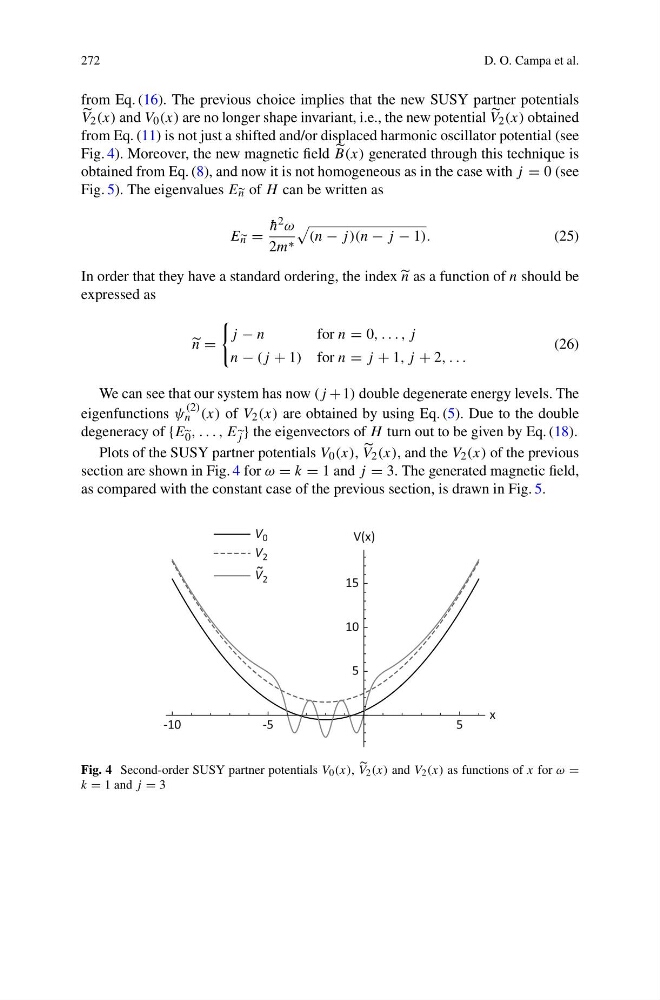
from Eq. (16). The previous choice implies that the new SUSY partner potentials
V 2 (x) and V 0 (x) are no longer shape invariant, i.e., the new potential
V 2 (x) obtained
from Eq. (11) is not just a shifted and/or displaced harmonic oscillator potential (see
Fig. 4). Moreover, the new magnetic field
B(x) generated through this technique is
obtained from Eq. (8), and now it is not homogeneous as in the case with j = 0 (see
Fig. 5). The eigenvalues E n of H can be written as
E n =
¯
h 2 ω
2m ∗
(n − j )(n − j − 1).
(25)
In order that they have a standard ordering, the index n as a function of n should be
expressed as
n =
j − n
for n = 0, . . . , j
n − (j + 1) for n = j + 1, j + 2, . . .
(26)
We can see that our system has now (j + 1) double degenerate energy levels. The
eigenfunctions ψ
(2)
n (x) of V 2 (x) are obtained by using Eq. (5). Due to the double
degeneracy of {E 0 , . . . , E j } the eigenvectors of H turn out to be given by Eq. (18).
Plots of the SUSY partner potentials V 0 (x),
V 2 (x), and the V 2 (x) of the previous
section are shown in Fig. 4 for ω = k = 1 and j = 3. The generated magnetic field,
as compared with the constant case of the previous section, is drawn in Fig. 5.
-10
-5
5
x
5
10
15
V(x)
V 0
V 2
V 2
˜
Fig. 4 Second-order SUSY partner potentials V 0 (x),
V 2 (x) and V 2 (x) as functions of x for ω =
k = 1 and j = 3
D. O. Campa et al.
from Eq. (16). The previous choice implies that the new SUSY partner potentials
V 2 (x) and V 0 (x) are no longer shape invariant, i.e., the new potential
V 2 (x) obtained
from Eq. (11) is not just a shifted and/or displaced harmonic oscillator potential (see
Fig. 4). Moreover, the new magnetic field
B(x) generated through this technique is
obtained from Eq. (8), and now it is not homogeneous as in the case with j = 0 (see
Fig. 5). The eigenvalues E n of H can be written as
E n =
¯
h 2 ω
2m ∗
(n − j )(n − j − 1).
(25)
In order that they have a standard ordering, the index n as a function of n should be
expressed as
n =
j − n
for n = 0, . . . , j
n − (j + 1) for n = j + 1, j + 2, . . .
(26)
We can see that our system has now (j + 1) double degenerate energy levels. The
eigenfunctions ψ
(2)
n (x) of V 2 (x) are obtained by using Eq. (5). Due to the double
degeneracy of {E 0 , . . . , E j } the eigenvectors of H turn out to be given by Eq. (18).
Plots of the SUSY partner potentials V 0 (x),
V 2 (x), and the V 2 (x) of the previous
section are shown in Fig. 4 for ω = k = 1 and j = 3. The generated magnetic field,
as compared with the constant case of the previous section, is drawn in Fig. 5.
-10
-5
5
x
5
10
15
V(x)
V 0
V 2
V 2
˜
Fig. 4 Second-order SUSY partner potentials V 0 (x),
V 2 (x) and V 2 (x) as functions of x for ω =
k = 1 and j = 3