

Electron in Bilayer Graphene with Magnetic Fields Associated with Solvable Potentials
273
-10
-5
5
x
-0.6
-0.4
-0.2
0.2
0.4
0.6
0.8
e
c
B(x)
B(x)
B(x) ˜
h
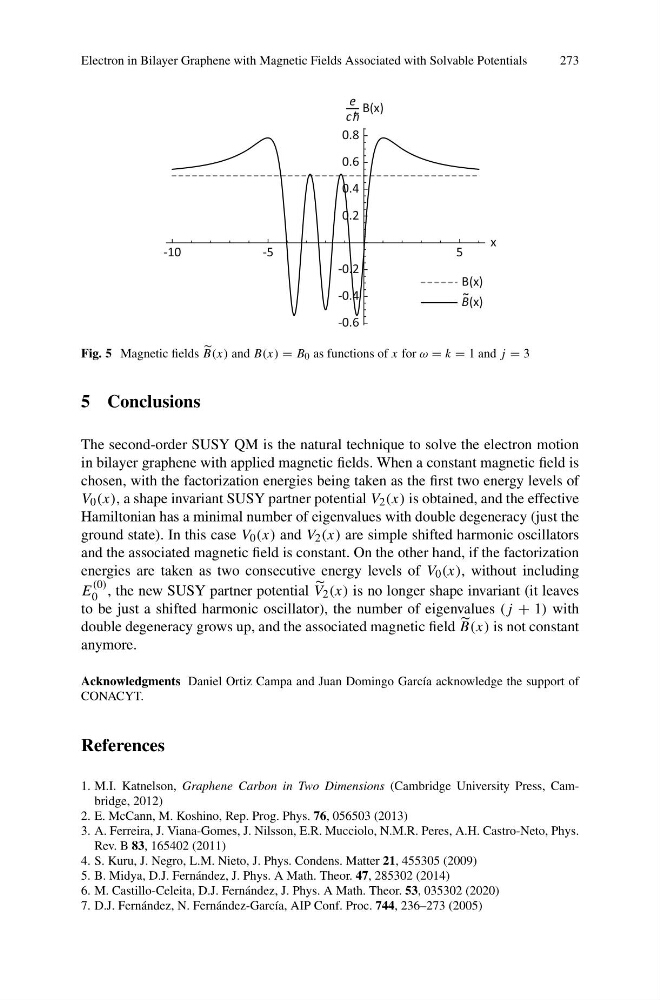
Fig. 5 Magnetic fields
B(x) and B(x) = B 0 as functions of x for ω = k = 1 and j = 3
5 Conclusions
The second-order SUSY QM is the natural technique to solve the electron motion
in bilayer graphene with applied magnetic fields. When a constant magnetic field is
chosen, with the factorization energies being taken as the first two energy levels of
V 0 (x), a shape invariant SUSY partner potential V 2 (x) is obtained, and the effective
Hamiltonian has a minimal number of eigenvalues with double degeneracy (just the
ground state). In this case V 0 (x) and V 2 (x) are simple shifted harmonic oscillators
and the associated magnetic field is constant. On the other hand, if the factorization
energies are taken as two consecutive energy levels of V 0 (x), without including
E
(0)
0 , the new SUSY partner potential
V 2 (x) is no longer shape invariant (it leaves
to be just a shifted harmonic oscillator), the number of eigenvalues (j + 1) with
double degeneracy grows up, and the associated magnetic field
B(x) is not constant
anymore.
Acknowledgments Daniel Ortiz Campa and Juan Domingo García acknowledge the support of
CONACYT.
References
1. M.I. Katnelson, Graphene Carbon in Two Dimensions (Cambridge University Press, Cambridge, 2012)
2. E. McCann, M. Koshino, Rep. Prog. Phys. 76, 056503 (2013)
3. A. Ferreira, J. Viana-Gomes, J. Nilsson, E.R. Mucciolo, N.M.R. Peres, A.H. Castro-Neto, Phys.
Rev. B 83, 165402 (2011)
4. S. Kuru, J. Negro, L.M. Nieto, J. Phys. Condens. Matter 21, 455305 (2009)
5. B. Midya, D.J. Fernández, J. Phys. A Math. Theor. 47, 285302 (2014)
6. M. Castillo-Celeita, D.J. Fernández, J. Phys. A Math. Theor. 53, 035302 (2020)
7. D.J. Fernández, N. Fernández-García, AIP Conf. Proc. 744, 236–273 (2005)
273
-10
-5
5
x
-0.6
-0.4
-0.2
0.2
0.4
0.6
0.8
e
c
B(x)
B(x)
B(x) ˜
h
Fig. 5 Magnetic fields
B(x) and B(x) = B 0 as functions of x for ω = k = 1 and j = 3
5 Conclusions
The second-order SUSY QM is the natural technique to solve the electron motion
in bilayer graphene with applied magnetic fields. When a constant magnetic field is
chosen, with the factorization energies being taken as the first two energy levels of
V 0 (x), a shape invariant SUSY partner potential V 2 (x) is obtained, and the effective
Hamiltonian has a minimal number of eigenvalues with double degeneracy (just the
ground state). In this case V 0 (x) and V 2 (x) are simple shifted harmonic oscillators
and the associated magnetic field is constant. On the other hand, if the factorization
energies are taken as two consecutive energy levels of V 0 (x), without including
E
(0)
0 , the new SUSY partner potential
V 2 (x) is no longer shape invariant (it leaves
to be just a shifted harmonic oscillator), the number of eigenvalues (j + 1) with
double degeneracy grows up, and the associated magnetic field
B(x) is not constant
anymore.
Acknowledgments Daniel Ortiz Campa and Juan Domingo García acknowledge the support of
CONACYT.
References
1. M.I. Katnelson, Graphene Carbon in Two Dimensions (Cambridge University Press, Cambridge, 2012)
2. E. McCann, M. Koshino, Rep. Prog. Phys. 76, 056503 (2013)
3. A. Ferreira, J. Viana-Gomes, J. Nilsson, E.R. Mucciolo, N.M.R. Peres, A.H. Castro-Neto, Phys.
Rev. B 83, 165402 (2011)
4. S. Kuru, J. Negro, L.M. Nieto, J. Phys. Condens. Matter 21, 455305 (2009)
5. B. Midya, D.J. Fernández, J. Phys. A Math. Theor. 47, 285302 (2014)
6. M. Castillo-Celeita, D.J. Fernández, J. Phys. A Math. Theor. 53, 035302 (2020)
7. D.J. Fernández, N. Fernández-García, AIP Conf. Proc. 744, 236–273 (2005)