

260
J. Moran and V. Hussin
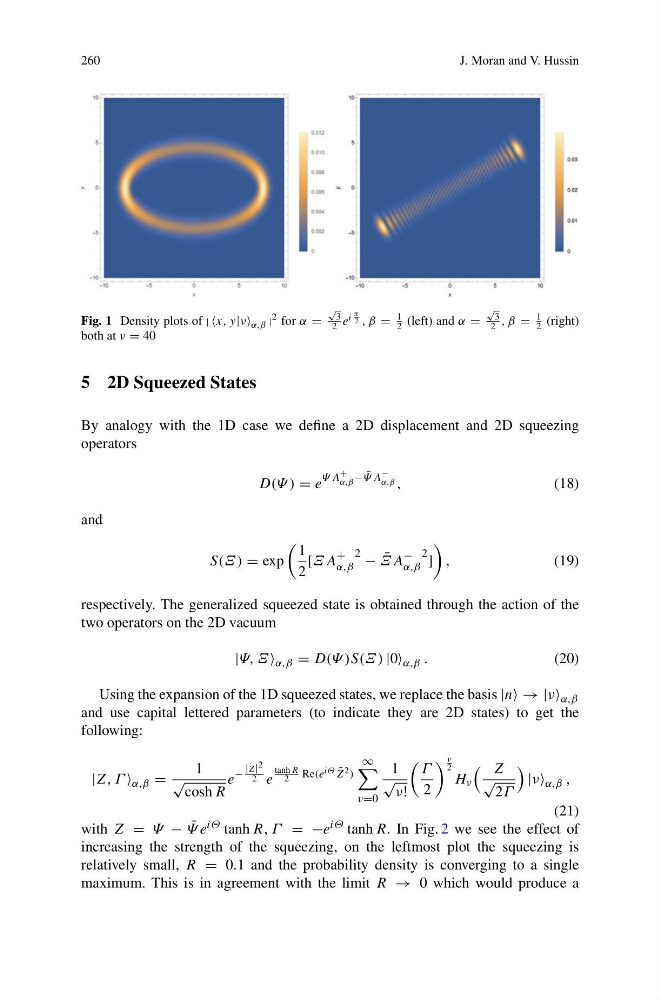
Fig. 1 Density plots of | x, y|ν α,β |
2 for α =
√
3
2 e
i
π
2 , β =
1
2 (left) and α =
√
3
2 , β =
1
2 (right)
both at ν = 40
5 2D Squeezed States
By analogy with the 1D case we define a 2D displacement and 2D squeezing
operators
D(Ψ ) = e
Ψ A
+
α,β − ¯
Ψ A
−
α,β ,
(18)
and
S(Ξ ) = exp
1
2
[ΞA
+
α,β
2 − ¯
ΞA
−
α,β
2 ]
,
(19)
respectively. The generalized squeezed state is obtained through the action of the
two operators on the 2D vacuum
|Ψ, Ξ α,β = D(Ψ )S(Ξ ) |0 α,β .
(20)
Using the expansion of the 1D squeezed states, we replace the basis |n → |ν α,β
and use capital lettered parameters (to indicate they are 2D states) to get the
following:
|Z, Γ α,β =
1
√
cosh R
e
−
|Z| 2
2 e
tanh R
2 Re(e iΘ ¯
Z 2 )
∞
ν=0
1
√
ν!
Γ
2
ν
2
H ν
Z
√
2Γ
|ν α,β ,
(21)
with Z = Ψ − ¯
Ψ e iΘ tanh R, Γ = −e iΘ tanh R. In Fig. 2 we see the effect of
increasing the strength of the squeezing, on the leftmost plot the squeezing is
relatively small, R = 0.1 and the probability density is converging to a single
maximum. This is in agreement with the limit R → 0 which would produce a
J. Moran and V. Hussin
Fig. 1 Density plots of | x, y|ν α,β |
2 for α =
√
3
2 e
i
π
2 , β =
1
2 (left) and α =
√
3
2 , β =
1
2 (right)
both at ν = 40
5 2D Squeezed States
By analogy with the 1D case we define a 2D displacement and 2D squeezing
operators
D(Ψ ) = e
Ψ A
+
α,β − ¯
Ψ A
−
α,β ,
(18)
and
S(Ξ ) = exp
1
2
[ΞA
+
α,β
2 − ¯
ΞA
−
α,β
2 ]
,
(19)
respectively. The generalized squeezed state is obtained through the action of the
two operators on the 2D vacuum
|Ψ, Ξ α,β = D(Ψ )S(Ξ ) |0 α,β .
(20)
Using the expansion of the 1D squeezed states, we replace the basis |n → |ν α,β
and use capital lettered parameters (to indicate they are 2D states) to get the
following:
|Z, Γ α,β =
1
√
cosh R
e
−
|Z| 2
2 e
tanh R
2 Re(e iΘ ¯
Z 2 )
∞
ν=0
1
√
ν!
Γ
2
ν
2
H ν
Z
√
2Γ
|ν α,β ,
(21)
with Z = Ψ − ¯
Ψ e iΘ tanh R, Γ = −e iΘ tanh R. In Fig. 2 we see the effect of
increasing the strength of the squeezing, on the leftmost plot the squeezing is
relatively small, R = 0.1 and the probability density is converging to a single
maximum. This is in agreement with the limit R → 0 which would produce a