

Spin Chains of Haldane–Shastry Type: A Bird’s Eye View
11
4.2 The Partition Function
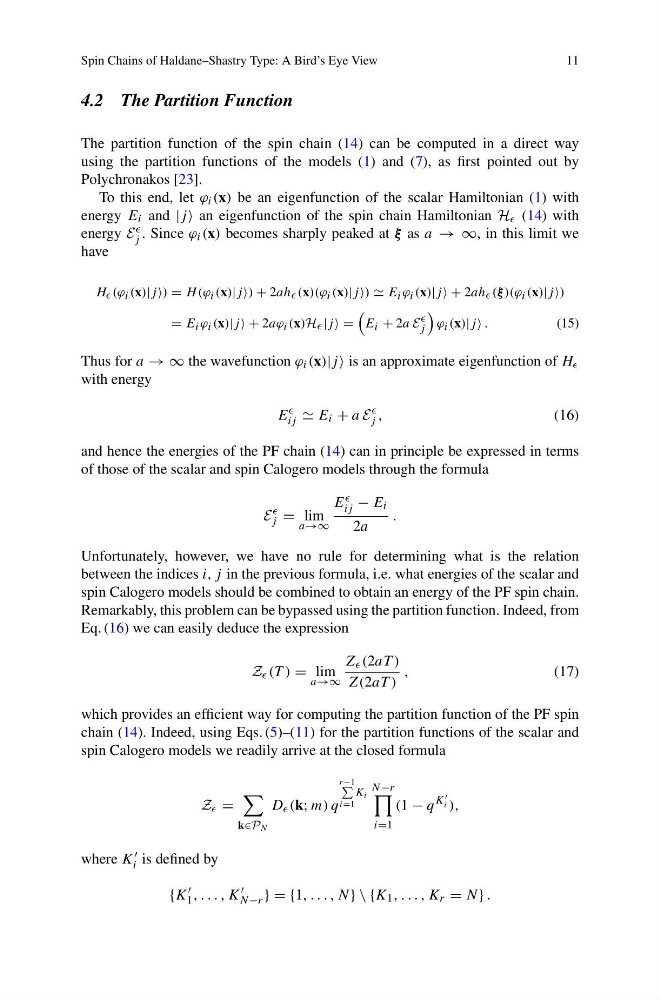
The partition function of the spin chain (14) can be computed in a direct way
using the partition functions of the models (1) and (7), as first pointed out by
Polychronakos [23].
To this end, let ϕ i (x) be an eigenfunction of the scalar Hamiltonian (1) with
energy E i and |j an eigenfunction of the spin chain Hamiltonian H (14) with
energy E
j . Since ϕ i (x) becomes sharply peaked at ξ as a → ∞, in this limit we
have
H (ϕ i (x)|j = H (ϕ i (x)|j + 2ah (x)(ϕ i (x)|j E i ϕ i (x)|j + 2ah (ξ )(ϕ i (x)|j
= E i ϕ i (x)|j + 2aϕ i (x)H |j =
E i + 2a E
j
ϕ i (x)|j .
(15)
Thus for a → ∞ the wavefunction ϕ i (x)|j is an approximate eigenfunction of H
with energy
E
ij E i + a E
j ,
(16)
and hence the energies of the PF chain (14) can in principle be expressed in terms
of those of the scalar and spin Calogero models through the formula
E
j = lim
a→∞
E
ij − E i
2a
.
Unfortunately, however, we have no rule for determining what is the relation
between the indices i, j in the previous formula, i.e. what energies of the scalar and
spin Calogero models should be combined to obtain an energy of the PF spin chain.
Remarkably, this problem can be bypassed using the partition function. Indeed, from
Eq. (16) we can easily deduce the expression
Z (T ) = lim
a→∞
Z (2aT )
Z(2aT )
,
(17)
which provides an efficient way for computing the partition function of the PF spin
chain (14). Indeed, using Eqs. (5)–(11) for the partition functions of the scalar and
spin Calogero models we readily arrive at the closed formula
Z =
k∈P N
D (k; m) q
r−1
i=1
K i
N −r
i=1
(1 − q
K
i ),
where K
i is defined by
{K
1 , . . . , K
N −r } = {1, . . . , N} \ {K 1 , . . . , K r = N } .
11
4.2 The Partition Function
The partition function of the spin chain (14) can be computed in a direct way
using the partition functions of the models (1) and (7), as first pointed out by
Polychronakos [23].
To this end, let ϕ i (x) be an eigenfunction of the scalar Hamiltonian (1) with
energy E i and |j an eigenfunction of the spin chain Hamiltonian H (14) with
energy E
j . Since ϕ i (x) becomes sharply peaked at ξ as a → ∞, in this limit we
have
H (ϕ i (x)|j = H (ϕ i (x)|j + 2ah (x)(ϕ i (x)|j E i ϕ i (x)|j + 2ah (ξ )(ϕ i (x)|j
= E i ϕ i (x)|j + 2aϕ i (x)H |j =
E i + 2a E
j
ϕ i (x)|j .
(15)
Thus for a → ∞ the wavefunction ϕ i (x)|j is an approximate eigenfunction of H
with energy
E
ij E i + a E
j ,
(16)
and hence the energies of the PF chain (14) can in principle be expressed in terms
of those of the scalar and spin Calogero models through the formula
E
j = lim
a→∞
E
ij − E i
2a
.
Unfortunately, however, we have no rule for determining what is the relation
between the indices i, j in the previous formula, i.e. what energies of the scalar and
spin Calogero models should be combined to obtain an energy of the PF spin chain.
Remarkably, this problem can be bypassed using the partition function. Indeed, from
Eq. (16) we can easily deduce the expression
Z (T ) = lim
a→∞
Z (2aT )
Z(2aT )
,
(17)
which provides an efficient way for computing the partition function of the PF spin
chain (14). Indeed, using Eqs. (5)–(11) for the partition functions of the scalar and
spin Calogero models we readily arrive at the closed formula
Z =
k∈P N
D (k; m) q
r−1
i=1
K i
N −r
i=1
(1 − q
K
i ),
where K
i is defined by
{K
1 , . . . , K
N −r } = {1, . . . , N} \ {K 1 , . . . , K r = N } .