

10
F. Finkel et al.
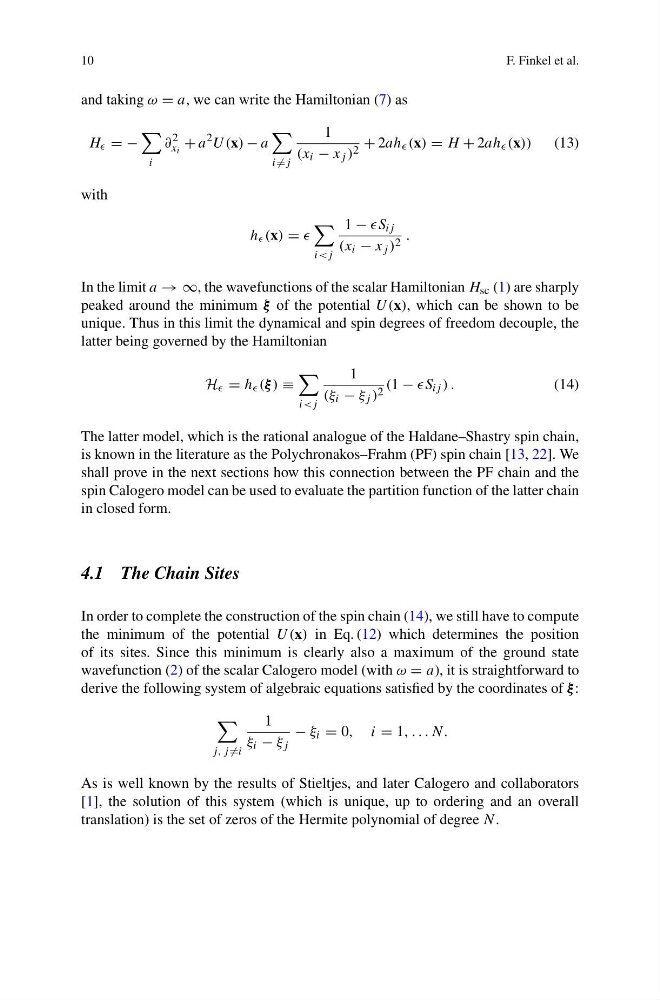
and taking ω = a, we can write the Hamiltonian (7) as
H = −
i
∂
2
x i
+ a
2 U(x) − a
i =j
1
(x i − x j ) 2 + 2ah (x) = H + 2ah (x)) (13)
with
h (x) =
i
(x i − x j ) 2 .
In the limit a → ∞, the wavefunctions of the scalar Hamiltonian H sc (1) are sharply
peaked around the minimum ξ of the potential U(x), which can be shown to be
unique. Thus in this limit the dynamical and spin degrees of freedom decouple, the
latter being governed by the Hamiltonian
H = h (ξ ) ≡
i
(ξ i − ξ j ) 2 (1 − S ij ) .
(14)
The latter model, which is the rational analogue of the Haldane–Shastry spin chain,
is known in the literature as the Polychronakos–Frahm (PF) spin chain [13, 22]. We
shall prove in the next sections how this connection between the PF chain and the
spin Calogero model can be used to evaluate the partition function of the latter chain
in closed form.
4.1 The Chain Sites
In order to complete the construction of the spin chain (14), we still have to compute
the minimum of the potential U(x) in Eq. (12) which determines the position
of its sites. Since this minimum is clearly also a maximum of the ground state
wavefunction (2) of the scalar Calogero model (with ω = a), it is straightforward to
derive the following system of algebraic equations satisfied by the coordinates of ξ :
j, j =i
1
ξ i − ξ j
− ξ i = 0, i = 1, . . . N.
As is well known by the results of Stieltjes, and later Calogero and collaborators
[1], the solution of this system (which is unique, up to ordering and an overall
translation) is the set of zeros of the Hermite polynomial of degree N .
F. Finkel et al.
and taking ω = a, we can write the Hamiltonian (7) as
H = −
i
∂
2
x i
+ a
2 U(x) − a
i =j
1
(x i − x j ) 2 + 2ah (x) = H + 2ah (x)) (13)
with
h (x) =
i
(x i − x j ) 2 .
In the limit a → ∞, the wavefunctions of the scalar Hamiltonian H sc (1) are sharply
peaked around the minimum ξ of the potential U(x), which can be shown to be
unique. Thus in this limit the dynamical and spin degrees of freedom decouple, the
latter being governed by the Hamiltonian
H = h (ξ ) ≡
i
(ξ i − ξ j ) 2 (1 − S ij ) .
(14)
The latter model, which is the rational analogue of the Haldane–Shastry spin chain,
is known in the literature as the Polychronakos–Frahm (PF) spin chain [13, 22]. We
shall prove in the next sections how this connection between the PF chain and the
spin Calogero model can be used to evaluate the partition function of the latter chain
in closed form.
4.1 The Chain Sites
In order to complete the construction of the spin chain (14), we still have to compute
the minimum of the potential U(x) in Eq. (12) which determines the position
of its sites. Since this minimum is clearly also a maximum of the ground state
wavefunction (2) of the scalar Calogero model (with ω = a), it is straightforward to
derive the following system of algebraic equations satisfied by the coordinates of ξ :
j, j =i
1
ξ i − ξ j
− ξ i = 0, i = 1, . . . N.
As is well known by the results of Stieltjes, and later Calogero and collaborators
[1], the solution of this system (which is unique, up to ordering and an overall
translation) is the set of zeros of the Hermite polynomial of degree N .