

Supersymmetric Partners of the Rosen–Morse Potential
241
200
–200
–400
–400
–200
π
4
π
2
3π
4
π
π
4
π
2
3π
4
π
200
400
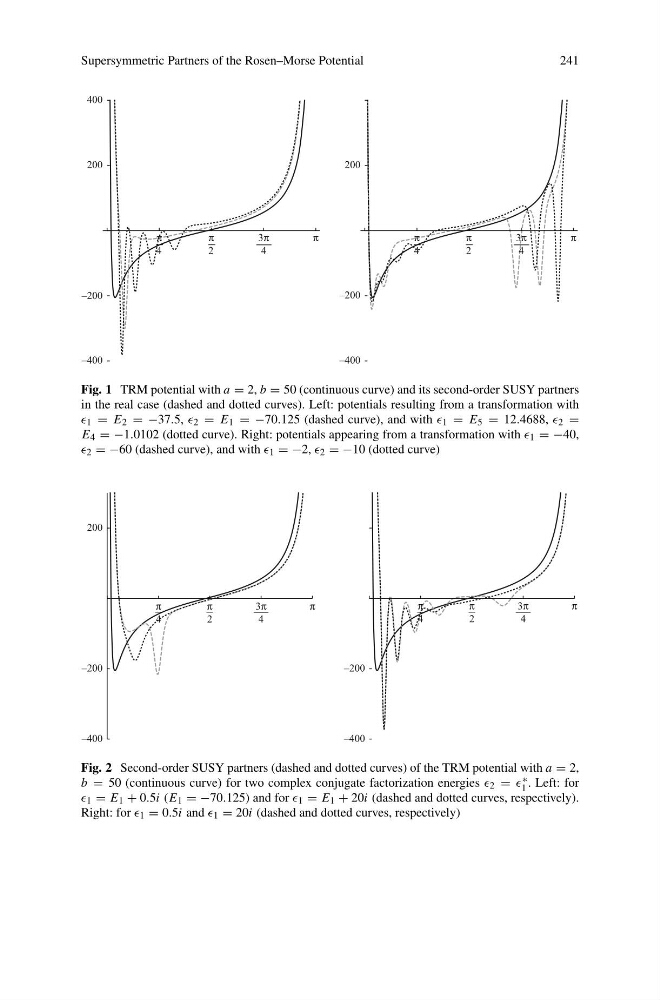
Fig. 1 TRM potential with a = 2, b = 50 (continuous curve) and its second-order SUSY partners
in the real case (dashed and dotted curves). Left: potentials resulting from a transformation with
1 = E 2 = −37.5, 2 = E 1 = −70.125 (dashed curve), and with 1 = E 5 = 12.4688, 2 =
E 4 = −1.0102 (dotted curve). Right: potentials appearing from a transformation with 1 = −40,
2 = −60 (dashed curve), and with 1 = −2, 2 = −10 (dotted curve)
–200
–400
–400
–200
π
4
π
2
3π
4
π
π
4
π
2
3π
4
π
200
Fig. 2 Second-order SUSY partners (dashed and dotted curves) of the TRM potential with a = 2,
b = 50 (continuous curve) for two complex conjugate factorization energies 2 = ∗
1 . Left: for
1 = E 1 + 0.5i (E 1 = −70.125) and for 1 = E 1 + 20i (dashed and dotted curves, respectively).
Right: for 1 = 0.5i and 1 = 20i (dashed and dotted curves, respectively)
241
200
–200
–400
–400
–200
π
4
π
2
3π
4
π
π
4
π
2
3π
4
π
200
400
Fig. 1 TRM potential with a = 2, b = 50 (continuous curve) and its second-order SUSY partners
in the real case (dashed and dotted curves). Left: potentials resulting from a transformation with
1 = E 2 = −37.5, 2 = E 1 = −70.125 (dashed curve), and with 1 = E 5 = 12.4688, 2 =
E 4 = −1.0102 (dotted curve). Right: potentials appearing from a transformation with 1 = −40,
2 = −60 (dashed curve), and with 1 = −2, 2 = −10 (dotted curve)
–200
–400
–400
–200
π
4
π
2
3π
4
π
π
4
π
2
3π
4
π
200
Fig. 2 Second-order SUSY partners (dashed and dotted curves) of the TRM potential with a = 2,
b = 50 (continuous curve) for two complex conjugate factorization energies 2 = ∗
1 . Left: for
1 = E 1 + 0.5i (E 1 = −70.125) and for 1 = E 1 + 20i (dashed and dotted curves, respectively).
Right: for 1 = 0.5i and 1 = 20i (dashed and dotted curves, respectively)