

242
R. Reyes et al.
π
4
π
2
3π
4
π
π
4
π
2
3π
4
π
–600
–400
–200
200
400
–600
–400
–200
200
400
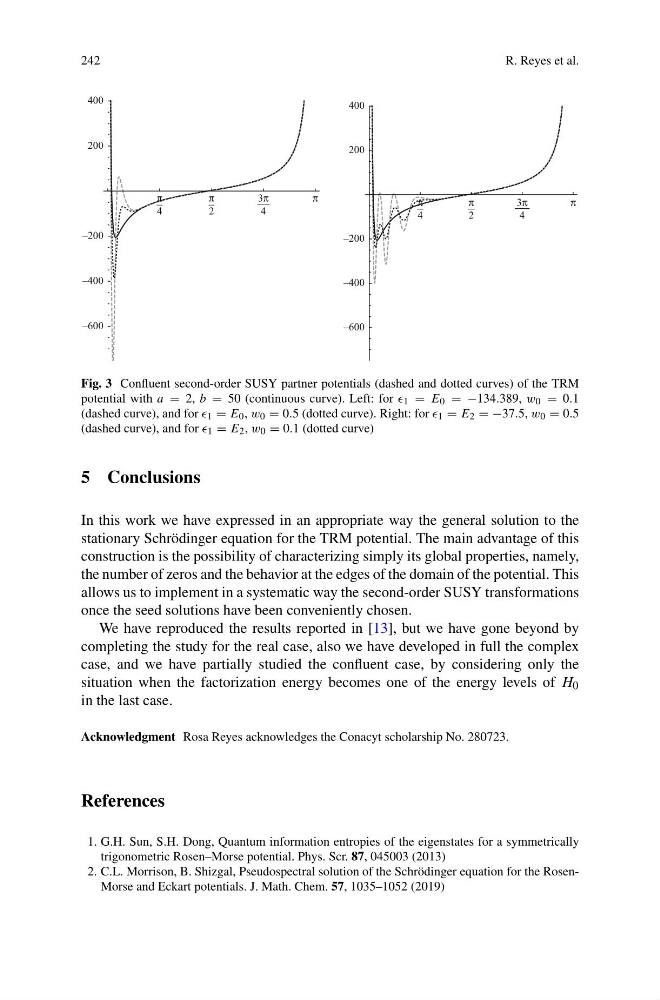
Fig. 3 Confluent second-order SUSY partner potentials (dashed and dotted curves) of the TRM
potential with a = 2, b = 50 (continuous curve). Left: for 1 = E 0 = −134.389, w 0 = 0.1
(dashed curve), and for 1 = E 0 , w 0 = 0.5 (dotted curve). Right: for 1 = E 2 = −37.5, w 0 = 0.5
(dashed curve), and for 1 = E 2 , w 0 = 0.1 (dotted curve)
5 Conclusions
In this work we have expressed in an appropriate way the general solution to the
stationary Schrödinger equation for the TRM potential. The main advantage of this
construction is the possibility of characterizing simply its global properties, namely,
the number of zeros and the behavior at the edges of the domain of the potential. This
allows us to implement in a systematic way the second-order SUSY transformations
once the seed solutions have been conveniently chosen.
We have reproduced the results reported in [13], but we have gone beyond by
completing the study for the real case, also we have developed in full the complex
case, and we have partially studied the confluent case, by considering only the
situation when the factorization energy becomes one of the energy levels of H 0
in the last case.
Acknowledgment Rosa Reyes acknowledges the Conacyt scholarship No. 280723.
References
1. G.H. Sun, S.H. Dong, Quantum information entropies of the eigenstates for a symmetrically
trigonometric Rosen–Morse potential. Phys. Scr. 87, 045003 (2013)
2. C.L. Morrison, B. Shizgal, Pseudospectral solution of the Schrödinger equation for the RosenMorse and Eckart potentials. J. Math. Chem. 57, 1035–1052 (2019)
R. Reyes et al.
π
4
π
2
3π
4
π
π
4
π
2
3π
4
π
–600
–400
–200
200
400
–600
–400
–200
200
400
Fig. 3 Confluent second-order SUSY partner potentials (dashed and dotted curves) of the TRM
potential with a = 2, b = 50 (continuous curve). Left: for 1 = E 0 = −134.389, w 0 = 0.1
(dashed curve), and for 1 = E 0 , w 0 = 0.5 (dotted curve). Right: for 1 = E 2 = −37.5, w 0 = 0.5
(dashed curve), and for 1 = E 2 , w 0 = 0.1 (dotted curve)
5 Conclusions
In this work we have expressed in an appropriate way the general solution to the
stationary Schrödinger equation for the TRM potential. The main advantage of this
construction is the possibility of characterizing simply its global properties, namely,
the number of zeros and the behavior at the edges of the domain of the potential. This
allows us to implement in a systematic way the second-order SUSY transformations
once the seed solutions have been conveniently chosen.
We have reproduced the results reported in [13], but we have gone beyond by
completing the study for the real case, also we have developed in full the complex
case, and we have partially studied the confluent case, by considering only the
situation when the factorization energy becomes one of the energy levels of H 0
in the last case.
Acknowledgment Rosa Reyes acknowledges the Conacyt scholarship No. 280723.
References
1. G.H. Sun, S.H. Dong, Quantum information entropies of the eigenstates for a symmetrically
trigonometric Rosen–Morse potential. Phys. Scr. 87, 045003 (2013)
2. C.L. Morrison, B. Shizgal, Pseudospectral solution of the Schrödinger equation for the RosenMorse and Eckart potentials. J. Math. Chem. 57, 1035–1052 (2019)