

228
J. Gaboriaud et al.
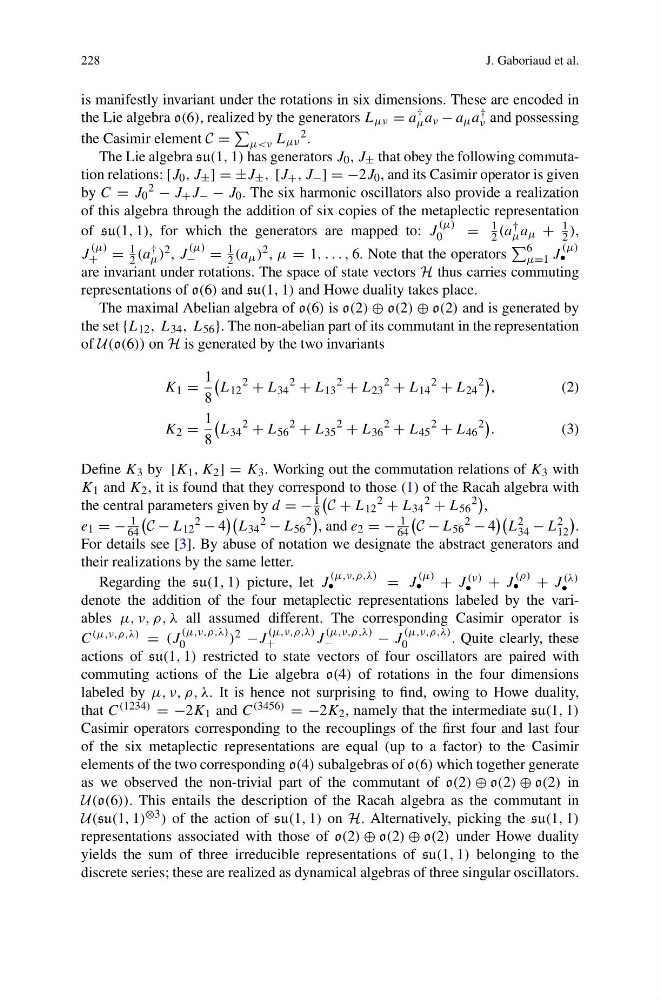
is manifestly invariant under the rotations in six dimensions. These are encoded in
the Lie algebra o(6), realized by the generators L μν = a †
μ a ν − a μ a †
ν and possessing
the Casimir element C =
μ<ν L μν
2 .
The Lie algebra su(1, 1) has generators J 0 , J ± that obey the following commutation relations: [J 0 , J ± ] = ±J ± , [J + , J − ] = −2J 0 , and its Casimir operator is given
by C = J 0
2 − J + J − − J 0 . The six harmonic oscillators also provide a realization
of this algebra through the addition of six copies of the metaplectic representation
of su(1, 1), for which the generators are mapped to: J
(μ)
0
=
1
2 (a †
μ a μ +
1
2 ),
J
(μ)
+ =
1
2 (a †
μ ) 2 , J
(μ)
− =
1
2 (a μ ) 2 , μ = 1, . . . , 6. Note that the operators
6
μ=1 J
(μ)
•
are invariant under rotations. The space of state vectors H thus carries commuting
representations of o(6) and su(1, 1) and Howe duality takes place.
The maximal Abelian algebra of o(6) is o(2) ⊕ o(2) ⊕ o(2) and is generated by
the set {L 12 , L 34 , L 56 }. The non-abelian part of its commutant in the representation
of U (o(6)) on H is generated by the two invariants
K 1 =
1
8
L 12
2
+ L 34
2
+ L 13
2
+ L 23
2
+ L 14
2
+ L 24
2
,
(2)
K 2 =
1
8
L 34
2
+ L 56
2
+ L 35
2
+ L 36
2
+ L 45
2
+ L 46
2
.
(3)
Define K 3 by [K 1 , K 2 ] = K 3 . Working out the commutation relations of K 3 with
K 1 and K 2 , it is found that they correspond to those (1) of the Racah algebra with
the central parameters given by d = −
1
8
C + L 12
2 + L 34
2 + L 56
2
,
e 1 = −
1
64
C − L 12
2 − 4
L 34
2 − L 56
2
, and e 2 = −
1
64
C − L 56
2 − 4
L 2
34 − L 2
12
.
For details see [3]. By abuse of notation we designate the abstract generators and
their realizations by the same letter.
Regarding the su(1, 1) picture, let J
(μ,ν,ρ,λ)
•
= J
(μ)
•
+ J (ν)
•
+ J
(ρ)
•
+ J (λ)
•
denote the addition of the four metaplectic representations labeled by the variables μ, ν, ρ, λ all assumed different. The corresponding Casimir operator is
C (μ,ν,ρ,λ) = (J
(μ,ν,ρ,λ)
0
) 2 −J
(μ,ν,ρ,λ)
+
J
(μ,ν,ρ,λ)
−
− J
(μ,ν,ρ,λ)
0
. Quite clearly, these
actions of su(1, 1) restricted to state vectors of four oscillators are paired with
commuting actions of the Lie algebra o(4) of rotations in the four dimensions
labeled by μ, ν, ρ, λ. It is hence not surprising to find, owing to Howe duality,
that C (1234) = −2K 1 and C (3456) = −2K 2 , namely that the intermediate su(1, 1)
Casimir operators corresponding to the recouplings of the first four and last four
of the six metaplectic representations are equal (up to a factor) to the Casimir
elements of the two corresponding o(4) subalgebras of o(6) which together generate
as we observed the non-trivial part of the commutant of o(2) ⊕ o(2) ⊕ o(2) in
U (o(6)). This entails the description of the Racah algebra as the commutant in
U (su(1, 1) ⊗3 ) of the action of su(1, 1) on H. Alternatively, picking the su(1, 1)
representations associated with those of o(2) ⊕ o(2) ⊕ o(2) under Howe duality
yields the sum of three irreducible representations of su(1, 1) belonging to the
discrete series; these are realized as dynamical algebras of three singular oscillators.
J. Gaboriaud et al.
is manifestly invariant under the rotations in six dimensions. These are encoded in
the Lie algebra o(6), realized by the generators L μν = a †
μ a ν − a μ a †
ν and possessing
the Casimir element C =
μ<ν L μν
2 .
The Lie algebra su(1, 1) has generators J 0 , J ± that obey the following commutation relations: [J 0 , J ± ] = ±J ± , [J + , J − ] = −2J 0 , and its Casimir operator is given
by C = J 0
2 − J + J − − J 0 . The six harmonic oscillators also provide a realization
of this algebra through the addition of six copies of the metaplectic representation
of su(1, 1), for which the generators are mapped to: J
(μ)
0
=
1
2 (a †
μ a μ +
1
2 ),
J
(μ)
+ =
1
2 (a †
μ ) 2 , J
(μ)
− =
1
2 (a μ ) 2 , μ = 1, . . . , 6. Note that the operators
6
μ=1 J
(μ)
•
are invariant under rotations. The space of state vectors H thus carries commuting
representations of o(6) and su(1, 1) and Howe duality takes place.
The maximal Abelian algebra of o(6) is o(2) ⊕ o(2) ⊕ o(2) and is generated by
the set {L 12 , L 34 , L 56 }. The non-abelian part of its commutant in the representation
of U (o(6)) on H is generated by the two invariants
K 1 =
1
8
L 12
2
+ L 34
2
+ L 13
2
+ L 23
2
+ L 14
2
+ L 24
2
,
(2)
K 2 =
1
8
L 34
2
+ L 56
2
+ L 35
2
+ L 36
2
+ L 45
2
+ L 46
2
.
(3)
Define K 3 by [K 1 , K 2 ] = K 3 . Working out the commutation relations of K 3 with
K 1 and K 2 , it is found that they correspond to those (1) of the Racah algebra with
the central parameters given by d = −
1
8
C + L 12
2 + L 34
2 + L 56
2
,
e 1 = −
1
64
C − L 12
2 − 4
L 34
2 − L 56
2
, and e 2 = −
1
64
C − L 56
2 − 4
L 2
34 − L 2
12
.
For details see [3]. By abuse of notation we designate the abstract generators and
their realizations by the same letter.
Regarding the su(1, 1) picture, let J
(μ,ν,ρ,λ)
•
= J
(μ)
•
+ J (ν)
•
+ J
(ρ)
•
+ J (λ)
•
denote the addition of the four metaplectic representations labeled by the variables μ, ν, ρ, λ all assumed different. The corresponding Casimir operator is
C (μ,ν,ρ,λ) = (J
(μ,ν,ρ,λ)
0
) 2 −J
(μ,ν,ρ,λ)
+
J
(μ,ν,ρ,λ)
−
− J
(μ,ν,ρ,λ)
0
. Quite clearly, these
actions of su(1, 1) restricted to state vectors of four oscillators are paired with
commuting actions of the Lie algebra o(4) of rotations in the four dimensions
labeled by μ, ν, ρ, λ. It is hence not surprising to find, owing to Howe duality,
that C (1234) = −2K 1 and C (3456) = −2K 2 , namely that the intermediate su(1, 1)
Casimir operators corresponding to the recouplings of the first four and last four
of the six metaplectic representations are equal (up to a factor) to the Casimir
elements of the two corresponding o(4) subalgebras of o(6) which together generate
as we observed the non-trivial part of the commutant of o(2) ⊕ o(2) ⊕ o(2) in
U (o(6)). This entails the description of the Racah algebra as the commutant in
U (su(1, 1) ⊗3 ) of the action of su(1, 1) on H. Alternatively, picking the su(1, 1)
representations associated with those of o(2) ⊕ o(2) ⊕ o(2) under Howe duality
yields the sum of three irreducible representations of su(1, 1) belonging to the
discrete series; these are realized as dynamical algebras of three singular oscillators.