

Howe Duality and AW Algebras
229
Note that corresponding to the su(1, 1) representation J
(μ,ν)
•
= J
(μ)
•
+ J (ν)
• is the
Casimir C (μν) = −
1
4
L μν
2 + 1
. With the dependence on the polar angles “rotated
out”, the total Casimir element C (123456) becomes the Hamiltonian of the generic
superintegrable system on the two-sphere; the constants of motion are the quotiented
intermediate Casimir elements and the symmetry algebra that they generate is hence
that of Racah.
4 More Dual Pictures: An Overview
The main algebras of Askey–Wilson type have been studied recently from the
commutant and Howe duality viewpoints. We summarize in the following the main
results and give in particular the dualities that are involved.
4.1 The Racah Family
The higher rank extension of the Racah algebra [4] defined as the algebra generated
by all the intermediate Casimir elements of σ 1 ⊗ σ 2 ⊗ · · · ⊗ σ n (Δ (n−1) (su(1, 1)))
can be described in the framework of the preceding section with the help of the dual
pair (o(2n), su(1, 1)) using in this case the module formed by the state vectors of
2n harmonic oscillators. It is then seen to be dually the commutant of o(2) ⊕n in the
oscillator representation of U (o(2n)) [5].
The case n = 2 is special and of particular interest since it pertains to the
Clebsch–Gordan problem for su(1, 1), that is, the recoupling of the two irreducible
representations σ 1 and σ 2 . There are no intermediate Casimirs here; the relevant
operators associated with the direct product basis and the recoupled one are
respectively M 1 = σ 1 (J 0 ) − σ 2 (J 0 ) and the total Casimir M 2 = (σ 1 ⊗ σ 2 )Δ(C).
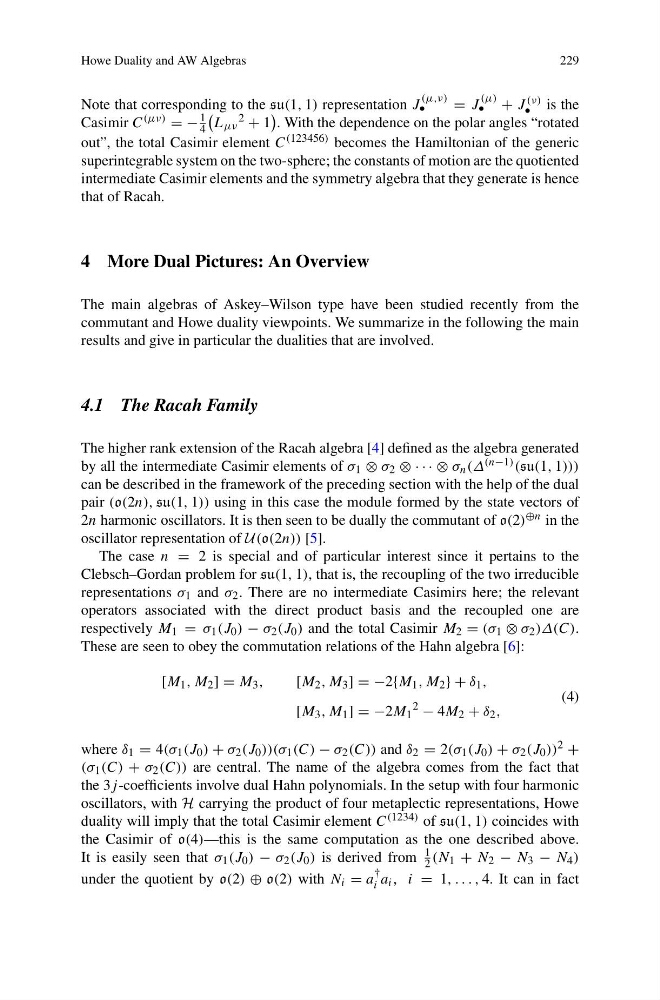
These are seen to obey the commutation relations of the Hahn algebra [6]:
[M 1 , M 2 ] = M 3 ,
[M 2 , M 3 ] = −2{M 1 , M 2 } + δ 1 ,
[M 3 , M 1 ] = −2M 1
2
− 4M 2 + δ 2 ,
(4)
where δ 1 = 4(σ 1 (J 0 ) + σ 2 (J 0 ))(σ 1 (C) − σ 2 (C)) and δ 2 = 2(σ 1 (J 0 ) + σ 2 (J 0 )) 2 +
(σ 1 (C) + σ 2 (C)) are central. The name of the algebra comes from the fact that
the 3j -coefficients involve dual Hahn polynomials. In the setup with four harmonic
oscillators, with H carrying the product of four metaplectic representations, Howe
duality will imply that the total Casimir element C (1234) of su(1, 1) coincides with
the Casimir of o(4)—this is the same computation as the one described above.
It is easily seen that σ 1 (J 0 ) − σ 2 (J 0 ) is derived from
1
2 (N 1 + N 2 − N 3 − N 4 )
under the quotient by o(2) ⊕ o(2) with N i = a
†
i a i , i = 1, . . . , 4. It can in fact
229
Note that corresponding to the su(1, 1) representation J
(μ,ν)
•
= J
(μ)
•
+ J (ν)
• is the
Casimir C (μν) = −
1
4
L μν
2 + 1
. With the dependence on the polar angles “rotated
out”, the total Casimir element C (123456) becomes the Hamiltonian of the generic
superintegrable system on the two-sphere; the constants of motion are the quotiented
intermediate Casimir elements and the symmetry algebra that they generate is hence
that of Racah.
4 More Dual Pictures: An Overview
The main algebras of Askey–Wilson type have been studied recently from the
commutant and Howe duality viewpoints. We summarize in the following the main
results and give in particular the dualities that are involved.
4.1 The Racah Family
The higher rank extension of the Racah algebra [4] defined as the algebra generated
by all the intermediate Casimir elements of σ 1 ⊗ σ 2 ⊗ · · · ⊗ σ n (Δ (n−1) (su(1, 1)))
can be described in the framework of the preceding section with the help of the dual
pair (o(2n), su(1, 1)) using in this case the module formed by the state vectors of
2n harmonic oscillators. It is then seen to be dually the commutant of o(2) ⊕n in the
oscillator representation of U (o(2n)) [5].
The case n = 2 is special and of particular interest since it pertains to the
Clebsch–Gordan problem for su(1, 1), that is, the recoupling of the two irreducible
representations σ 1 and σ 2 . There are no intermediate Casimirs here; the relevant
operators associated with the direct product basis and the recoupled one are
respectively M 1 = σ 1 (J 0 ) − σ 2 (J 0 ) and the total Casimir M 2 = (σ 1 ⊗ σ 2 )Δ(C).
These are seen to obey the commutation relations of the Hahn algebra [6]:
[M 1 , M 2 ] = M 3 ,
[M 2 , M 3 ] = −2{M 1 , M 2 } + δ 1 ,
[M 3 , M 1 ] = −2M 1
2
− 4M 2 + δ 2 ,
(4)
where δ 1 = 4(σ 1 (J 0 ) + σ 2 (J 0 ))(σ 1 (C) − σ 2 (C)) and δ 2 = 2(σ 1 (J 0 ) + σ 2 (J 0 )) 2 +
(σ 1 (C) + σ 2 (C)) are central. The name of the algebra comes from the fact that
the 3j -coefficients involve dual Hahn polynomials. In the setup with four harmonic
oscillators, with H carrying the product of four metaplectic representations, Howe
duality will imply that the total Casimir element C (1234) of su(1, 1) coincides with
the Casimir of o(4)—this is the same computation as the one described above.
It is easily seen that σ 1 (J 0 ) − σ 2 (J 0 ) is derived from
1
2 (N 1 + N 2 − N 3 − N 4 )
under the quotient by o(2) ⊕ o(2) with N i = a
†
i a i , i = 1, . . . , 4. It can in fact