

Howe Duality and AW Algebras
227
given representation on H mod h, by those elements in the universal enveloping
algebra of g that commute with X
⊕n . In other words, A can also be identified as the
commutant of h ⊂ g in U (g) as represented on H.
There is an equivalent way of looking at this. The pairing of the representations of
g and g' through Howe duality manifests itself in the fact that the Casimir elements
of g and g' are affinely related. Let C be a Casimir element of g'. Consider for
example the intermediate Casimir element given by ¯
σ ⊗4 [((Δ ⊗ Δ) ◦ Δ)(C)] ⊗
1 ⊗(2n−4) corresponding to the embedding of g' in the first four factors of g'
⊗2n .
There will be a subalgebra g 1 of g that will be dually related to g' on the restriction of
H to V ⊗4 so that its Casimir element will be essentially the one of g'. Next, looking
at the intermediate Casimir element of g' associated with a different embedding,
for instance in the four last factors of g'
⊗2n , there will be a dual pairing with a
different embedding in g of the same subalgebra g 1 and again the two Casimir
elements will basically coincide. These observations lead to the conclusion that
the set of intermediate Casimir elements associated with the representation of g'
is algebraically identical to the set of Casimir elements of the subalgebras of g that
form dual pairs with g' when intermediate representations of the latter are taken. It
is not difficult to convince oneself that the set of invariants connected to the relevant
subalgebras of g consists in the commutant of the maximal Abelian subalgebra of g
as concluded differently before.
To summarize, in situations where Howe duality prevails with (g, g') the pair
of algebras that are dually represented on H and if the representation of g' is of
the form ¯
σ ⊗2n [Δ (2n−1) (g')], the quadratic algebras A of Askey–Wilson type can be
viewed on one hand as the commutant of this action of g' on H and thus generated
by the intermediate Casimir elements of g', or on the other hand as the commutant
of h ⊂ g in the intervening representation of U (g). We shall present next an example
of how this can be concretely realized.
3 The Dual Presentations of the Racah Algebra
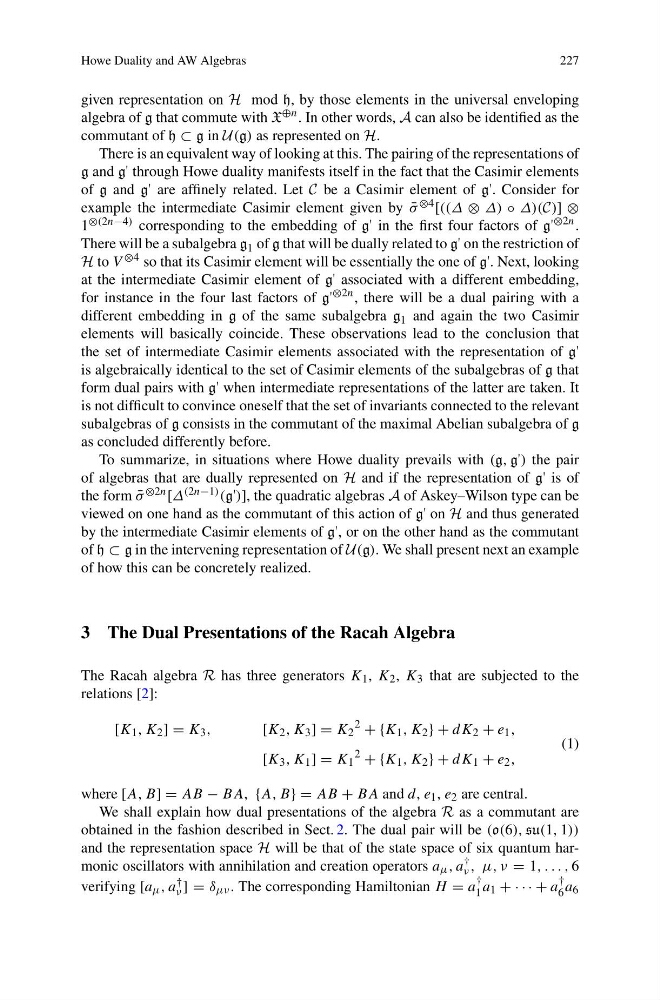
The Racah algebra R has three generators K 1 , K 2 , K 3 that are subjected to the
relations [2]:
[K 1 , K 2 ] = K 3 ,
[K 2 , K 3 ] = K 2
2
+ {K 1 , K 2 } + dK 2 + e 1 ,
[K 3 , K 1 ] = K 1
2
+ {K 1 , K 2 } + dK 1 + e 2 ,
(1)
where [A, B] = AB − BA, {A, B} = AB + BA and d, e 1 , e 2 are central.
We shall explain how dual presentations of the algebra R as a commutant are
obtained in the fashion described in Sect. 2. The dual pair will be (o(6), su(1, 1))
and the representation space H will be that of the state space of six quantum harmonic oscillators with annihilation and creation operators a μ , a †
ν , μ, ν = 1, . . . , 6
verifying [a μ , a †
ν ] = δ μν . The corresponding Hamiltonian H = a
†
1 a 1 + · · · + a
†
6 a 6
227
given representation on H mod h, by those elements in the universal enveloping
algebra of g that commute with X
⊕n . In other words, A can also be identified as the
commutant of h ⊂ g in U (g) as represented on H.
There is an equivalent way of looking at this. The pairing of the representations of
g and g' through Howe duality manifests itself in the fact that the Casimir elements
of g and g' are affinely related. Let C be a Casimir element of g'. Consider for
example the intermediate Casimir element given by ¯
σ ⊗4 [((Δ ⊗ Δ) ◦ Δ)(C)] ⊗
1 ⊗(2n−4) corresponding to the embedding of g' in the first four factors of g'
⊗2n .
There will be a subalgebra g 1 of g that will be dually related to g' on the restriction of
H to V ⊗4 so that its Casimir element will be essentially the one of g'. Next, looking
at the intermediate Casimir element of g' associated with a different embedding,
for instance in the four last factors of g'
⊗2n , there will be a dual pairing with a
different embedding in g of the same subalgebra g 1 and again the two Casimir
elements will basically coincide. These observations lead to the conclusion that
the set of intermediate Casimir elements associated with the representation of g'
is algebraically identical to the set of Casimir elements of the subalgebras of g that
form dual pairs with g' when intermediate representations of the latter are taken. It
is not difficult to convince oneself that the set of invariants connected to the relevant
subalgebras of g consists in the commutant of the maximal Abelian subalgebra of g
as concluded differently before.
To summarize, in situations where Howe duality prevails with (g, g') the pair
of algebras that are dually represented on H and if the representation of g' is of
the form ¯
σ ⊗2n [Δ (2n−1) (g')], the quadratic algebras A of Askey–Wilson type can be
viewed on one hand as the commutant of this action of g' on H and thus generated
by the intermediate Casimir elements of g', or on the other hand as the commutant
of h ⊂ g in the intervening representation of U (g). We shall present next an example
of how this can be concretely realized.
3 The Dual Presentations of the Racah Algebra
The Racah algebra R has three generators K 1 , K 2 , K 3 that are subjected to the
relations [2]:
[K 1 , K 2 ] = K 3 ,
[K 2 , K 3 ] = K 2
2
+ {K 1 , K 2 } + dK 2 + e 1 ,
[K 3 , K 1 ] = K 1
2
+ {K 1 , K 2 } + dK 1 + e 2 ,
(1)
where [A, B] = AB − BA, {A, B} = AB + BA and d, e 1 , e 2 are central.
We shall explain how dual presentations of the algebra R as a commutant are
obtained in the fashion described in Sect. 2. The dual pair will be (o(6), su(1, 1))
and the representation space H will be that of the state space of six quantum harmonic oscillators with annihilation and creation operators a μ , a †
ν , μ, ν = 1, . . . , 6
verifying [a μ , a †
ν ] = δ μν . The corresponding Hamiltonian H = a
†
1 a 1 + · · · + a
†
6 a 6