

226
J. Gaboriaud et al.
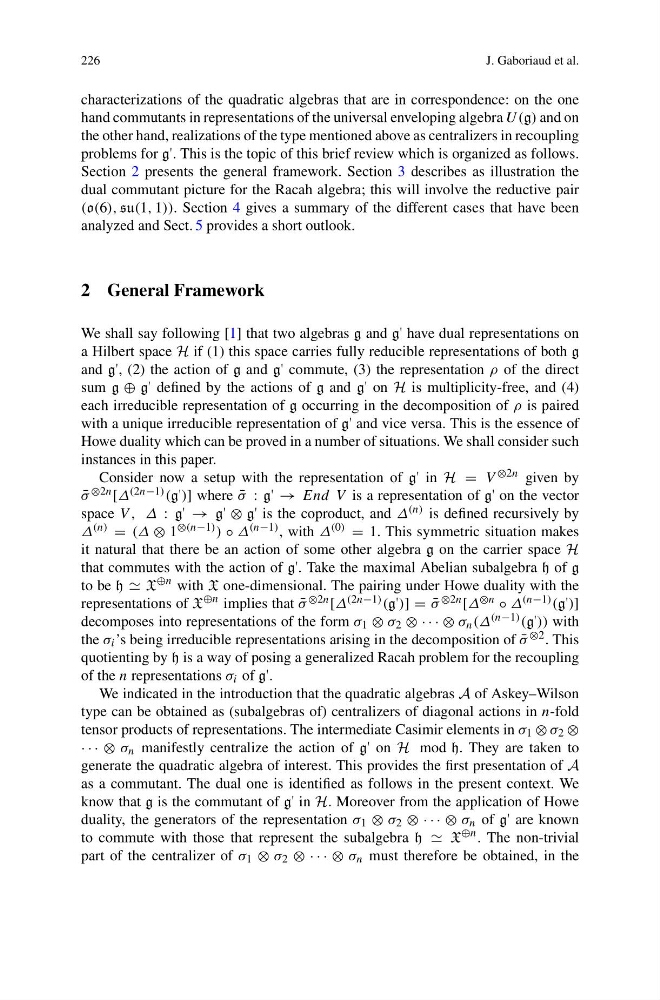
characterizations of the quadratic algebras that are in correspondence: on the one
hand commutants in representations of the universal enveloping algebra U(g) and on
the other hand, realizations of the type mentioned above as centralizers in recoupling
problems for g'. This is the topic of this brief review which is organized as follows.
Section 2 presents the general framework. Section 3 describes as illustration the
dual commutant picture for the Racah algebra; this will involve the reductive pair
(o(6), su(1, 1)). Section 4 gives a summary of the different cases that have been
analyzed and Sect. 5 provides a short outlook.
2 General Framework
We shall say following [1] that two algebras g and g' have dual representations on
a Hilbert space H if (1) this space carries fully reducible representations of both g
and g', (2) the action of g and g' commute, (3) the representation ρ of the direct
sum g ⊕ g' defined by the actions of g and g' on H is multiplicity-free, and (4)
each irreducible representation of g occurring in the decomposition of ρ is paired
with a unique irreducible representation of g' and vice versa. This is the essence of
Howe duality which can be proved in a number of situations. We shall consider such
instances in this paper.
Consider now a setup with the representation of g' in H = V ⊗2n given by
¯
σ ⊗2n [Δ (2n−1) (g')] where ¯
σ : g' → End V is a representation of g' on the vector
space V , Δ : g' → g' ⊗ g' is the coproduct, and Δ (n) is defined recursively by
Δ (n) = (Δ ⊗ 1 ⊗(n−1) ) ◦ Δ (n−1) , with Δ (0) = 1. This symmetric situation makes
it natural that there be an action of some other algebra g on the carrier space H
that commutes with the action of g'. Take the maximal Abelian subalgebra h of g
to be h X
⊕n with X one-dimensional. The pairing under Howe duality with the
representations of X
⊕n implies that ¯
σ ⊗2n [Δ (2n−1) (g')] = ¯
σ ⊗2n [Δ ⊗n ◦ Δ (n−1) (g')]
decomposes into representations of the form σ 1 ⊗ σ 2 ⊗ · · · ⊗ σ n (Δ (n−1) (g')) with
the σ i ’s being irreducible representations arising in the decomposition of ¯
σ ⊗2 . This
quotienting by h is a way of posing a generalized Racah problem for the recoupling
of the n representations σ i of g'.
We indicated in the introduction that the quadratic algebras A of Askey–Wilson
type can be obtained as (subalgebras of) centralizers of diagonal actions in n-fold
tensor products of representations. The intermediate Casimir elements in σ 1 ⊗ σ 2 ⊗
· · · ⊗ σ n manifestly centralize the action of g' on H mod h. They are taken to
generate the quadratic algebra of interest. This provides the first presentation of A
as a commutant. The dual one is identified as follows in the present context. We
know that g is the commutant of g' in H. Moreover from the application of Howe
duality, the generators of the representation σ 1 ⊗ σ 2 ⊗ · · · ⊗ σ n of g' are known
to commute with those that represent the subalgebra h X
⊕n . The non-trivial
part of the centralizer of σ 1 ⊗ σ 2 ⊗ · · · ⊗ σ n must therefore be obtained, in the
J. Gaboriaud et al.
characterizations of the quadratic algebras that are in correspondence: on the one
hand commutants in representations of the universal enveloping algebra U(g) and on
the other hand, realizations of the type mentioned above as centralizers in recoupling
problems for g'. This is the topic of this brief review which is organized as follows.
Section 2 presents the general framework. Section 3 describes as illustration the
dual commutant picture for the Racah algebra; this will involve the reductive pair
(o(6), su(1, 1)). Section 4 gives a summary of the different cases that have been
analyzed and Sect. 5 provides a short outlook.
2 General Framework
We shall say following [1] that two algebras g and g' have dual representations on
a Hilbert space H if (1) this space carries fully reducible representations of both g
and g', (2) the action of g and g' commute, (3) the representation ρ of the direct
sum g ⊕ g' defined by the actions of g and g' on H is multiplicity-free, and (4)
each irreducible representation of g occurring in the decomposition of ρ is paired
with a unique irreducible representation of g' and vice versa. This is the essence of
Howe duality which can be proved in a number of situations. We shall consider such
instances in this paper.
Consider now a setup with the representation of g' in H = V ⊗2n given by
¯
σ ⊗2n [Δ (2n−1) (g')] where ¯
σ : g' → End V is a representation of g' on the vector
space V , Δ : g' → g' ⊗ g' is the coproduct, and Δ (n) is defined recursively by
Δ (n) = (Δ ⊗ 1 ⊗(n−1) ) ◦ Δ (n−1) , with Δ (0) = 1. This symmetric situation makes
it natural that there be an action of some other algebra g on the carrier space H
that commutes with the action of g'. Take the maximal Abelian subalgebra h of g
to be h X
⊕n with X one-dimensional. The pairing under Howe duality with the
representations of X
⊕n implies that ¯
σ ⊗2n [Δ (2n−1) (g')] = ¯
σ ⊗2n [Δ ⊗n ◦ Δ (n−1) (g')]
decomposes into representations of the form σ 1 ⊗ σ 2 ⊗ · · · ⊗ σ n (Δ (n−1) (g')) with
the σ i ’s being irreducible representations arising in the decomposition of ¯
σ ⊗2 . This
quotienting by h is a way of posing a generalized Racah problem for the recoupling
of the n representations σ i of g'.
We indicated in the introduction that the quadratic algebras A of Askey–Wilson
type can be obtained as (subalgebras of) centralizers of diagonal actions in n-fold
tensor products of representations. The intermediate Casimir elements in σ 1 ⊗ σ 2 ⊗
· · · ⊗ σ n manifestly centralize the action of g' on H mod h. They are taken to
generate the quadratic algebra of interest. This provides the first presentation of A
as a commutant. The dual one is identified as follows in the present context. We
know that g is the commutant of g' in H. Moreover from the application of Howe
duality, the generators of the representation σ 1 ⊗ σ 2 ⊗ · · · ⊗ σ n of g' are known
to commute with those that represent the subalgebra h X
⊕n . The non-trivial
part of the centralizer of σ 1 ⊗ σ 2 ⊗ · · · ⊗ σ n must therefore be obtained, in the