

Spin Chains of Haldane–Shastry Type: A Bird’s Eye View
7
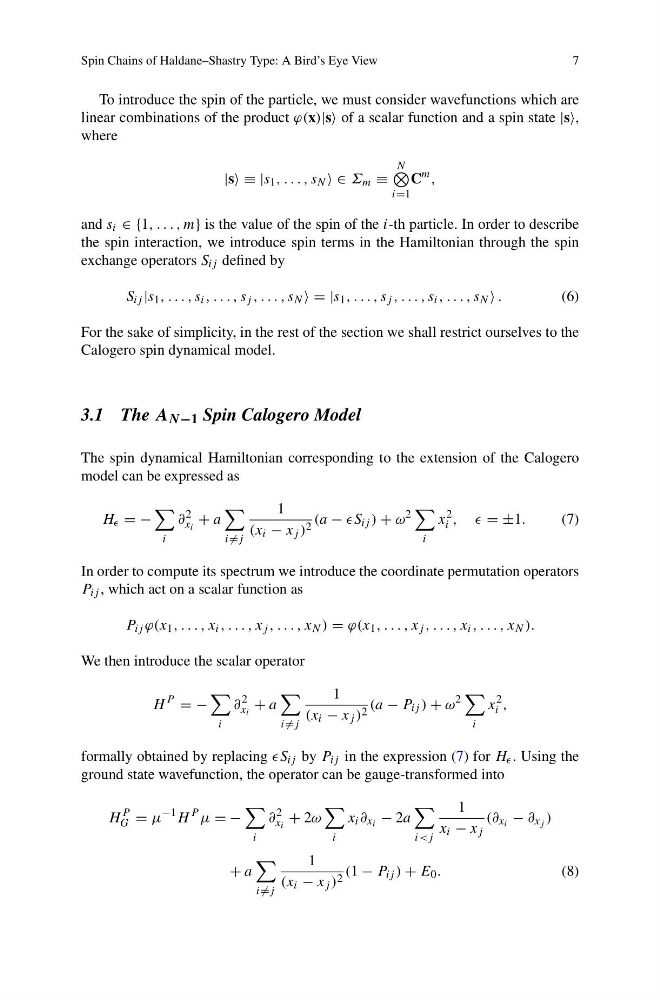
To introduce the spin of the particle, we must consider wavefunctions which are
linear combinations of the product ϕ(x)|s of a scalar function and a spin state |s
where
|s ≡ |s 1 , . . . , s N ∈ Σ m ≡
N
i=1
C
m ,
and s i ∈ {1, . . . , m} is the value of the spin of the i-th particle. In order to describe
the spin interaction, we introduce spin terms in the Hamiltonian through the spin
exchange operators S ij defined by
S ij |s 1 , . . . , s i , . . . , s j , . . . , s N = |s 1 , . . . , s j , . . . , s i , . . . , s N .
(6)
For the sake of simplicity, in the rest of the section we shall restrict ourselves to the
Calogero spin dynamical model.
3.1 The A N−1 Spin Calogero Model
The spin dynamical Hamiltonian corresponding to the extension of the Calogero
model can be expressed as
H = −
i
∂
2
x i
+ a
i =j
1
(x i − x j ) 2 (a − S ij ) + ω
2
i
x
2
i , , = ±1.
(7)
In order to compute its spectrum we introduce the coordinate permutation operators
P ij , which act on a scalar function as
P ij ϕ(x 1 , . . . , x i , . . . , x j , . . . , x N ) = ϕ(x 1 , . . . , x j , . . . , x i , . . . , x N ).
We then introduce the scalar operator
H
P
= −
i
∂
2
x i
+ a
i =j
1
(x i − x j ) 2 (a − P ij ) + ω
2
i
x
2
i ,
formally obtained by replacing S ij by P ij in the expression (7) for H . Using the
ground state wavefunction, the operator can be gauge-transformed into
H
P
G = μ
−1 H
P μ = −
i
∂
2
x i
+ 2ω
i
x i ∂ x i − 2a
i
x i − x j
(∂ x i − ∂ x j )
+ a
i =j
1
(x i − x j ) 2 (1 − P ij ) + E 0 .
(8)
7
To introduce the spin of the particle, we must consider wavefunctions which are
linear combinations of the product ϕ(x)|s of a scalar function and a spin state |s
where
|s ≡ |s 1 , . . . , s N ∈ Σ m ≡
N
i=1
C
m ,
and s i ∈ {1, . . . , m} is the value of the spin of the i-th particle. In order to describe
the spin interaction, we introduce spin terms in the Hamiltonian through the spin
exchange operators S ij defined by
S ij |s 1 , . . . , s i , . . . , s j , . . . , s N = |s 1 , . . . , s j , . . . , s i , . . . , s N .
(6)
For the sake of simplicity, in the rest of the section we shall restrict ourselves to the
Calogero spin dynamical model.
3.1 The A N−1 Spin Calogero Model
The spin dynamical Hamiltonian corresponding to the extension of the Calogero
model can be expressed as
H = −
i
∂
2
x i
+ a
i =j
1
(x i − x j ) 2 (a − S ij ) + ω
2
i
x
2
i , , = ±1.
(7)
In order to compute its spectrum we introduce the coordinate permutation operators
P ij , which act on a scalar function as
P ij ϕ(x 1 , . . . , x i , . . . , x j , . . . , x N ) = ϕ(x 1 , . . . , x j , . . . , x i , . . . , x N ).
We then introduce the scalar operator
H
P
= −
i
∂
2
x i
+ a
i =j
1
(x i − x j ) 2 (a − P ij ) + ω
2
i
x
2
i ,
formally obtained by replacing S ij by P ij in the expression (7) for H . Using the
ground state wavefunction, the operator can be gauge-transformed into
H
P
G = μ
−1 H
P μ = −
i
∂
2
x i
+ 2ω
i
x i ∂ x i − 2a
i
x i − x j
(∂ x i − ∂ x j )
+ a
i =j
1
(x i − x j ) 2 (1 − P ij ) + E 0 .
(8)