

8
F. Finkel et al.
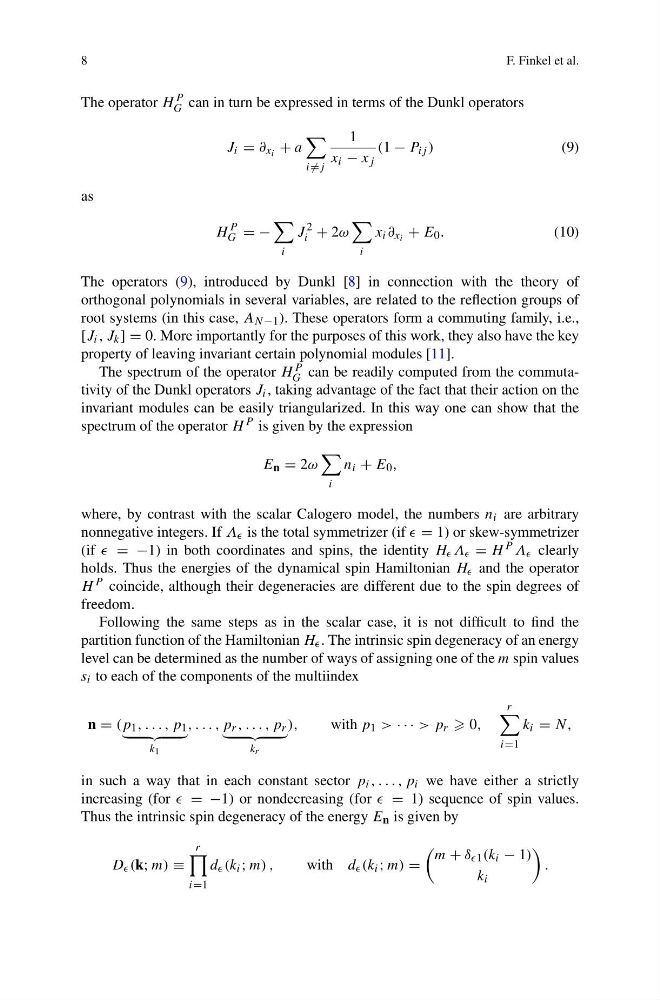
The operator H P
G can in turn be expressed in terms of the Dunkl operators
J i = ∂ x i + a
i =j
1
x i − x j
(1 − P ij )
(9)
as
H
P
G = −
i
J
2
i + 2ω
i
x i ∂ x i + E 0 .
(10)
The operators (9), introduced by Dunkl [8] in connection with the theory of
orthogonal polynomials in several variables, are related to the reflection groups of
root systems (in this case, A N −1 ). These operators form a commuting family, i.e.,
[J i , J k ] = 0. More importantly for the purposes of this work, they also have the key
property of leaving invariant certain polynomial modules [11].
The spectrum of the operator H P
G can be readily computed from the commutativity of the Dunkl operators J i , taking advantage of the fact that their action on the
invariant modules can be easily triangularized. In this way one can show that the
spectrum of the operator H P is given by the expression
E n = 2ω
i
n i + E 0 ,
where, by contrast with the scalar Calogero model, the numbers n i are arbitrary
nonnegative integers. If Λ is the total symmetrizer (if = 1) or skew-symmetrizer
(if = −1) in both coordinates and spins, the identity H Λ = H P Λ clearly
holds. Thus the energies of the dynamical spin Hamiltonian H and the operator
H P coincide, although their degeneracies are different due to the spin degrees of
freedom.
Following the same steps as in the scalar case, it is not difficult to find the
partition function of the Hamiltonian H . The intrinsic spin degeneracy of an energy
level can be determined as the number of ways of assigning one of the m spin values
s i to each of the components of the multiindex
n = (p 1 , . . . , p 1
k 1
, . . . , p r , . . . , p r
k r
),
with p 1 > · · · > p r 0,
r
i=1
k i = N,
in such a way that in each constant sector p i , . . . , p i we have either a strictly
increasing (for = −1) or nondecreasing (for = 1) sequence of spin values.
Thus the intrinsic spin degeneracy of the energy E n is given by
D (k; m) ≡
r
i=1
d (k i ; m) ,
with d (k i ; m) =
m + δ 1 (k i − 1)
k i
.
F. Finkel et al.
The operator H P
G can in turn be expressed in terms of the Dunkl operators
J i = ∂ x i + a
i =j
1
x i − x j
(1 − P ij )
(9)
as
H
P
G = −
i
J
2
i + 2ω
i
x i ∂ x i + E 0 .
(10)
The operators (9), introduced by Dunkl [8] in connection with the theory of
orthogonal polynomials in several variables, are related to the reflection groups of
root systems (in this case, A N −1 ). These operators form a commuting family, i.e.,
[J i , J k ] = 0. More importantly for the purposes of this work, they also have the key
property of leaving invariant certain polynomial modules [11].
The spectrum of the operator H P
G can be readily computed from the commutativity of the Dunkl operators J i , taking advantage of the fact that their action on the
invariant modules can be easily triangularized. In this way one can show that the
spectrum of the operator H P is given by the expression
E n = 2ω
i
n i + E 0 ,
where, by contrast with the scalar Calogero model, the numbers n i are arbitrary
nonnegative integers. If Λ is the total symmetrizer (if = 1) or skew-symmetrizer
(if = −1) in both coordinates and spins, the identity H Λ = H P Λ clearly
holds. Thus the energies of the dynamical spin Hamiltonian H and the operator
H P coincide, although their degeneracies are different due to the spin degrees of
freedom.
Following the same steps as in the scalar case, it is not difficult to find the
partition function of the Hamiltonian H . The intrinsic spin degeneracy of an energy
level can be determined as the number of ways of assigning one of the m spin values
s i to each of the components of the multiindex
n = (p 1 , . . . , p 1
k 1
, . . . , p r , . . . , p r
k r
),
with p 1 > · · · > p r 0,
r
i=1
k i = N,
in such a way that in each constant sector p i , . . . , p i we have either a strictly
increasing (for = −1) or nondecreasing (for = 1) sequence of spin values.
Thus the intrinsic spin degeneracy of the energy E n is given by
D (k; m) ≡
r
i=1
d (k i ; m) ,
with d (k i ; m) =
m + δ 1 (k i − 1)
k i
.