

154
D. Levi et al.
Conditional Discretization of the Generalized Reaction–Diffusion Eq. (2)
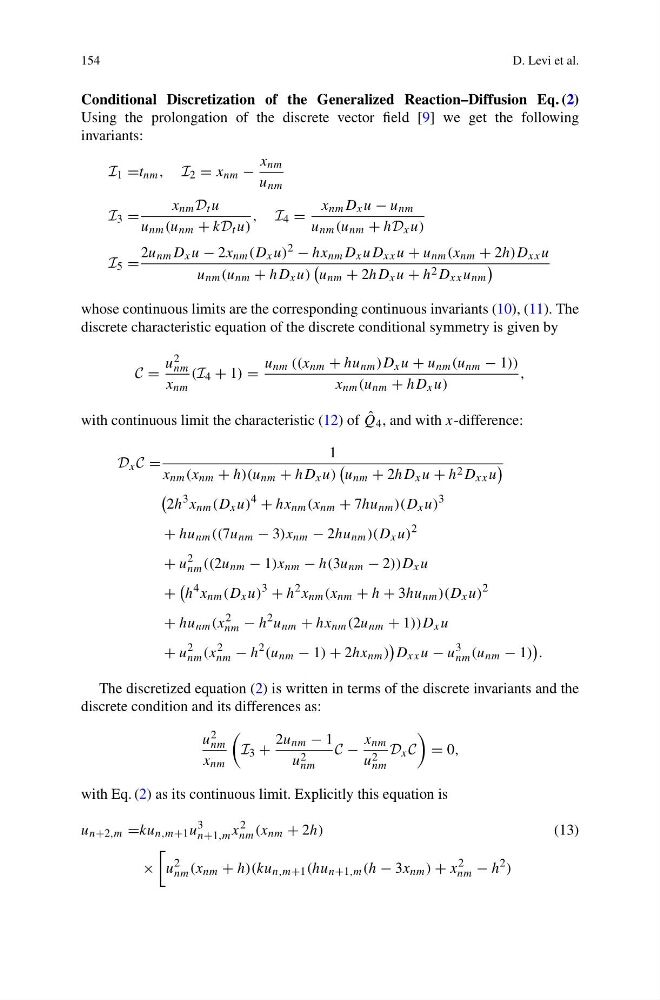
Using the prolongation of the discrete vector field [9] we get the following
invariants:
I 1 =t nm , I 2 = x nm −
x nm
u nm
I 3 =
x nm D t u
u nm (u nm + kD t u)
, I 4 =
x nm D x u − u nm
u nm (u nm + hD x u)
I 5 =
2u nm D x u − 2x nm (D x u) 2 − hx nm D x uD xx u + u nm (x nm + 2h)D xx u
u nm (u nm + hD x u)
u nm + 2hD x u + h 2 D xx u nm
whose continuous limits are the corresponding continuous invariants (10), (11). The
discrete characteristic equation of the discrete conditional symmetry is given by
C =
u 2
nm
x nm
(I 4 + 1) =
u nm ((x nm + hu nm )D x u + u nm (u nm − 1))
x nm (u nm + hD x u)
,
with continuous limit the characteristic (12) of ˆ
Q 4 , and with x-difference:
D x C =
1
x nm (x nm + h)(u nm + hD x u)
u nm + 2hD x u + h 2 D xx u
2h
3 x nm (D x u)
4
+ hx nm (x nm + 7hu nm )(D x u)
3
+ hu nm ((7u nm − 3)x nm − 2hu nm )(D x u)
2
+ u
2
nm ((2u nm − 1)x nm − h(3u nm − 2))D x u
+
h
4 x nm (D x u)
3
+ h
2 x nm (x nm + h + 3hu nm )(D x u)
2
+ hu nm (x
2
nm − h
2 u nm + hx nm (2u nm + 1))D x u
+ u
2
nm (x
2
nm − h
2 (u nm − 1) + 2hx nm )
D xx u − u
3
nm (u nm − 1)
.
The discretized equation (2) is written in terms of the discrete invariants and the
discrete condition and its differences as:
u 2
nm
x nm
I 3 +
2u nm − 1
u 2
nm
C −
x nm
u 2
nm
D x C
= 0,
with Eq. (2) as its continuous limit. Explicitly this equation is
u n+2,m =ku n,m+1 u
3
n+1,m x
2
nm (x nm + 2h)
(13)
×
u
2
nm (x nm + h)(ku n,m+1 (hu n+1,m (h − 3x nm ) + x
2
nm − h
2 )
D. Levi et al.
Conditional Discretization of the Generalized Reaction–Diffusion Eq. (2)
Using the prolongation of the discrete vector field [9] we get the following
invariants:
I 1 =t nm , I 2 = x nm −
x nm
u nm
I 3 =
x nm D t u
u nm (u nm + kD t u)
, I 4 =
x nm D x u − u nm
u nm (u nm + hD x u)
I 5 =
2u nm D x u − 2x nm (D x u) 2 − hx nm D x uD xx u + u nm (x nm + 2h)D xx u
u nm (u nm + hD x u)
u nm + 2hD x u + h 2 D xx u nm
whose continuous limits are the corresponding continuous invariants (10), (11). The
discrete characteristic equation of the discrete conditional symmetry is given by
C =
u 2
nm
x nm
(I 4 + 1) =
u nm ((x nm + hu nm )D x u + u nm (u nm − 1))
x nm (u nm + hD x u)
,
with continuous limit the characteristic (12) of ˆ
Q 4 , and with x-difference:
D x C =
1
x nm (x nm + h)(u nm + hD x u)
u nm + 2hD x u + h 2 D xx u
2h
3 x nm (D x u)
4
+ hx nm (x nm + 7hu nm )(D x u)
3
+ hu nm ((7u nm − 3)x nm − 2hu nm )(D x u)
2
+ u
2
nm ((2u nm − 1)x nm − h(3u nm − 2))D x u
+
h
4 x nm (D x u)
3
+ h
2 x nm (x nm + h + 3hu nm )(D x u)
2
+ hu nm (x
2
nm − h
2 u nm + hx nm (2u nm + 1))D x u
+ u
2
nm (x
2
nm − h
2 (u nm − 1) + 2hx nm )
D xx u − u
3
nm (u nm − 1)
.
The discretized equation (2) is written in terms of the discrete invariants and the
discrete condition and its differences as:
u 2
nm
x nm
I 3 +
2u nm − 1
u 2
nm
C −
x nm
u 2
nm
D x C
= 0,
with Eq. (2) as its continuous limit. Explicitly this equation is
u n+2,m =ku n,m+1 u
3
n+1,m x
2
nm (x nm + 2h)
(13)
×
u
2
nm (x nm + h)(ku n,m+1 (hu n+1,m (h − 3x nm ) + x
2
nm − h
2 )