

Quantum Superintegrable Systems
113
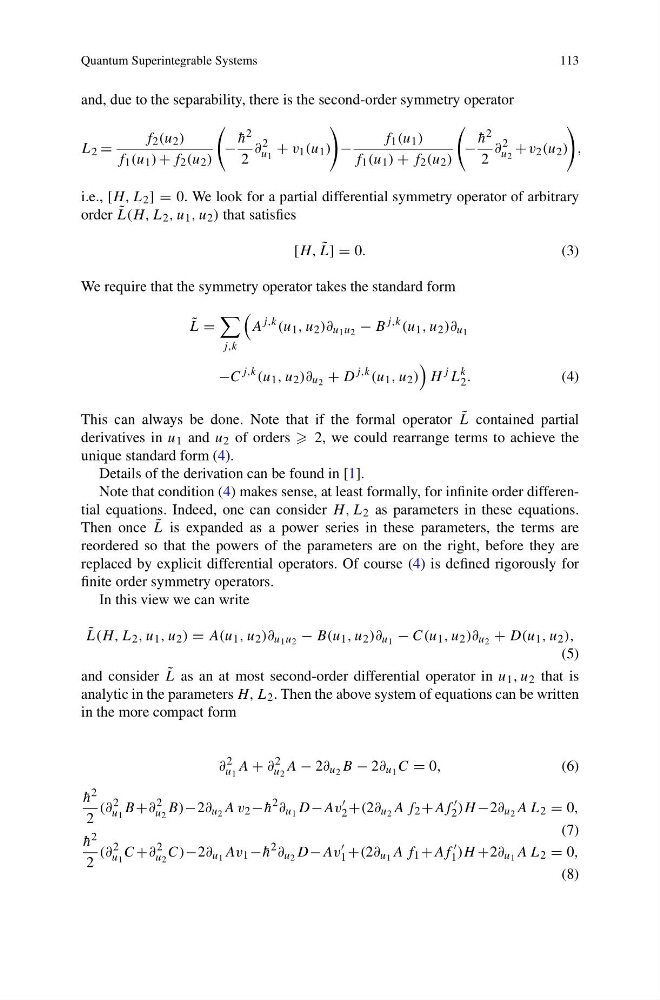
and, due to the separability, there is the second-order symmetry operator
L 2 =
f 2 (u 2 )
f 1 (u 1 ) + f 2 (u 2 )
−
¯
h 2
2
∂
2
u 1
+ v 1 (u 1 )
−
f 1 (u 1 )
f 1 (u 1 ) + f 2 (u 2 )
−
¯
h 2
2
∂
2
u 2
+ v 2 (u 2 )
,
i.e., [H, L 2 ] = 0. We look for a partial differential symmetry operator of arbitrary
order ˜
L(H, L 2 , u 1 , u 2 ) that satisfies
[H, ˜
L] = 0.
(3)
We require that the symmetry operator takes the standard form
˜
L =
j,k
A
j,k (u 1 , u 2 )∂ u 1 u 2 − B
j,k (u 1 , u 2 )∂ u 1
−C
j,k (u 1 , u 2 )∂ u 2 + D
j,k (u 1 , u 2 )
H
j L
k
2 .
(4)
This can always be done. Note that if the formal operator ˜
L contained partial
derivatives in u 1 and u 2 of orders 2, we could rearrange terms to achieve the
unique standard form (4).
Details of the derivation can be found in [1].
Note that condition (4) makes sense, at least formally, for infinite order differential equations. Indeed, one can consider H, L 2 as parameters in these equations.
Then once ˜
L is expanded as a power series in these parameters, the terms are
reordered so that the powers of the parameters are on the right, before they are
replaced by explicit differential operators. Of course (4) is defined rigorously for
finite order symmetry operators.
In this view we can write
˜
L(H, L 2 , u 1 , u 2 ) = A(u 1 , u 2 )∂ u 1 u 2 − B(u 1 , u 2 )∂ u 1 − C(u 1 , u 2 )∂ u 2 + D(u 1 , u 2 ),
(5)
and consider ˜
L as an at most second-order differential operator in u 1 , u 2 that is
analytic in the parameters H, L 2 . Then the above system of equations can be written
in the more compact form
∂
2
u 1
A + ∂
2
u 2
A − 2∂ u 2 B − 2∂ u 1 C = 0,
(6)
¯
h 2
2
(∂
2
u 1
B +∂
2
u 2
B)−2∂ u 2 A v 2 − ¯
h
2 ∂ u 1 D−Av
2 +(2∂ u 2 A f 2 +Af
2 )H −2∂ u 2 A L 2 = 0,
(7)
¯
h 2
2
(∂
2
u 1
C +∂
2
u 2
C)−2∂ u 1 Av 1 − ¯
h
2 ∂ u 2 D−Av
1 +(2∂ u 1 A f 1 +Af
1 )H +2∂ u 1 A L 2 = 0,
(8)
113
and, due to the separability, there is the second-order symmetry operator
L 2 =
f 2 (u 2 )
f 1 (u 1 ) + f 2 (u 2 )
−
¯
h 2
2
∂
2
u 1
+ v 1 (u 1 )
−
f 1 (u 1 )
f 1 (u 1 ) + f 2 (u 2 )
−
¯
h 2
2
∂
2
u 2
+ v 2 (u 2 )
,
i.e., [H, L 2 ] = 0. We look for a partial differential symmetry operator of arbitrary
order ˜
L(H, L 2 , u 1 , u 2 ) that satisfies
[H, ˜
L] = 0.
(3)
We require that the symmetry operator takes the standard form
˜
L =
j,k
A
j,k (u 1 , u 2 )∂ u 1 u 2 − B
j,k (u 1 , u 2 )∂ u 1
−C
j,k (u 1 , u 2 )∂ u 2 + D
j,k (u 1 , u 2 )
H
j L
k
2 .
(4)
This can always be done. Note that if the formal operator ˜
L contained partial
derivatives in u 1 and u 2 of orders 2, we could rearrange terms to achieve the
unique standard form (4).
Details of the derivation can be found in [1].
Note that condition (4) makes sense, at least formally, for infinite order differential equations. Indeed, one can consider H, L 2 as parameters in these equations.
Then once ˜
L is expanded as a power series in these parameters, the terms are
reordered so that the powers of the parameters are on the right, before they are
replaced by explicit differential operators. Of course (4) is defined rigorously for
finite order symmetry operators.
In this view we can write
˜
L(H, L 2 , u 1 , u 2 ) = A(u 1 , u 2 )∂ u 1 u 2 − B(u 1 , u 2 )∂ u 1 − C(u 1 , u 2 )∂ u 2 + D(u 1 , u 2 ),
(5)
and consider ˜
L as an at most second-order differential operator in u 1 , u 2 that is
analytic in the parameters H, L 2 . Then the above system of equations can be written
in the more compact form
∂
2
u 1
A + ∂
2
u 2
A − 2∂ u 2 B − 2∂ u 1 C = 0,
(6)
¯
h 2
2
(∂
2
u 1
B +∂
2
u 2
B)−2∂ u 2 A v 2 − ¯
h
2 ∂ u 1 D−Av
2 +(2∂ u 2 A f 2 +Af
2 )H −2∂ u 2 A L 2 = 0,
(7)
¯
h 2
2
(∂
2
u 1
C +∂
2
u 2
C)−2∂ u 1 Av 1 − ¯
h
2 ∂ u 2 D−Av
1 +(2∂ u 1 A f 1 +Af
1 )H +2∂ u 1 A L 2 = 0,
(8)