

114
B. K. Berntson et al.
−
¯
h 2
2
(∂
2
u 1
D + ∂
2
u 2
D) + 2∂ u 1 B v 1 + 2∂ u 2 C v 2 + Bv
1 + Cv
2
(9)
− (2∂ u 1 B f 1 + 2∂ u 2 C f 2 + Bf
1 + Cf
2 )H + (−2∂ u 1 B + 2∂ u 2 C) L 2 = 0.
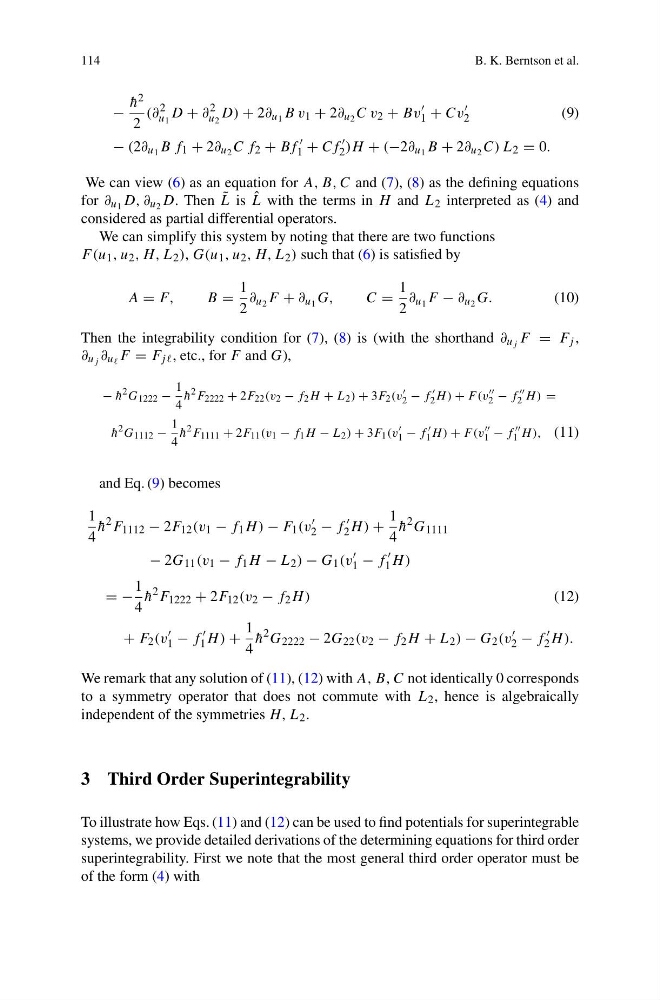
We can view (6) as an equation for A, B, C and (7), (8) as the defining equations
for ∂ u 1 D, ∂ u 2 D. Then ˜
L is ˆ
L with the terms in H and L 2 interpreted as (4) and
considered as partial differential operators.
We can simplify this system by noting that there are two functions
F (u 1 , u 2 , H, L 2 ), G(u 1 , u 2 , H, L 2 ) such that (6) is satisfied by
A = F,
B =
1
2
∂ u 2 F + ∂ u 1 G,
C =
1
2
∂ u 1 F − ∂ u 2 G.
(10)
Then the integrability condition for (7), (8) is (with the shorthand ∂ u j F = F j ,
∂ u j ∂ u F = F jj , etc., for F and G),
− ¯
h
2 G 1222 −
1
4
¯
h
2 F 2222 + 2F 22 (v 2 − f 2 H + L 2 ) + 3F 2 (v
2 − f
2 H ) + F (v
2 − f
2 H ) =
¯
h
2 G 1112 −
1
4
¯
h
2 F 1111 + 2F 11 (v 1 − f 1 H − L 2 ) + 3F 1 (v
1 − f
1 H ) + F (v
1 − f
1 H ), (11)
and Eq. (9) becomes
1
4
¯
h
2 F 1112 − 2F 12 (v 1 − f 1 H ) − F 1 (v
2 − f
2 H ) +
1
4
¯
h
2 G 1111
− 2G 11 (v 1 − f 1 H − L 2 ) − G 1 (v
1 − f
1 H )
= −
1
4
¯
h
2 F 1222 + 2F 12 (v 2 − f 2 H )
(12)
+ F 2 (v
1 − f
1 H ) +
1
4
¯
h
2 G 2222 − 2G 22 (v 2 − f 2 H + L 2 ) − G 2 (v
2 − f
2 H ).
We remark that any solution of (11), (12) with A, B, C not identically 0 corresponds
to a symmetry operator that does not commute with L 2 , hence is algebraically
independent of the symmetries H, L 2 .
3 Third Order Superintegrability
To illustrate how Eqs. (11) and (12) can be used to find potentials for superintegrable
systems, we provide detailed derivations of the determining equations for third order
superintegrability. First we note that the most general third order operator must be
of the form (4) with
B. K. Berntson et al.
−
¯
h 2
2
(∂
2
u 1
D + ∂
2
u 2
D) + 2∂ u 1 B v 1 + 2∂ u 2 C v 2 + Bv
1 + Cv
2
(9)
− (2∂ u 1 B f 1 + 2∂ u 2 C f 2 + Bf
1 + Cf
2 )H + (−2∂ u 1 B + 2∂ u 2 C) L 2 = 0.
We can view (6) as an equation for A, B, C and (7), (8) as the defining equations
for ∂ u 1 D, ∂ u 2 D. Then ˜
L is ˆ
L with the terms in H and L 2 interpreted as (4) and
considered as partial differential operators.
We can simplify this system by noting that there are two functions
F (u 1 , u 2 , H, L 2 ), G(u 1 , u 2 , H, L 2 ) such that (6) is satisfied by
A = F,
B =
1
2
∂ u 2 F + ∂ u 1 G,
C =
1
2
∂ u 1 F − ∂ u 2 G.
(10)
Then the integrability condition for (7), (8) is (with the shorthand ∂ u j F = F j ,
∂ u j ∂ u F = F jj , etc., for F and G),
− ¯
h
2 G 1222 −
1
4
¯
h
2 F 2222 + 2F 22 (v 2 − f 2 H + L 2 ) + 3F 2 (v
2 − f
2 H ) + F (v
2 − f
2 H ) =
¯
h
2 G 1112 −
1
4
¯
h
2 F 1111 + 2F 11 (v 1 − f 1 H − L 2 ) + 3F 1 (v
1 − f
1 H ) + F (v
1 − f
1 H ), (11)
and Eq. (9) becomes
1
4
¯
h
2 F 1112 − 2F 12 (v 1 − f 1 H ) − F 1 (v
2 − f
2 H ) +
1
4
¯
h
2 G 1111
− 2G 11 (v 1 − f 1 H − L 2 ) − G 1 (v
1 − f
1 H )
= −
1
4
¯
h
2 F 1222 + 2F 12 (v 2 − f 2 H )
(12)
+ F 2 (v
1 − f
1 H ) +
1
4
¯
h
2 G 2222 − 2G 22 (v 2 − f 2 H + L 2 ) − G 2 (v
2 − f
2 H ).
We remark that any solution of (11), (12) with A, B, C not identically 0 corresponds
to a symmetry operator that does not commute with L 2 , hence is algebraically
independent of the symmetries H, L 2 .
3 Third Order Superintegrability
To illustrate how Eqs. (11) and (12) can be used to find potentials for superintegrable
systems, we provide detailed derivations of the determining equations for third order
superintegrability. First we note that the most general third order operator must be
of the form (4) with