

112
B. K. Berntson et al.
1 Introduction
In the paper [1] the authors constructed a canonical form for symmetry operators
of any order in 2D and used it to give the first proof of the superintegrability
of the quantum Tremblay, Turbiner, and Winternitz (TTW) system [2] in polar
coordinates, for all rational values of the parameter k. In the original method
the various potentials were given and the problem was the construction of higher
order symmetry operators that would verify superintegrability. The method was
highly algebraic and required the solution of systems of difference equations on
a lattice. Here, we consider an arbitrary space admitting a separation in some
orthogonal coordinate system (hence admitting a 2nd order symmetry operator), and
search for all potentials V for which the Schrödinger equation admits an additional
independent symmetry operator of order higher than 2. Now the problem reduces to
solving a system of partial differential equations.
We give a brief introduction to the method and then specialize it to third order
superintegrable systems where we treat a few examples. We revisit the Tremblay and
Winternitz derivation of the Painlevé VI potential for a third order superintegrable
flat space system that separates in polar coordinates [3], and we show among
other new results that the Painlevé VI potential also appears for a third order
superintegrable system on the 2-sphere that separates in spherical coordinates, as
well as a third order superintegrable system on the 2-hyperboloid that separates in
spherical coordinates.
2 The Canonical Form for a Symmetry Operator
We consider a Schrödinger equation on a 2D real or complex Riemannian manifold
with Laplace–Beltrami operator Δ 2 and potential V :
H Ψ ≡
−
¯
h 2
2
Δ 2 + V
Ψ = EΨ
(1)
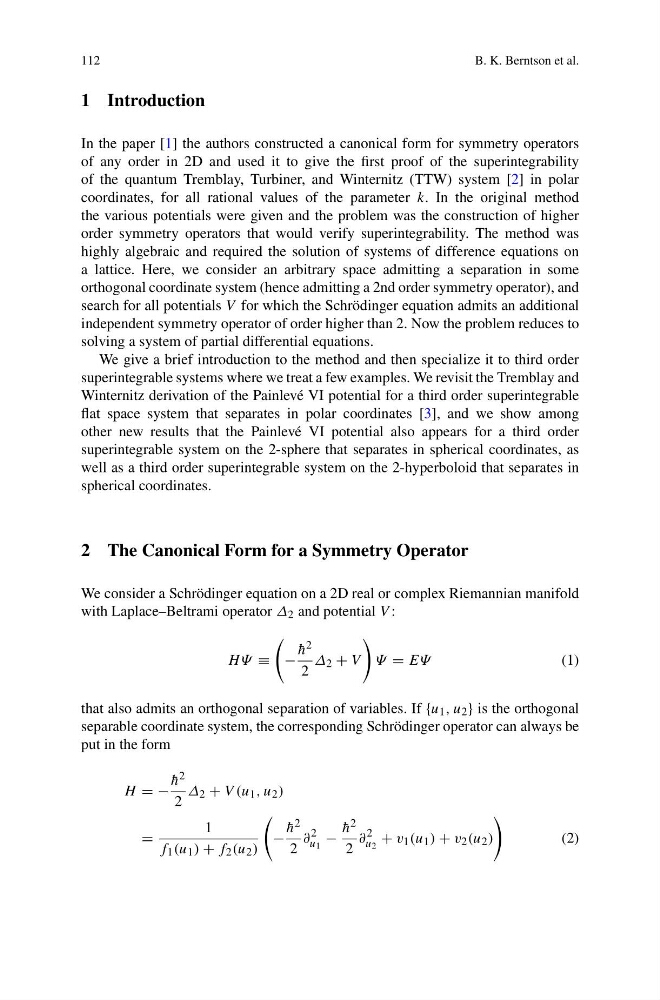
that also admits an orthogonal separation of variables. If {u 1 , u 2 } is the orthogonal
separable coordinate system, the corresponding Schrödinger operator can always be
put in the form
H = −
¯
h 2
2
Δ 2 + V (u 1 , u 2 )
=
1
f 1 (u 1 ) + f 2 (u 2 )
−
¯
h 2
2
∂
2
u 1
−
¯
h 2
2
∂
2
u 2
+ v 1 (u 1 ) + v 2 (u 2 )
(2)
B. K. Berntson et al.
1 Introduction
In the paper [1] the authors constructed a canonical form for symmetry operators
of any order in 2D and used it to give the first proof of the superintegrability
of the quantum Tremblay, Turbiner, and Winternitz (TTW) system [2] in polar
coordinates, for all rational values of the parameter k. In the original method
the various potentials were given and the problem was the construction of higher
order symmetry operators that would verify superintegrability. The method was
highly algebraic and required the solution of systems of difference equations on
a lattice. Here, we consider an arbitrary space admitting a separation in some
orthogonal coordinate system (hence admitting a 2nd order symmetry operator), and
search for all potentials V for which the Schrödinger equation admits an additional
independent symmetry operator of order higher than 2. Now the problem reduces to
solving a system of partial differential equations.
We give a brief introduction to the method and then specialize it to third order
superintegrable systems where we treat a few examples. We revisit the Tremblay and
Winternitz derivation of the Painlevé VI potential for a third order superintegrable
flat space system that separates in polar coordinates [3], and we show among
other new results that the Painlevé VI potential also appears for a third order
superintegrable system on the 2-sphere that separates in spherical coordinates, as
well as a third order superintegrable system on the 2-hyperboloid that separates in
spherical coordinates.
2 The Canonical Form for a Symmetry Operator
We consider a Schrödinger equation on a 2D real or complex Riemannian manifold
with Laplace–Beltrami operator Δ 2 and potential V :
H Ψ ≡
−
¯
h 2
2
Δ 2 + V
Ψ = EΨ
(1)
that also admits an orthogonal separation of variables. If {u 1 , u 2 } is the orthogonal
separable coordinate system, the corresponding Schrödinger operator can always be
put in the form
H = −
¯
h 2
2
Δ 2 + V (u 1 , u 2 )
=
1
f 1 (u 1 ) + f 2 (u 2 )
−
¯
h 2
2
∂
2
u 1
−
¯
h 2
2
∂
2
u 2
+ v 1 (u 1 ) + v 2 (u 2 )
(2)