

167
The identification and selection of an appropriate set of indicators forms the
basis of any useful impact assessment. Often-cited weaknesses include incomplete
coverage of many different factors, including: issues, key considerations, processes,
and the causes and effects of the interlinked trends (Van Cauwenbergh et al. 2007).
To avoid these, the scope of our literature review covered not only CSA, but also
sustainable intensification and organic agriculture. In addition, a thorough scrutiny
of potential indicators, in terms of measurability, relevance and practicability, was
conducted on those that made the long-list (Lebacq et al. 2013; Van Cauwenbergh
et al. 2007; Nambiar et al. 2001; Brown 2009). Narrowing down the long-list with
local stakeholders ensured that the final list of indicators is grounded in the local
context, and relevant to the challenges being faced and the vision for development
in the region. The recent efforts by, for example, CCAFS (Quinney et al. 2016) and
the World Bank (2016) to review and guide the selection of suitable CSA indicators
are likely to further facilitate this process.
14.3.2 Importance of Indicators in the Food Security
and Adaptation Pillars
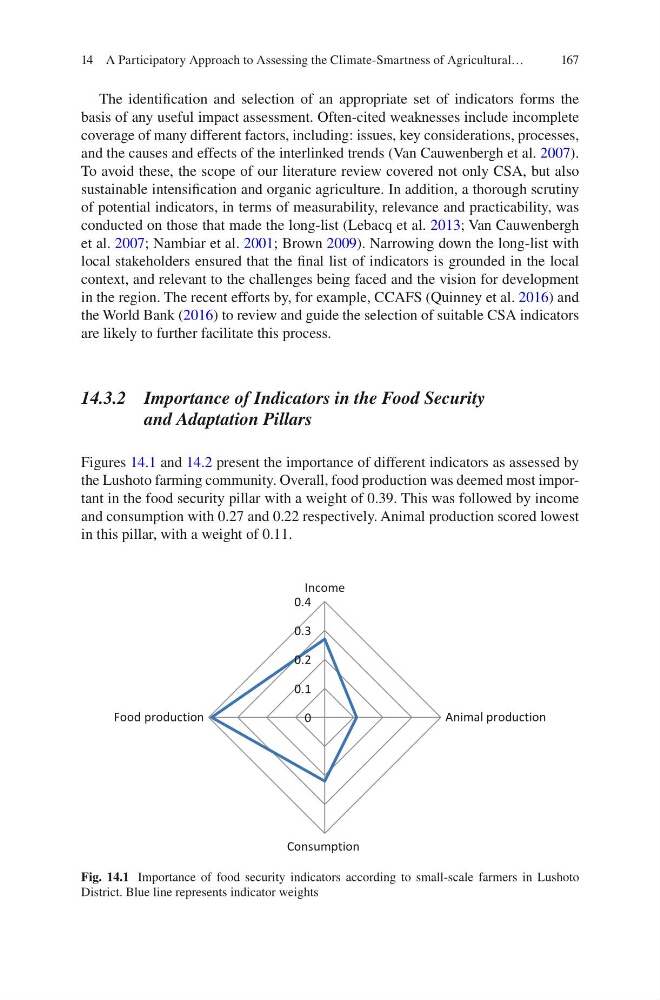
Figures 14.1 and 14.2 present the importance of different indicators as assessed by
the Lushoto farming community. Overall, food production was deemed most important in the food security pillar with a weight of 0.39. This was followed by income
and consumption with 0.27 and 0.22 respectively. Animal production scored lowest
in this pillar, with a weight of 0.11.
0
0.1
0.2
0.3
0.4
Income
Animal production
Consumption
Food production
Fig. 14.1 Importance of food security indicators according to small-scale farmers in Lushoto
District. Blue line represents indicator weights
14 A Participatory Approach to Assessing the Climate-Smartness of Agricultural…
The identification and selection of an appropriate set of indicators forms the
basis of any useful impact assessment. Often-cited weaknesses include incomplete
coverage of many different factors, including: issues, key considerations, processes,
and the causes and effects of the interlinked trends (Van Cauwenbergh et al. 2007).
To avoid these, the scope of our literature review covered not only CSA, but also
sustainable intensification and organic agriculture. In addition, a thorough scrutiny
of potential indicators, in terms of measurability, relevance and practicability, was
conducted on those that made the long-list (Lebacq et al. 2013; Van Cauwenbergh
et al. 2007; Nambiar et al. 2001; Brown 2009). Narrowing down the long-list with
local stakeholders ensured that the final list of indicators is grounded in the local
context, and relevant to the challenges being faced and the vision for development
in the region. The recent efforts by, for example, CCAFS (Quinney et al. 2016) and
the World Bank (2016) to review and guide the selection of suitable CSA indicators
are likely to further facilitate this process.
14.3.2 Importance of Indicators in the Food Security
and Adaptation Pillars
Figures 14.1 and 14.2 present the importance of different indicators as assessed by
the Lushoto farming community. Overall, food production was deemed most important in the food security pillar with a weight of 0.39. This was followed by income
and consumption with 0.27 and 0.22 respectively. Animal production scored lowest
in this pillar, with a weight of 0.11.
0
0.1
0.2
0.3
0.4
Income
Animal production
Consumption
Food production
Fig. 14.1 Importance of food security indicators according to small-scale farmers in Lushoto
District. Blue line represents indicator weights
14 A Participatory Approach to Assessing the Climate-Smartness of Agricultural…