

168
We associate the first figure with the farmers’ priority on allocating resources,
where a large proportion of land is allocated for food crops. Likewise, the farmers’
priority towards the income indicator was associated with the large proportion of
income spent on food items. The importance of the consumption indicator was associated with its direct correlation to food security. The farmers’ responses around the
animal production indicator points to the higher importance of crop production than
livestock for most farmers. A study carried out by Lyamchai et al. (2011) in Lushoto
District indeed suggested that 100% of the food crop is produced by smallholder
farmers and that crop agriculture is the dominant sector in the area. The findings of
this study are also in line with a characterisation survey carried out in western Kenya
in which food production was deemed most important by farmers followed by
income (Waithaka et al. 2006). Moreover, the study of Shikuku et al. (2016) reported
that income and yield were deemed the most important CSA indicators by both
male and female farmers in Mbeya, Tanzania. Yet, the study did not specify whether
yield is coming from the production of crops and/or animals.
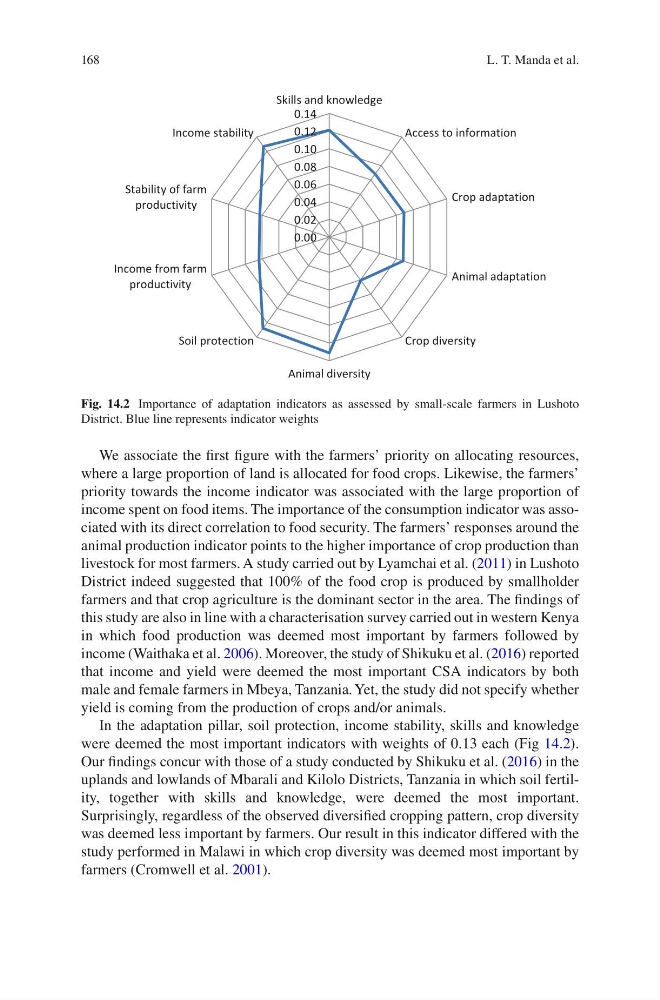
In the adaptation pillar, soil protection, income stability, skills and knowledge
were deemed the most important indicators with weights of 0.13 each (Fig 14.2).
Our findings concur with those of a study conducted by Shikuku et al. (2016) in the
uplands and lowlands of Mbarali and Kilolo Districts, Tanzania in which soil fertility, together with skills and knowledge, were deemed the most important.
Surprisingly, regardless of the observed diversified cropping pattern, crop diversity
was deemed less important by farmers. Our result in this indicator differed with the
study performed in Malawi in which crop diversity was deemed most important by
farmers (Cromwell et al. 2001).
0.00
0.02
0.04
0.06
0.08
0.10
0.12
0.14
Skills and knowledge
Access to information
Crop adaptation
Animal adaptation
Crop diversity
Animal diversity
Soil protection
Income from farm
productivity
Stability of farm
productivity
Income stability
Fig. 14.2 Importance of adaptation indicators as assessed by small-scale farmers in Lushoto
District. Blue line represents indicator weights
L. T. Manda et al.
We associate the first figure with the farmers’ priority on allocating resources,
where a large proportion of land is allocated for food crops. Likewise, the farmers’
priority towards the income indicator was associated with the large proportion of
income spent on food items. The importance of the consumption indicator was associated with its direct correlation to food security. The farmers’ responses around the
animal production indicator points to the higher importance of crop production than
livestock for most farmers. A study carried out by Lyamchai et al. (2011) in Lushoto
District indeed suggested that 100% of the food crop is produced by smallholder
farmers and that crop agriculture is the dominant sector in the area. The findings of
this study are also in line with a characterisation survey carried out in western Kenya
in which food production was deemed most important by farmers followed by
income (Waithaka et al. 2006). Moreover, the study of Shikuku et al. (2016) reported
that income and yield were deemed the most important CSA indicators by both
male and female farmers in Mbeya, Tanzania. Yet, the study did not specify whether
yield is coming from the production of crops and/or animals.
In the adaptation pillar, soil protection, income stability, skills and knowledge
were deemed the most important indicators with weights of 0.13 each (Fig 14.2).
Our findings concur with those of a study conducted by Shikuku et al. (2016) in the
uplands and lowlands of Mbarali and Kilolo Districts, Tanzania in which soil fertility, together with skills and knowledge, were deemed the most important.
Surprisingly, regardless of the observed diversified cropping pattern, crop diversity
was deemed less important by farmers. Our result in this indicator differed with the
study performed in Malawi in which crop diversity was deemed most important by
farmers (Cromwell et al. 2001).
0.00
0.02
0.04
0.06
0.08
0.10
0.12
0.14
Skills and knowledge
Access to information
Crop adaptation
Animal adaptation
Crop diversity
Animal diversity
Soil protection
Income from farm
productivity
Stability of farm
productivity
Income stability
Fig. 14.2 Importance of adaptation indicators as assessed by small-scale farmers in Lushoto
District. Blue line represents indicator weights
L. T. Manda et al.