

105
them, and the seed potato unit at the National Potato Program has adopted the technology into their seed production system. The body that regulates seed certification
has also endorsed apical cuttings and is integrating the technology into seed potato
certification protocol.
Progressive farmers and ISM hosted two trials to assess the productivity of apical
cuttings over two seasons. This was the first time after one on-station trial to assess
productivity, and while the results from the first season were highly variable, they
mostly achieved the expected multiplication rate of eight tubers/cutting (data not
presented).
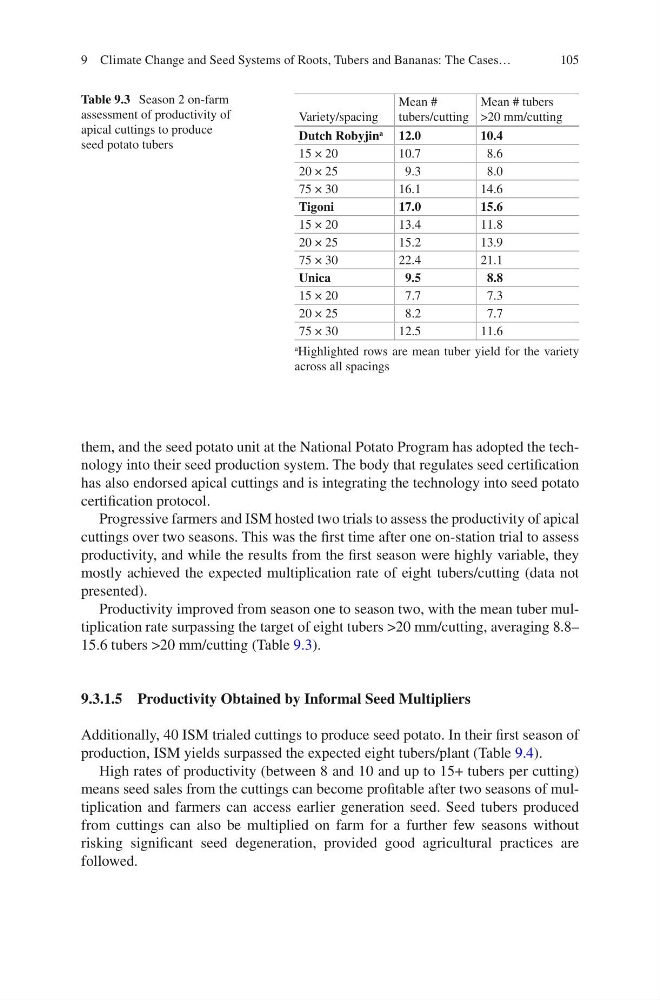
Productivity improved from season one to season two, with the mean tuber multiplication rate surpassing the target of eight tubers >20 mm/cutting, averaging 8.8–
15.6 tubers >20 mm/cutting (Table 9.3).
9.3.1.5 Productivity Obtained by Informal Seed Multipliers
Additionally, 40 ISM trialed cuttings to produce seed potato. In their first season of
production, ISM yields surpassed the expected eight tubers/plant (Table 9.4).
High rates of productivity (between 8 and 10 and up to 15+ tubers per cutting)
means seed sales from the cuttings can become profitable after two seasons of multiplication and farmers can access earlier generation seed. Seed tubers produced
from cuttings can also be multiplied on farm for a further few seasons without
risking significant seed degeneration, provided good agricultural practices are
followed.
Table 9.3 Season 2 on-farm
assessment of productivity of
apical cuttings to produce
seed potato tubers
Variety/spacing
Mean #
tubers/cutting
Mean # tubers
>20 mm/cutting
Dutch Robyjin
a
12.0
10.4
15 × 20
10.7
8.6
20 × 25
9.3
8.0
75 × 30
16.1
14.6
Tigoni
17.0
15.6
15 × 20
13.4
11.8
20 × 25
15.2
13.9
75 × 30
22.4
21.1
Unica
9.5
8.8
15 × 20
7.7
7.3
20 × 25
8.2
7.7
75 × 30
12.5
11.6
a
Highlighted rows are mean tuber yield for the variety
across all spacings
9 Climate Change and Seed Systems of Roots, Tubers and Bananas: The Cases…
them, and the seed potato unit at the National Potato Program has adopted the technology into their seed production system. The body that regulates seed certification
has also endorsed apical cuttings and is integrating the technology into seed potato
certification protocol.
Progressive farmers and ISM hosted two trials to assess the productivity of apical
cuttings over two seasons. This was the first time after one on-station trial to assess
productivity, and while the results from the first season were highly variable, they
mostly achieved the expected multiplication rate of eight tubers/cutting (data not
presented).
Productivity improved from season one to season two, with the mean tuber multiplication rate surpassing the target of eight tubers >20 mm/cutting, averaging 8.8–
15.6 tubers >20 mm/cutting (Table 9.3).
9.3.1.5 Productivity Obtained by Informal Seed Multipliers
Additionally, 40 ISM trialed cuttings to produce seed potato. In their first season of
production, ISM yields surpassed the expected eight tubers/plant (Table 9.4).
High rates of productivity (between 8 and 10 and up to 15+ tubers per cutting)
means seed sales from the cuttings can become profitable after two seasons of multiplication and farmers can access earlier generation seed. Seed tubers produced
from cuttings can also be multiplied on farm for a further few seasons without
risking significant seed degeneration, provided good agricultural practices are
followed.
Table 9.3 Season 2 on-farm
assessment of productivity of
apical cuttings to produce
seed potato tubers
Variety/spacing
Mean #
tubers/cutting
Mean # tubers
>20 mm/cutting
Dutch Robyjin
a
12.0
10.4
15 × 20
10.7
8.6
20 × 25
9.3
8.0
75 × 30
16.1
14.6
Tigoni
17.0
15.6
15 × 20
13.4
11.8
20 × 25
15.2
13.9
75 × 30
22.4
21.1
Unica
9.5
8.8
15 × 20
7.7
7.3
20 × 25
8.2
7.7
75 × 30
12.5
11.6
a
Highlighted rows are mean tuber yield for the variety
across all spacings
9 Climate Change and Seed Systems of Roots, Tubers and Bananas: The Cases…