

106
9.3.2 Adapting Sweetpotato Varieties and Seed Systems
Combatting Drought and Food Insecurity
in Mozambique
Mozambique has experienced 13 significant drought years between 1979 and 2016
1
and represents the challenge across much of SSA, where an estimated 2.3 million
people needed humanitarian assistance between January and March 2017 (FSIN
2017). Levels of chronic undernutrition are high among children under five in the
region, with 71.2% estimated to be vitamin A deficient (VAD) (Aguayo et al. 2005).
High levels of VAD in young children prompted researchers to introduce betacarotene rich sweetpotato into Mozambique in the late 1990s, because one root
(125 g) of an OFSP variety can meet a young child’s daily vitamin A needs (Low
et al. 2017). Sweetpotato (Ipomoea batatas L.) has long been a staple in Mozambique,
but the dominant varieties are white-fleshed with no beta-carotene, which the body
converts into vitamin A. Initial efforts focused on testing contending varieties from
around the world, resulting in the release of nine OFSP varieties in 2000. In 2002
these varieties were widely distributed in southern Mozambique as a post-flood
disaster recovery initiative. They performed well in southern and central Mozambique
until three seasons of consecutive drought hit in 2005.
Among the most popular of these first-generation varieties was the Americanbred Resisto, which outyielded local varieties, matured earlier (at 4 months), had a
deep orange flesh, moderate dry matter (24%) and the smooth oblong shape favoured
by marketers. In the dry season, when farmers plant a second crop in valley bottoms
with residual moisture. Resisto produced more roots than the dominant, reputedly
drought tolerant local variety Canasumana, but it had no vines left at the time of
harvest. In contrast, Canasumana had abundant foliage left (Low et al. 2001). In
tropical areas, sweetpotato is largely propagated from vine cuttings of the previous
crop, therefore not maintaining sufficient quantities of vigorous vines resulted in a
shortage of Resisto planting material the following season.
1 Significant drought in parts of the country in 1979, 1981, 1987, 1990, 1998, 2001, 2005, 2007,
2008, 2010, 2015, 2016.
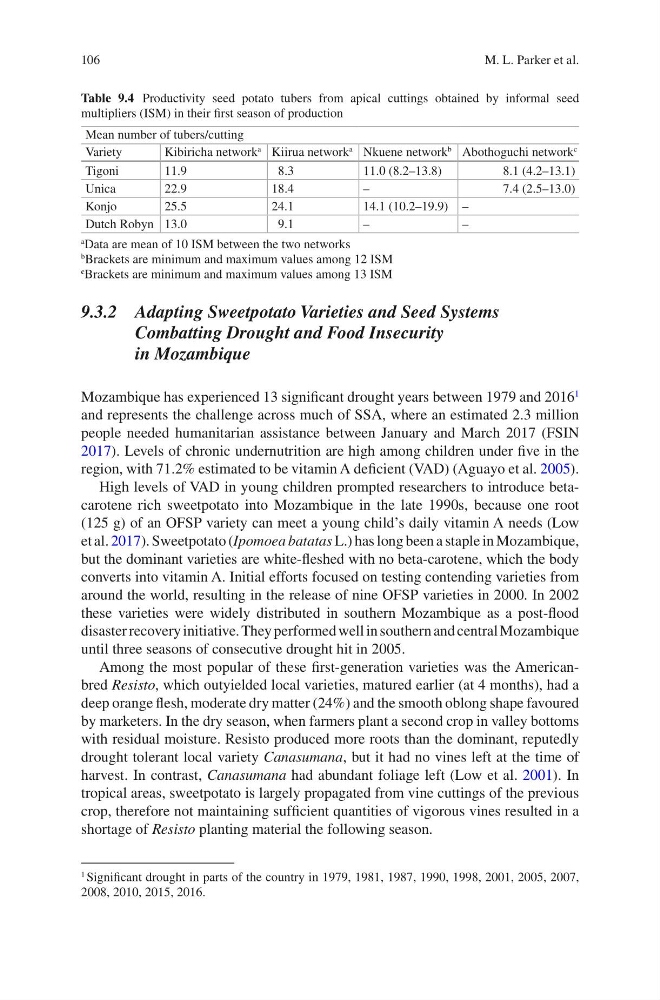
Table 9.4 Productivity seed potato tubers from apical cuttings obtained by informal seed
multipliers (ISM) in their first season of production
Mean number of tubers/cutting
Variety
Kibiricha network
a Kiirua network
a Nkuene network
b Abothoguchi network
c
Tigoni
11.9
8.3
11.0 (8.2–13.8)
8.1 (4.2–13.1)
Unica
22.9
18.4
–
7.4 (2.5–13.0)
Konjo
25.5
24.1
14.1 (10.2–19.9) –
Dutch Robyn 13.0
9.1
–
–
a
Data are mean of 10 ISM between the two networks
b
Brackets are minimum and maximum values among 12 ISM
c
Brackets are minimum and maximum values among 13 ISM
M. L. Parker et al.
9.3.2 Adapting Sweetpotato Varieties and Seed Systems
Combatting Drought and Food Insecurity
in Mozambique
Mozambique has experienced 13 significant drought years between 1979 and 2016
1
and represents the challenge across much of SSA, where an estimated 2.3 million
people needed humanitarian assistance between January and March 2017 (FSIN
2017). Levels of chronic undernutrition are high among children under five in the
region, with 71.2% estimated to be vitamin A deficient (VAD) (Aguayo et al. 2005).
High levels of VAD in young children prompted researchers to introduce betacarotene rich sweetpotato into Mozambique in the late 1990s, because one root
(125 g) of an OFSP variety can meet a young child’s daily vitamin A needs (Low
et al. 2017). Sweetpotato (Ipomoea batatas L.) has long been a staple in Mozambique,
but the dominant varieties are white-fleshed with no beta-carotene, which the body
converts into vitamin A. Initial efforts focused on testing contending varieties from
around the world, resulting in the release of nine OFSP varieties in 2000. In 2002
these varieties were widely distributed in southern Mozambique as a post-flood
disaster recovery initiative. They performed well in southern and central Mozambique
until three seasons of consecutive drought hit in 2005.
Among the most popular of these first-generation varieties was the Americanbred Resisto, which outyielded local varieties, matured earlier (at 4 months), had a
deep orange flesh, moderate dry matter (24%) and the smooth oblong shape favoured
by marketers. In the dry season, when farmers plant a second crop in valley bottoms
with residual moisture. Resisto produced more roots than the dominant, reputedly
drought tolerant local variety Canasumana, but it had no vines left at the time of
harvest. In contrast, Canasumana had abundant foliage left (Low et al. 2001). In
tropical areas, sweetpotato is largely propagated from vine cuttings of the previous
crop, therefore not maintaining sufficient quantities of vigorous vines resulted in a
shortage of Resisto planting material the following season.
1 Significant drought in parts of the country in 1979, 1981, 1987, 1990, 1998, 2001, 2005, 2007,
2008, 2010, 2015, 2016.
Table 9.4 Productivity seed potato tubers from apical cuttings obtained by informal seed
multipliers (ISM) in their first season of production
Mean number of tubers/cutting
Variety
Kibiricha network
a Kiirua network
a Nkuene network
b Abothoguchi network
c
Tigoni
11.9
8.3
11.0 (8.2–13.8)
8.1 (4.2–13.1)
Unica
22.9
18.4
–
7.4 (2.5–13.0)
Konjo
25.5
24.1
14.1 (10.2–19.9) –
Dutch Robyn 13.0
9.1
–
–
a
Data are mean of 10 ISM between the two networks
b
Brackets are minimum and maximum values among 12 ISM
c
Brackets are minimum and maximum values among 13 ISM
M. L. Parker et al.