

Atomic Force Microscopy-Based Force Spectroscopy …
593
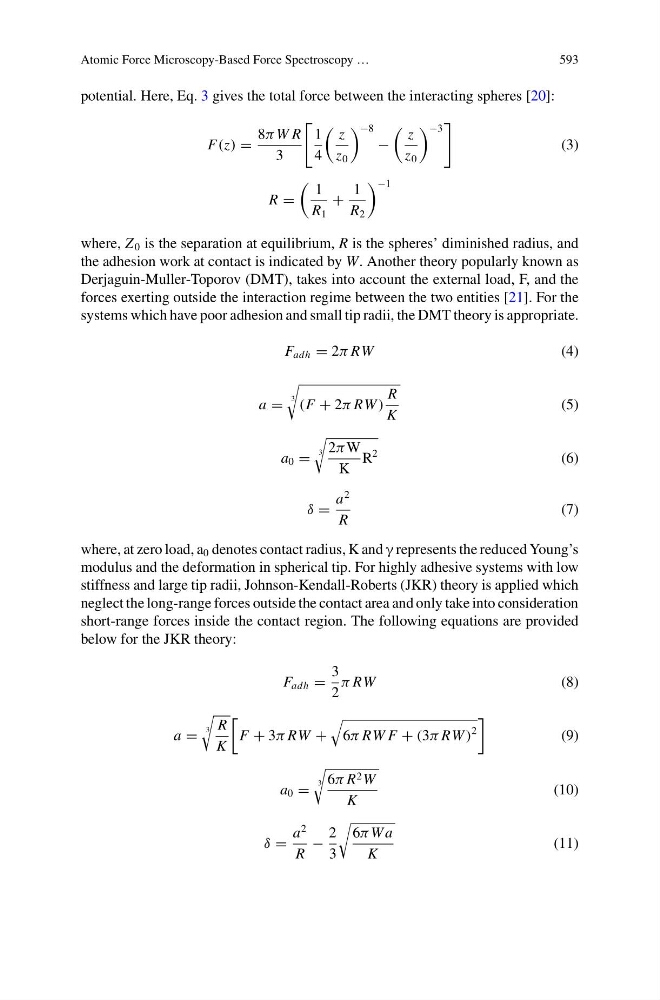
potential. Here, Eq. 3 gives the total force between the interacting spheres [20]:
F(z) =
8π W R
3
1
4
z
z 0
−8
−
z
z 0
−3
(3)
R =
1
R 1
+
1
R 2
−1
where, Z 0 is the separation at equilibrium, R is the spheres’ diminished radius, and
the adhesion work at contact is indicated by W. Another theory popularly known as
Derjaguin-Muller-Toporov (DMT), takes into account the external load, F, and the
forces exerting outside the interaction regime between the two entities [21]. For the
systems which have poor adhesion and small tip radii, the DMT theory is appropriate.
F adh = 2π RW
(4)
a =
3
(F + 2π RW )
R
K
(5)
a 0 =
3
2π W
K
R
2
(6)
δ =
a
2
R
(7)
where, at zero load, a 0 denotes contact radius, K and γ represents the reduced Young’s
modulus and the deformation in spherical tip. For highly adhesive systems with low
stiffness and large tip radii, Johnson-Kendall-Roberts (JKR) theory is applied which
neglect the long-range forces outside the contact area and only take into consideration
short-range forces inside the contact region. The following equations are provided
below for the JKR theory:
F adh =
3
2
π RW
(8)
a =
3
R
K
F + 3π RW +
6π RW F + (3π RW )
2
(9)
a 0 =
3
6π R 2 W
K
(10)
δ =
a
2
R
−
2
3
6π W a
K
(11)
593
potential. Here, Eq. 3 gives the total force between the interacting spheres [20]:
F(z) =
8π W R
3
1
4
z
z 0
−8
−
z
z 0
−3
(3)
R =
1
R 1
+
1
R 2
−1
where, Z 0 is the separation at equilibrium, R is the spheres’ diminished radius, and
the adhesion work at contact is indicated by W. Another theory popularly known as
Derjaguin-Muller-Toporov (DMT), takes into account the external load, F, and the
forces exerting outside the interaction regime between the two entities [21]. For the
systems which have poor adhesion and small tip radii, the DMT theory is appropriate.
F adh = 2π RW
(4)
a =
3
(F + 2π RW )
R
K
(5)
a 0 =
3
2π W
K
R
2
(6)
δ =
a
2
R
(7)
where, at zero load, a 0 denotes contact radius, K and γ represents the reduced Young’s
modulus and the deformation in spherical tip. For highly adhesive systems with low
stiffness and large tip radii, Johnson-Kendall-Roberts (JKR) theory is applied which
neglect the long-range forces outside the contact area and only take into consideration
short-range forces inside the contact region. The following equations are provided
below for the JKR theory:
F adh =
3
2
π RW
(8)
a =
3
R
K
F + 3π RW +
6π RW F + (3π RW )
2
(9)
a 0 =
3
6π R 2 W
K
(10)
δ =
a
2
R
−
2
3
6π W a
K
(11)