

592
J. Jaisawal et al.
4.3 Unfolding and Stretching Measurement
Force spectroscopy exhibits the major application in the stretching of molecules
located between the sample surface and the tip of cantilever. Further, this technique
acquires the considerable interest among biological researchers to understand the
challenging problem of the protein unfolding.
4.4 Force Mapping
These force curves are single point measurements which often requires repeated
readings at multiple places within the sample to obtain true meaningful and accurate data being termed as force mapping or force-volume. Now days, modern AFM
machines are sufficient for mapping of the forces with grid automation, additionally,
utilized to calculate snap in, slops and adhesive forces in automated analysis.
5 Various Theories of Contact Region
Hertz gave the first theory to be applied in the contact region, which is a better model
to evaluate the Young’s modulus of the cells. This model predicts that deformation
occurs only on the sample throughout interaction of the tip and the sample instead
of the tip which is much stiffer than the biological sample. Attributed to the Young’s
modulus of the AFM tips for silicon nitride or silicon which is several orders of
magnitude higher than that for cells.
Apart from this, generalized model was developed, which is extended version of
the Hertz model [17]. This model reveals the significant importance and contribution
of the deformable tip [17]. Assuming the tip shape to be spherical or paraboloid, the
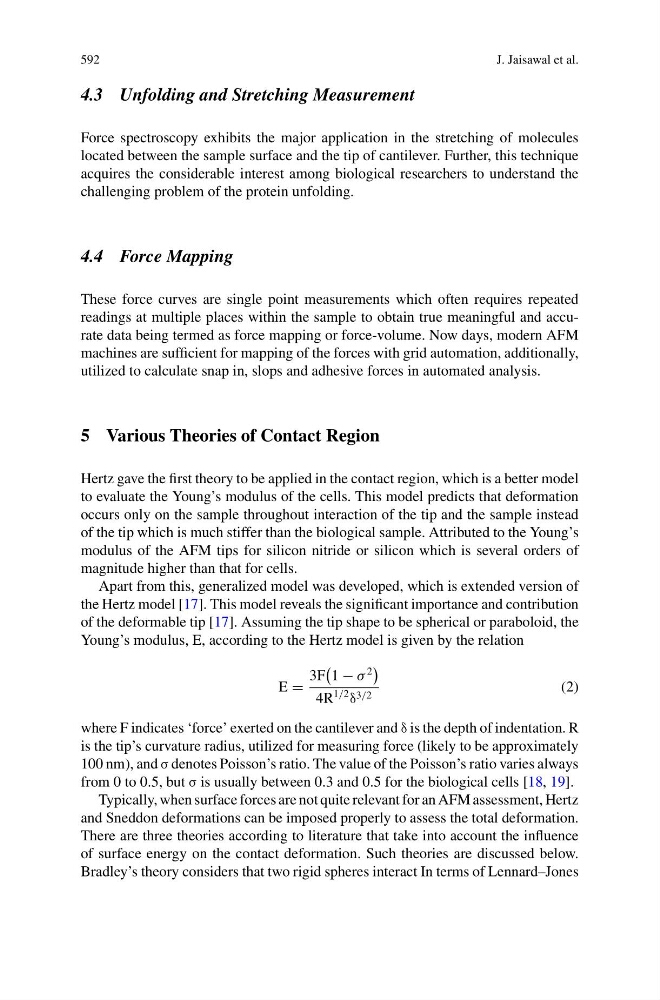
Young’s modulus, E, according to the Hertz model is given by the relation
E =
3F
1 − σ
2
4R
1/2
δ 3/2
(2)
where F indicates ‘force’ exerted on the cantilever and δ is the depth of indentation. R
is the tip’s curvature radius, utilized for measuring force (likely to be approximately
100 nm), and σ denotes Poisson’s ratio. The value of the Poisson’s ratio varies always
from 0 to 0.5, but σ is usually between 0.3 and 0.5 for the biological cells [18, 19].
Typically, when surface forces are not quite relevant for an AFM assessment, Hertz
and Sneddon deformations can be imposed properly to assess the total deformation.
There are three theories according to literature that take into account the influence
of surface energy on the contact deformation. Such theories are discussed below.
Bradley’s theory considers that two rigid spheres interact In terms of Lennard–Jones
J. Jaisawal et al.
4.3 Unfolding and Stretching Measurement
Force spectroscopy exhibits the major application in the stretching of molecules
located between the sample surface and the tip of cantilever. Further, this technique
acquires the considerable interest among biological researchers to understand the
challenging problem of the protein unfolding.
4.4 Force Mapping
These force curves are single point measurements which often requires repeated
readings at multiple places within the sample to obtain true meaningful and accurate data being termed as force mapping or force-volume. Now days, modern AFM
machines are sufficient for mapping of the forces with grid automation, additionally,
utilized to calculate snap in, slops and adhesive forces in automated analysis.
5 Various Theories of Contact Region
Hertz gave the first theory to be applied in the contact region, which is a better model
to evaluate the Young’s modulus of the cells. This model predicts that deformation
occurs only on the sample throughout interaction of the tip and the sample instead
of the tip which is much stiffer than the biological sample. Attributed to the Young’s
modulus of the AFM tips for silicon nitride or silicon which is several orders of
magnitude higher than that for cells.
Apart from this, generalized model was developed, which is extended version of
the Hertz model [17]. This model reveals the significant importance and contribution
of the deformable tip [17]. Assuming the tip shape to be spherical or paraboloid, the
Young’s modulus, E, according to the Hertz model is given by the relation
E =
3F
1 − σ
2
4R
1/2
δ 3/2
(2)
where F indicates ‘force’ exerted on the cantilever and δ is the depth of indentation. R
is the tip’s curvature radius, utilized for measuring force (likely to be approximately
100 nm), and σ denotes Poisson’s ratio. The value of the Poisson’s ratio varies always
from 0 to 0.5, but σ is usually between 0.3 and 0.5 for the biological cells [18, 19].
Typically, when surface forces are not quite relevant for an AFM assessment, Hertz
and Sneddon deformations can be imposed properly to assess the total deformation.
There are three theories according to literature that take into account the influence
of surface energy on the contact deformation. Such theories are discussed below.
Bradley’s theory considers that two rigid spheres interact In terms of Lennard–Jones