

594
J. Jaisawal et al.
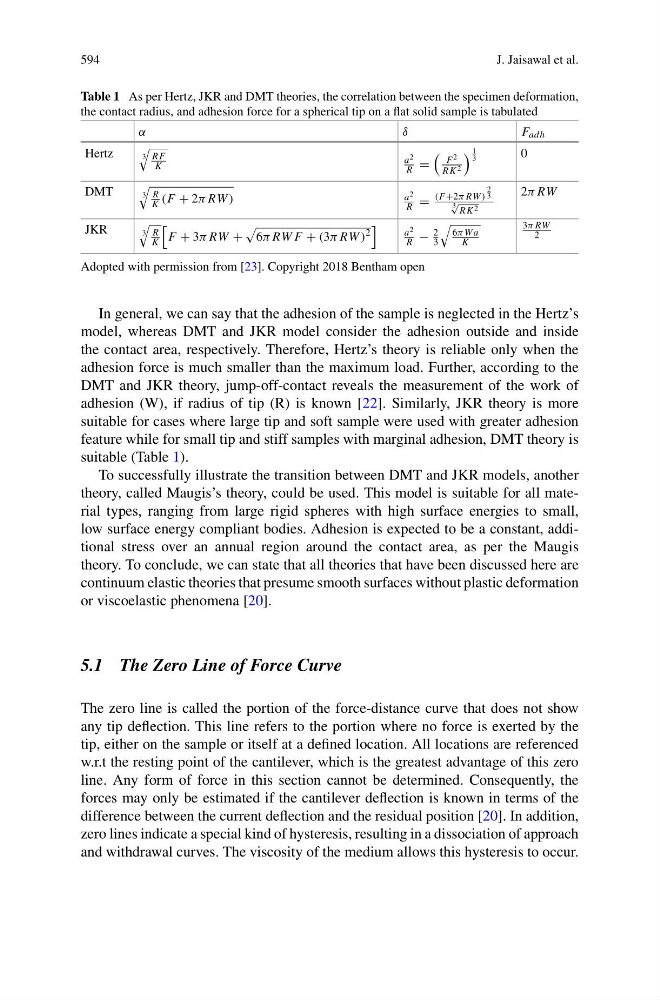
Table 1 As per Hertz, JKR and DMT theories, the correlation between the specimen deformation,
the contact radius, and adhesion force for a spherical tip on a flat solid sample is tabulated
α
δ
F adh
Hertz
3
R F
K
a 2
R =
F 2
RK 2
1
3
0
DMT
3
R
K (F + 2π RW )
a 2
R =
(F+2π RW )
2
3
3
√
RK 2
2π RW
JKR
3
R
K
F + 3π RW +
6π RW F + (3π RW )
2
a 2
R −
2
3
6π W a
K
3π RW
2
Adopted with permission from [23]. Copyright 2018 Bentham open
In general, we can say that the adhesion of the sample is neglected in the Hertz’s
model, whereas DMT and JKR model consider the adhesion outside and inside
the contact area, respectively. Therefore, Hertz’s theory is reliable only when the
adhesion force is much smaller than the maximum load. Further, according to the
DMT and JKR theory, jump-off-contact reveals the measurement of the work of
adhesion (W), if radius of tip (R) is known [22]. Similarly, JKR theory is more
suitable for cases where large tip and soft sample were used with greater adhesion
feature while for small tip and stiff samples with marginal adhesion, DMT theory is
suitable (Table 1).
To successfully illustrate the transition between DMT and JKR models, another
theory, called Maugis’s theory, could be used. This model is suitable for all material types, ranging from large rigid spheres with high surface energies to small,
low surface energy compliant bodies. Adhesion is expected to be a constant, additional stress over an annual region around the contact area, as per the Maugis
theory. To conclude, we can state that all theories that have been discussed here are
continuum elastic theories that presume smooth surfaces without plastic deformation
or viscoelastic phenomena [20].
5.1 The Zero Line of Force Curve
The zero line is called the portion of the force-distance curve that does not show
any tip deflection. This line refers to the portion where no force is exerted by the
tip, either on the sample or itself at a defined location. All locations are referenced
w.r.t the resting point of the cantilever, which is the greatest advantage of this zero
line. Any form of force in this section cannot be determined. Consequently, the
forces may only be estimated if the cantilever deflection is known in terms of the
difference between the current deflection and the residual position [20]. In addition,
zero lines indicate a special kind of hysteresis, resulting in a dissociation of approach
and withdrawal curves. The viscosity of the medium allows this hysteresis to occur.
J. Jaisawal et al.
Table 1 As per Hertz, JKR and DMT theories, the correlation between the specimen deformation,
the contact radius, and adhesion force for a spherical tip on a flat solid sample is tabulated
α
δ
F adh
Hertz
3
R F
K
a 2
R =
F 2
RK 2
1
3
0
DMT
3
R
K (F + 2π RW )
a 2
R =
(F+2π RW )
2
3
3
√
RK 2
2π RW
JKR
3
R
K
F + 3π RW +
6π RW F + (3π RW )
2
a 2
R −
2
3
6π W a
K
3π RW
2
Adopted with permission from [23]. Copyright 2018 Bentham open
In general, we can say that the adhesion of the sample is neglected in the Hertz’s
model, whereas DMT and JKR model consider the adhesion outside and inside
the contact area, respectively. Therefore, Hertz’s theory is reliable only when the
adhesion force is much smaller than the maximum load. Further, according to the
DMT and JKR theory, jump-off-contact reveals the measurement of the work of
adhesion (W), if radius of tip (R) is known [22]. Similarly, JKR theory is more
suitable for cases where large tip and soft sample were used with greater adhesion
feature while for small tip and stiff samples with marginal adhesion, DMT theory is
suitable (Table 1).
To successfully illustrate the transition between DMT and JKR models, another
theory, called Maugis’s theory, could be used. This model is suitable for all material types, ranging from large rigid spheres with high surface energies to small,
low surface energy compliant bodies. Adhesion is expected to be a constant, additional stress over an annual region around the contact area, as per the Maugis
theory. To conclude, we can state that all theories that have been discussed here are
continuum elastic theories that presume smooth surfaces without plastic deformation
or viscoelastic phenomena [20].
5.1 The Zero Line of Force Curve
The zero line is called the portion of the force-distance curve that does not show
any tip deflection. This line refers to the portion where no force is exerted by the
tip, either on the sample or itself at a defined location. All locations are referenced
w.r.t the resting point of the cantilever, which is the greatest advantage of this zero
line. Any form of force in this section cannot be determined. Consequently, the
forces may only be estimated if the cantilever deflection is known in terms of the
difference between the current deflection and the residual position [20]. In addition,
zero lines indicate a special kind of hysteresis, resulting in a dissociation of approach
and withdrawal curves. The viscosity of the medium allows this hysteresis to occur.