

Ellipsometry Techniques and Its Advanced Applications …
579
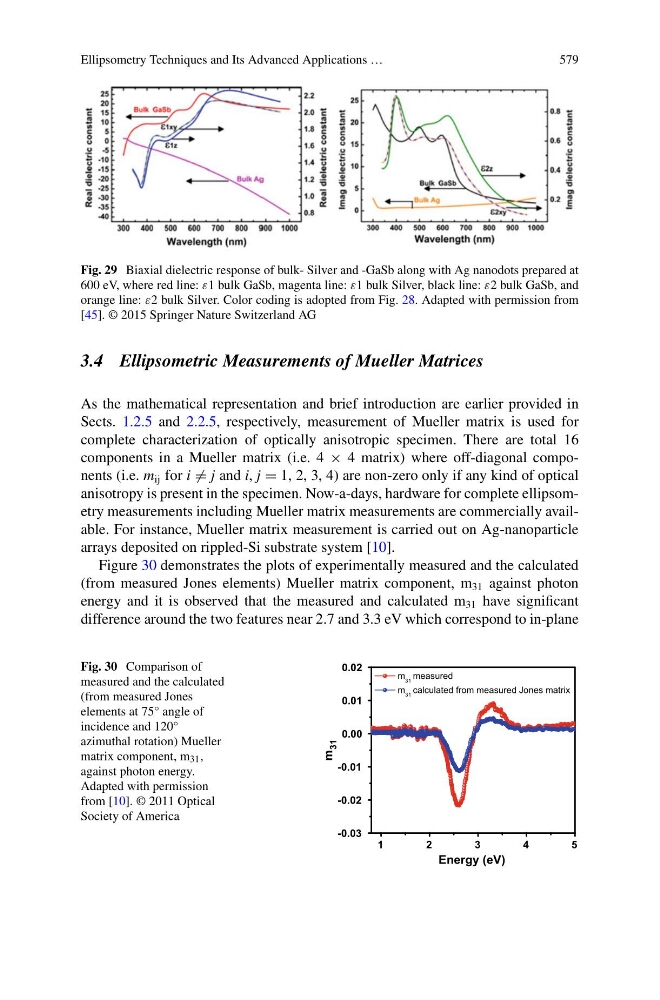
Fig. 29 Biaxial dielectric response of bulk- Silver and -GaSb along with Ag nanodots prepared at
600 eV, where red line: ε1 bulk GaSb, magenta line: ε1 bulk Silver, black line: ε2 bulk GaSb, and
orange line: ε2 bulk Silver. Color coding is adopted from Fig. 28. Adapted with permission from
[45]. © 2015 Springer Nature Switzerland AG
3.4 Ellipsometric Measurements of Mueller Matrices
As the mathematical representation and brief introduction are earlier provided in
Sects. 1.2.5 and 2.2.5, respectively, measurement of Mueller matrix is used for
complete characterization of optically anisotropic specimen. There are total 16
components in a Mueller matrix (i.e. 4 × 4 matrix) where off-diagonal components (i.e. m ij for i = j and i, j = 1, 2, 3, 4) are non-zero only if any kind of optical
anisotropy is present in the specimen. Now-a-days, hardware for complete ellipsometry measurements including Mueller matrix measurements are commercially available. For instance, Mueller matrix measurement is carried out on Ag-nanoparticle
arrays deposited on rippled-Si substrate system [10].
Figure 30 demonstrates the plots of experimentally measured and the calculated
(from measured Jones elements) Mueller matrix component, m 31 against photon
energy and it is observed that the measured and calculated m 31 have significant
difference around the two features near 2.7 and 3.3 eV which correspond to in-plane
Fig. 30 Comparison of
measured and the calculated
(from measured Jones
elements at 75° angle of
incidence and 120°
azimuthal rotation) Mueller
matrix component, m 31 ,
against photon energy.
Adapted with permission
from [10]. © 2011 Optical
Society of America
1
2
3
4
5
-0.03
-0.02
-0.01
0.00
0.01
0.02
m
31
Energy (eV)
m 31 measured
m 31 calculated from measured Jones matrix
579
Fig. 29 Biaxial dielectric response of bulk- Silver and -GaSb along with Ag nanodots prepared at
600 eV, where red line: ε1 bulk GaSb, magenta line: ε1 bulk Silver, black line: ε2 bulk GaSb, and
orange line: ε2 bulk Silver. Color coding is adopted from Fig. 28. Adapted with permission from
[45]. © 2015 Springer Nature Switzerland AG
3.4 Ellipsometric Measurements of Mueller Matrices
As the mathematical representation and brief introduction are earlier provided in
Sects. 1.2.5 and 2.2.5, respectively, measurement of Mueller matrix is used for
complete characterization of optically anisotropic specimen. There are total 16
components in a Mueller matrix (i.e. 4 × 4 matrix) where off-diagonal components (i.e. m ij for i = j and i, j = 1, 2, 3, 4) are non-zero only if any kind of optical
anisotropy is present in the specimen. Now-a-days, hardware for complete ellipsometry measurements including Mueller matrix measurements are commercially available. For instance, Mueller matrix measurement is carried out on Ag-nanoparticle
arrays deposited on rippled-Si substrate system [10].
Figure 30 demonstrates the plots of experimentally measured and the calculated
(from measured Jones elements) Mueller matrix component, m 31 against photon
energy and it is observed that the measured and calculated m 31 have significant
difference around the two features near 2.7 and 3.3 eV which correspond to in-plane
Fig. 30 Comparison of
measured and the calculated
(from measured Jones
elements at 75° angle of
incidence and 120°
azimuthal rotation) Mueller
matrix component, m 31 ,
against photon energy.
Adapted with permission
from [10]. © 2011 Optical
Society of America
1
2
3
4
5
-0.03
-0.02
-0.01
0.00
0.01
0.02
m
31
Energy (eV)
m 31 measured
m 31 calculated from measured Jones matrix