

580
M. Saini et al.
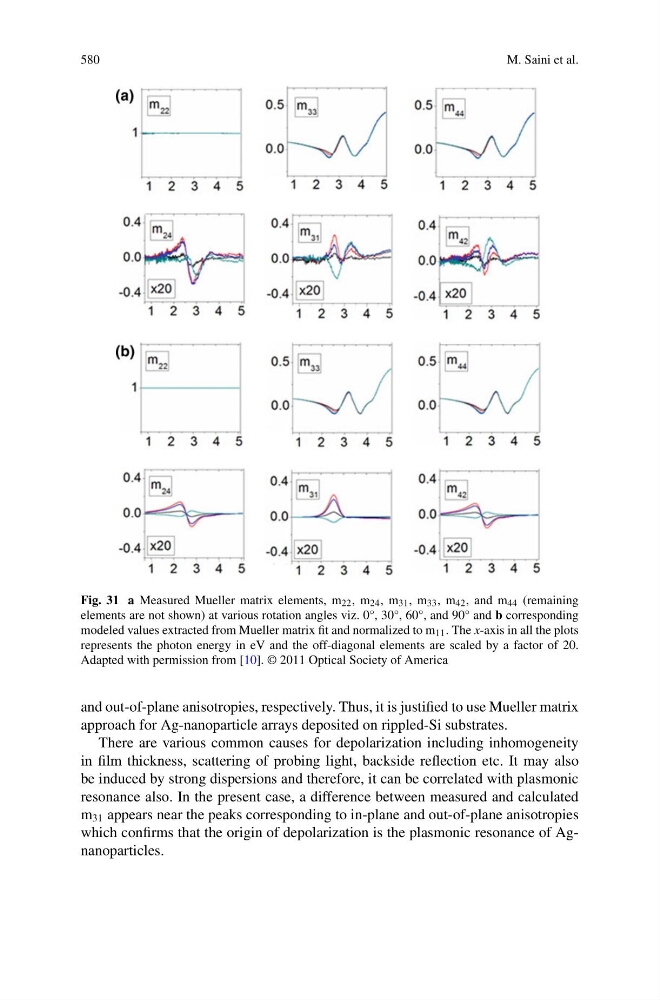
Fig. 31 a Measured Mueller matrix elements, m 22 , m 24 , m 31 , m 33 , m 42 , and m 44 (remaining
elements are not shown) at various rotation angles viz. 0°, 30°, 60°, and 90° and b corresponding
modeled values extracted from Mueller matrix fit and normalized to m 11 . The x-axis in all the plots
represents the photon energy in eV and the off-diagonal elements are scaled by a factor of 20.
Adapted with permission from [10]. © 2011 Optical Society of America
and out-of-plane anisotropies, respectively. Thus, it is justified to use Mueller matrix
approach for Ag-nanoparticle arrays deposited on rippled-Si substrates.
There are various common causes for depolarization including inhomogeneity
in film thickness, scattering of probing light, backside reflection etc. It may also
be induced by strong dispersions and therefore, it can be correlated with plasmonic
resonance also. In the present case, a difference between measured and calculated
m 31 appears near the peaks corresponding to in-plane and out-of-plane anisotropies
which confirms that the origin of depolarization is the plasmonic resonance of Agnanoparticles.
M. Saini et al.
Fig. 31 a Measured Mueller matrix elements, m 22 , m 24 , m 31 , m 33 , m 42 , and m 44 (remaining
elements are not shown) at various rotation angles viz. 0°, 30°, 60°, and 90° and b corresponding
modeled values extracted from Mueller matrix fit and normalized to m 11 . The x-axis in all the plots
represents the photon energy in eV and the off-diagonal elements are scaled by a factor of 20.
Adapted with permission from [10]. © 2011 Optical Society of America
and out-of-plane anisotropies, respectively. Thus, it is justified to use Mueller matrix
approach for Ag-nanoparticle arrays deposited on rippled-Si substrates.
There are various common causes for depolarization including inhomogeneity
in film thickness, scattering of probing light, backside reflection etc. It may also
be induced by strong dispersions and therefore, it can be correlated with plasmonic
resonance also. In the present case, a difference between measured and calculated
m 31 appears near the peaks corresponding to in-plane and out-of-plane anisotropies
which confirms that the origin of depolarization is the plasmonic resonance of Agnanoparticles.