

Ellipsometry Techniques and Its Advanced Applications …
573
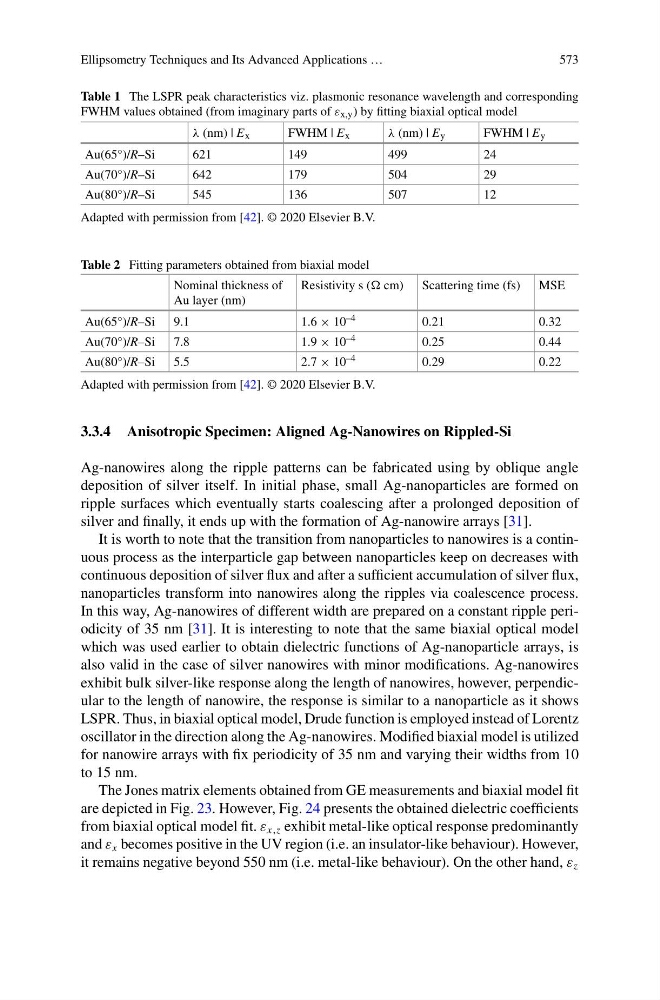
Table 1 The LSPR peak characteristics viz. plasmonic resonance wavelength and corresponding
FWHM values obtained (from imaginary parts of ε x,y ) by fitting biaxial optical model
λ (nm) | E x
FWHM | E x
λ (nm) | E y
FWHM | E y
Au(65°)/R–Si
621
149
499
24
Au(70°)/R–Si
642
179
504
29
Au(80°)/R–Si
545
136
507
12
Adapted with permission from [42]. © 2020 Elsevier B.V.
Table 2 Fitting parameters obtained from biaxial model
Nominal thickness of
Au layer (nm)
Resistivity s ( cm) Scattering time (fs) MSE
Au(65°)/R–Si 9.1
1.6 × 10 –4
0.21
0.32
Au(70°)/R–Si 7.8
1.9 × 10 –4
0.25
0.44
Au(80°)/R–Si 5.5
2.7 × 10 –4
0.29
0.22
Adapted with permission from [42]. © 2020 Elsevier B.V.
3.3.4 Anisotropic Specimen: Aligned Ag-Nanowires on Rippled-Si
Ag-nanowires along the ripple patterns can be fabricated using by oblique angle
deposition of silver itself. In initial phase, small Ag-nanoparticles are formed on
ripple surfaces which eventually starts coalescing after a prolonged deposition of
silver and finally, it ends up with the formation of Ag-nanowire arrays [31].
It is worth to note that the transition from nanoparticles to nanowires is a continuous process as the interparticle gap between nanoparticles keep on decreases with
continuous deposition of silver flux and after a sufficient accumulation of silver flux,
nanoparticles transform into nanowires along the ripples via coalescence process.
In this way, Ag-nanowires of different width are prepared on a constant ripple periodicity of 35 nm [31]. It is interesting to note that the same biaxial optical model
which was used earlier to obtain dielectric functions of Ag-nanoparticle arrays, is
also valid in the case of silver nanowires with minor modifications. Ag-nanowires
exhibit bulk silver-like response along the length of nanowires, however, perpendicular to the length of nanowire, the response is similar to a nanoparticle as it shows
LSPR. Thus, in biaxial optical model, Drude function is employed instead of Lorentz
oscillator in the direction along the Ag-nanowires. Modified biaxial model is utilized
for nanowire arrays with fix periodicity of 35 nm and varying their widths from 10
to 15 nm.
The Jones matrix elements obtained from GE measurements and biaxial model fit
are depicted in Fig. 23. However, Fig. 24 presents the obtained dielectric coefficients
from biaxial optical model fit. ε x ,z exhibit metal-like optical response predominantly
and ε x becomes positive in the UV region (i.e. an insulator-like behaviour). However,
it remains negative beyond 550 nm (i.e. metal-like behaviour). On the other hand, ε z
573
Table 1 The LSPR peak characteristics viz. plasmonic resonance wavelength and corresponding
FWHM values obtained (from imaginary parts of ε x,y ) by fitting biaxial optical model
λ (nm) | E x
FWHM | E x
λ (nm) | E y
FWHM | E y
Au(65°)/R–Si
621
149
499
24
Au(70°)/R–Si
642
179
504
29
Au(80°)/R–Si
545
136
507
12
Adapted with permission from [42]. © 2020 Elsevier B.V.
Table 2 Fitting parameters obtained from biaxial model
Nominal thickness of
Au layer (nm)
Resistivity s ( cm) Scattering time (fs) MSE
Au(65°)/R–Si 9.1
1.6 × 10 –4
0.21
0.32
Au(70°)/R–Si 7.8
1.9 × 10 –4
0.25
0.44
Au(80°)/R–Si 5.5
2.7 × 10 –4
0.29
0.22
Adapted with permission from [42]. © 2020 Elsevier B.V.
3.3.4 Anisotropic Specimen: Aligned Ag-Nanowires on Rippled-Si
Ag-nanowires along the ripple patterns can be fabricated using by oblique angle
deposition of silver itself. In initial phase, small Ag-nanoparticles are formed on
ripple surfaces which eventually starts coalescing after a prolonged deposition of
silver and finally, it ends up with the formation of Ag-nanowire arrays [31].
It is worth to note that the transition from nanoparticles to nanowires is a continuous process as the interparticle gap between nanoparticles keep on decreases with
continuous deposition of silver flux and after a sufficient accumulation of silver flux,
nanoparticles transform into nanowires along the ripples via coalescence process.
In this way, Ag-nanowires of different width are prepared on a constant ripple periodicity of 35 nm [31]. It is interesting to note that the same biaxial optical model
which was used earlier to obtain dielectric functions of Ag-nanoparticle arrays, is
also valid in the case of silver nanowires with minor modifications. Ag-nanowires
exhibit bulk silver-like response along the length of nanowires, however, perpendicular to the length of nanowire, the response is similar to a nanoparticle as it shows
LSPR. Thus, in biaxial optical model, Drude function is employed instead of Lorentz
oscillator in the direction along the Ag-nanowires. Modified biaxial model is utilized
for nanowire arrays with fix periodicity of 35 nm and varying their widths from 10
to 15 nm.
The Jones matrix elements obtained from GE measurements and biaxial model fit
are depicted in Fig. 23. However, Fig. 24 presents the obtained dielectric coefficients
from biaxial optical model fit. ε x ,z exhibit metal-like optical response predominantly
and ε x becomes positive in the UV region (i.e. an insulator-like behaviour). However,
it remains negative beyond 550 nm (i.e. metal-like behaviour). On the other hand, ε z