

Ellipsometry Techniques and Its Advanced Applications …
571
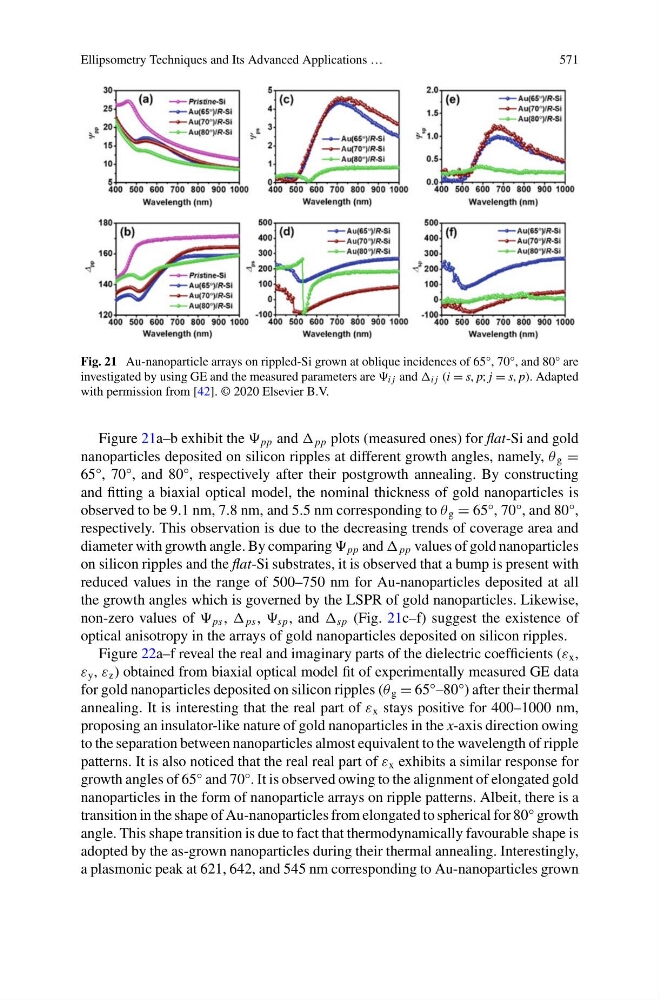
Fig. 21 Au-nanoparticle arrays on rippled-Si grown at oblique incidences of 65°, 70°, and 80° are
investigated by using GE and the measured parameters are i j and i j (i = s, p; j = s, p). Adapted
with permission from [42]. © 2020 Elsevier B.V.
Figure 21a–b exhibit the pp and pp plots (measured ones) for flat-Si and gold
nanoparticles deposited on silicon ripples at different growth angles, namely, θ g =
65°, 70°, and 80°, respectively after their postgrowth annealing. By constructing
and fitting a biaxial optical model, the nominal thickness of gold nanoparticles is
observed to be 9.1 nm, 7.8 nm, and 5.5 nm corresponding to θ g = 65°, 70°, and 80°,
respectively. This observation is due to the decreasing trends of coverage area and
diameter with growth angle. By comparing pp and pp values of gold nanoparticles
on silicon ripples and the flat-Si substrates, it is observed that a bump is present with
reduced values in the range of 500–750 nm for Au-nanoparticles deposited at all
the growth angles which is governed by the LSPR of gold nanoparticles. Likewise,
non-zero values of ps , ps , sp , and sp (Fig. 21c–f) suggest the existence of
optical anisotropy in the arrays of gold nanoparticles deposited on silicon ripples.
Figure 22a–f reveal the real and imaginary parts of the dielectric coefficients (ε x ,
ε y , ε z ) obtained from biaxial optical model fit of experimentally measured GE data
for gold nanoparticles deposited on silicon ripples (θ g = 65°–80°) after their thermal
annealing. It is interesting that the real part of ε x stays positive for 400–1000 nm,
proposing an insulator-like nature of gold nanoparticles in the x-axis direction owing
to the separation between nanoparticles almost equivalent to the wavelength of ripple
patterns. It is also noticed that the real real part of ε x exhibits a similar response for
growth angles of 65° and 70°. It is observed owing to the alignment of elongated gold
nanoparticles in the form of nanoparticle arrays on ripple patterns. Albeit, there is a
transition in the shape of Au-nanoparticles from elongated to spherical for 80° growth
angle. This shape transition is due to fact that thermodynamically favourable shape is
adopted by the as-grown nanoparticles during their thermal annealing. Interestingly,
a plasmonic peak at 621, 642, and 545 nm corresponding to Au-nanoparticles grown
571
Fig. 21 Au-nanoparticle arrays on rippled-Si grown at oblique incidences of 65°, 70°, and 80° are
investigated by using GE and the measured parameters are i j and i j (i = s, p; j = s, p). Adapted
with permission from [42]. © 2020 Elsevier B.V.
Figure 21a–b exhibit the pp and pp plots (measured ones) for flat-Si and gold
nanoparticles deposited on silicon ripples at different growth angles, namely, θ g =
65°, 70°, and 80°, respectively after their postgrowth annealing. By constructing
and fitting a biaxial optical model, the nominal thickness of gold nanoparticles is
observed to be 9.1 nm, 7.8 nm, and 5.5 nm corresponding to θ g = 65°, 70°, and 80°,
respectively. This observation is due to the decreasing trends of coverage area and
diameter with growth angle. By comparing pp and pp values of gold nanoparticles
on silicon ripples and the flat-Si substrates, it is observed that a bump is present with
reduced values in the range of 500–750 nm for Au-nanoparticles deposited at all
the growth angles which is governed by the LSPR of gold nanoparticles. Likewise,
non-zero values of ps , ps , sp , and sp (Fig. 21c–f) suggest the existence of
optical anisotropy in the arrays of gold nanoparticles deposited on silicon ripples.
Figure 22a–f reveal the real and imaginary parts of the dielectric coefficients (ε x ,
ε y , ε z ) obtained from biaxial optical model fit of experimentally measured GE data
for gold nanoparticles deposited on silicon ripples (θ g = 65°–80°) after their thermal
annealing. It is interesting that the real part of ε x stays positive for 400–1000 nm,
proposing an insulator-like nature of gold nanoparticles in the x-axis direction owing
to the separation between nanoparticles almost equivalent to the wavelength of ripple
patterns. It is also noticed that the real real part of ε x exhibits a similar response for
growth angles of 65° and 70°. It is observed owing to the alignment of elongated gold
nanoparticles in the form of nanoparticle arrays on ripple patterns. Albeit, there is a
transition in the shape of Au-nanoparticles from elongated to spherical for 80° growth
angle. This shape transition is due to fact that thermodynamically favourable shape is
adopted by the as-grown nanoparticles during their thermal annealing. Interestingly,
a plasmonic peak at 621, 642, and 545 nm corresponding to Au-nanoparticles grown