

570
M. Saini et al.
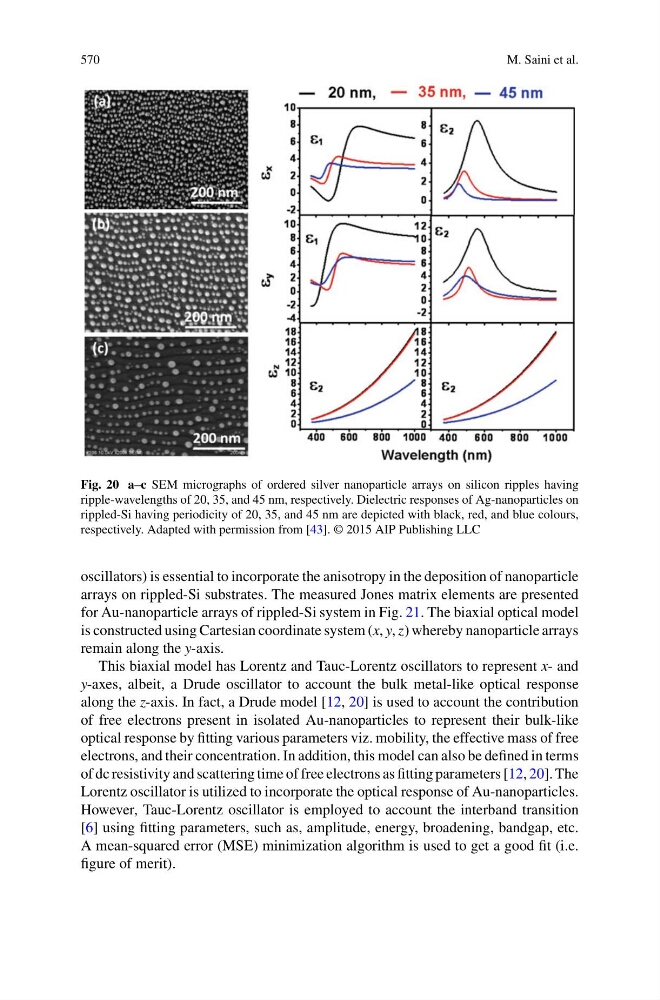
Fig. 20 a–c SEM micrographs of ordered silver nanoparticle arrays on silicon ripples having
ripple-wavelengths of 20, 35, and 45 nm, respectively. Dielectric responses of Ag-nanoparticles on
rippled-Si having periodicity of 20, 35, and 45 nm are depicted with black, red, and blue colours,
respectively. Adapted with permission from [43]. © 2015 AIP Publishing LLC
oscillators) is essential to incorporate the anisotropy in the deposition of nanoparticle
arrays on rippled-Si substrates. The measured Jones matrix elements are presented
for Au-nanoparticle arrays of rippled-Si system in Fig. 21. The biaxial optical model
is constructed using Cartesian coordinate system (x, y, z) whereby nanoparticle arrays
remain along the y-axis.
This biaxial model has Lorentz and Tauc-Lorentz oscillators to represent x- and
y-axes, albeit, a Drude oscillator to account the bulk metal-like optical response
along the z-axis. In fact, a Drude model [12, 20] is used to account the contribution
of free electrons present in isolated Au-nanoparticles to represent their bulk-like
optical response by fitting various parameters viz. mobility, the effective mass of free
electrons, and their concentration. In addition, this model can also be defined in terms
of dc resistivity and scattering time of free electrons as fitting parameters [12, 20]. The
Lorentz oscillator is utilized to incorporate the optical response of Au-nanoparticles.
However, Tauc-Lorentz oscillator is employed to account the interband transition
[6] using fitting parameters, such as, amplitude, energy, broadening, bandgap, etc.
A mean-squared error (MSE) minimization algorithm is used to get a good fit (i.e.
figure of merit).
M. Saini et al.
Fig. 20 a–c SEM micrographs of ordered silver nanoparticle arrays on silicon ripples having
ripple-wavelengths of 20, 35, and 45 nm, respectively. Dielectric responses of Ag-nanoparticles on
rippled-Si having periodicity of 20, 35, and 45 nm are depicted with black, red, and blue colours,
respectively. Adapted with permission from [43]. © 2015 AIP Publishing LLC
oscillators) is essential to incorporate the anisotropy in the deposition of nanoparticle
arrays on rippled-Si substrates. The measured Jones matrix elements are presented
for Au-nanoparticle arrays of rippled-Si system in Fig. 21. The biaxial optical model
is constructed using Cartesian coordinate system (x, y, z) whereby nanoparticle arrays
remain along the y-axis.
This biaxial model has Lorentz and Tauc-Lorentz oscillators to represent x- and
y-axes, albeit, a Drude oscillator to account the bulk metal-like optical response
along the z-axis. In fact, a Drude model [12, 20] is used to account the contribution
of free electrons present in isolated Au-nanoparticles to represent their bulk-like
optical response by fitting various parameters viz. mobility, the effective mass of free
electrons, and their concentration. In addition, this model can also be defined in terms
of dc resistivity and scattering time of free electrons as fitting parameters [12, 20]. The
Lorentz oscillator is utilized to incorporate the optical response of Au-nanoparticles.
However, Tauc-Lorentz oscillator is employed to account the interband transition
[6] using fitting parameters, such as, amplitude, energy, broadening, bandgap, etc.
A mean-squared error (MSE) minimization algorithm is used to get a good fit (i.e.
figure of merit).