

Ellipsometry Techniques and Its Advanced Applications …
569
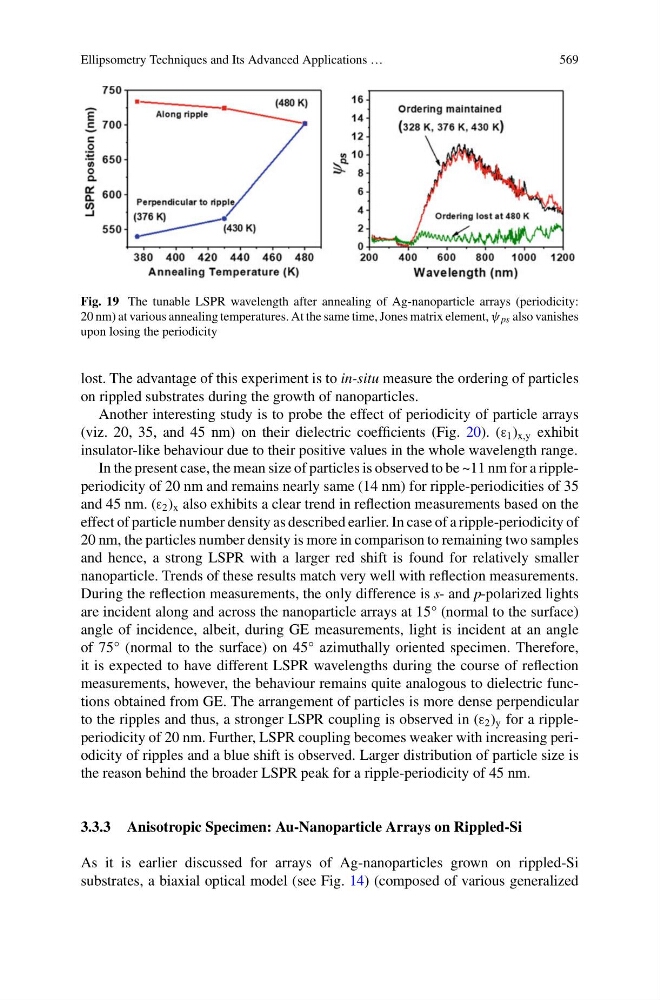
Fig. 19 The tunable LSPR wavelength after annealing of Ag-nanoparticle arrays (periodicity:
20 nm) at various annealing temperatures. At the same time, Jones matrix element, ψ ps also vanishes
upon losing the periodicity
lost. The advantage of this experiment is to in-situ measure the ordering of particles
on rippled substrates during the growth of nanoparticles.
Another interesting study is to probe the effect of periodicity of particle arrays
(viz. 20, 35, and 45 nm) on their dielectric coefficients (Fig. 20). (ε 1 ) x,y exhibit
insulator-like behaviour due to their positive values in the whole wavelength range.
In the present case, the mean size of particles is observed to be ~11 nm for a rippleperiodicity of 20 nm and remains nearly same (14 nm) for ripple-periodicities of 35
and 45 nm. (ε 2 ) x also exhibits a clear trend in reflection measurements based on the
effect of particle number density as described earlier. In case of a ripple-periodicity of
20 nm, the particles number density is more in comparison to remaining two samples
and hence, a strong LSPR with a larger red shift is found for relatively smaller
nanoparticle. Trends of these results match very well with reflection measurements.
During the reflection measurements, the only difference is s- and p-polarized lights
are incident along and across the nanoparticle arrays at 15° (normal to the surface)
angle of incidence, albeit, during GE measurements, light is incident at an angle
of 75° (normal to the surface) on 45° azimuthally oriented specimen. Therefore,
it is expected to have different LSPR wavelengths during the course of reflection
measurements, however, the behaviour remains quite analogous to dielectric functions obtained from GE. The arrangement of particles is more dense perpendicular
to the ripples and thus, a stronger LSPR coupling is observed in (ε 2 ) y for a rippleperiodicity of 20 nm. Further, LSPR coupling becomes weaker with increasing periodicity of ripples and a blue shift is observed. Larger distribution of particle size is
the reason behind the broader LSPR peak for a ripple-periodicity of 45 nm.
3.3.3 Anisotropic Specimen: Au-Nanoparticle Arrays on Rippled-Si
As it is earlier discussed for arrays of Ag-nanoparticles grown on rippled-Si
substrates, a biaxial optical model (see Fig. 14) (composed of various generalized
569
Fig. 19 The tunable LSPR wavelength after annealing of Ag-nanoparticle arrays (periodicity:
20 nm) at various annealing temperatures. At the same time, Jones matrix element, ψ ps also vanishes
upon losing the periodicity
lost. The advantage of this experiment is to in-situ measure the ordering of particles
on rippled substrates during the growth of nanoparticles.
Another interesting study is to probe the effect of periodicity of particle arrays
(viz. 20, 35, and 45 nm) on their dielectric coefficients (Fig. 20). (ε 1 ) x,y exhibit
insulator-like behaviour due to their positive values in the whole wavelength range.
In the present case, the mean size of particles is observed to be ~11 nm for a rippleperiodicity of 20 nm and remains nearly same (14 nm) for ripple-periodicities of 35
and 45 nm. (ε 2 ) x also exhibits a clear trend in reflection measurements based on the
effect of particle number density as described earlier. In case of a ripple-periodicity of
20 nm, the particles number density is more in comparison to remaining two samples
and hence, a strong LSPR with a larger red shift is found for relatively smaller
nanoparticle. Trends of these results match very well with reflection measurements.
During the reflection measurements, the only difference is s- and p-polarized lights
are incident along and across the nanoparticle arrays at 15° (normal to the surface)
angle of incidence, albeit, during GE measurements, light is incident at an angle
of 75° (normal to the surface) on 45° azimuthally oriented specimen. Therefore,
it is expected to have different LSPR wavelengths during the course of reflection
measurements, however, the behaviour remains quite analogous to dielectric functions obtained from GE. The arrangement of particles is more dense perpendicular
to the ripples and thus, a stronger LSPR coupling is observed in (ε 2 ) y for a rippleperiodicity of 20 nm. Further, LSPR coupling becomes weaker with increasing periodicity of ripples and a blue shift is observed. Larger distribution of particle size is
the reason behind the broader LSPR peak for a ripple-periodicity of 45 nm.
3.3.3 Anisotropic Specimen: Au-Nanoparticle Arrays on Rippled-Si
As it is earlier discussed for arrays of Ag-nanoparticles grown on rippled-Si
substrates, a biaxial optical model (see Fig. 14) (composed of various generalized